
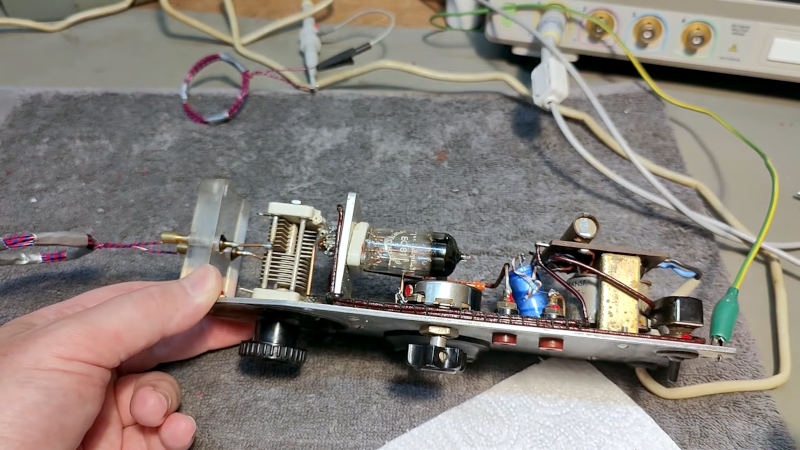
You don’t see them much anymore, but there was a time when any hobbyist who dealt with RF probably had a grid dip meter. The idea was to have an oscillator and measure the grid current as it coupled to external circuits. At resonance, the grid current would go down or dip, hence the name. In the hands of someone who knew how to use it, the meter could measure inductance, capacitance, tuned circuits, antennas, and more. [Thomas] takes a peek inside a homebrew unit from the 1950s in a recent video you can see below.
These meters often have a few things in common. They usually have a plug-in coil near the top and a big tuning capacitor. Of course, there’s also a meter. You have to pick the right coil for the frequency of interest, which both sets the oscillator frequency range and couples to the circuit under test.
The device has an odd case for a homebrew instrument. Whoever made it was an excellent metalworker. Inside was a neatly built circuit with an EC-81 triode and a unique selenium rectifier.
It would be nice to know who the unknown builder was, but with a bit of coaxing, the device still worked just fine. Of course, these days, you have many better options, but it is amazing what all this relatively simple device could do.
We’ve covered how these meters work before, including some pictures from our own benches.












I wished then as well not only having one but with a full set of coils marked for each range including the broadcast band. Years later the top shelf has a Heathkit cased unit and a set of coils I got free or cheap but don’t remember when.
The GDO to have was the Millen Dipper, have one here complete and it still works well.
There is also a Heathkit, Knight, and an Eico.
The one thing the GDO can do; is to determine the resonant frequency of a parallel resonant circuit without a physical connection to said circuit.
There is a little trick to employ for series resonant circuits…. that does involve hands on the circuit.
All the GDOs I have also have a wavemeter function used to “sniff out” RF and determine what frequency that RF is at.
And, in the ’70s Heathkit had a “Tunnel Dipper” that used a tunnel diode insted of a vacuum tube. The Heathkit Grid DIp Meter I used to have used a vacuum tube, it was a bit older.
I bought one years ago… burried it in a pile of unfinished projects and scrap and never actually tried it out.
Now I have one of those cheap testers that can do capacitors and inductors as well as semiconductors. I have a TinySA and a NanoVNA. 25 years ago when I worked at a radio station I remember we occasionally had to borrow a tool that cost more than most of our houses to do the measurements these things handle. Now look what is available!
I’m not sure if there is much left for me to use the grid dip meter for.
Then again… thinking about all the warnings of how easy it is to kill the frontend on some of those new tools… maybe I should dig it up and learn to use it. I bet I’d have to actually work at it to kill it!
The old RF test gear is good to learn on…..
if you blow it up; you can usually have it going again.
Rebuilt a couple of Military surplus sig gens….
You know…. You accidentally key that radio into it and…….
Whats that smell you ask….
That smell is what comes before uou realize you have to rebuild the attenuator
in that old surplus Navy signal generator.