Ask Hackaday: How Do You Detect Hidden Cameras?

The BBC recently published an exposé revealing that some Chinese subscription sites charge for access to their network of hundreds of hidden cameras in hotel rooms. Of course, this is presumably without the consent of the hotel management and probably isn’t specifically a problem in China. After all, cameras can now be very tiny, so it is extremely easy to rent a hotel room or a vacation rental and bug it. This is illegal, China has laws against spy cameras, and hotels are required to check for them, the BBC notes. However, there is a problem: At least one camera found didn’t show up on conventional camera detectors. So we wanted to ask you, Hackaday: How do you detect hidden cameras?

How it Works

Commercial detectors typically use one of two techniques. It is easy to scan for RF signals, and if the camera is emitting WiFi or another frequency you expect cameras to use, that works. But it also misses plenty. A camera might be hardwired, for example. Or store data on an SD card for later. If you have a camera that transmits on a strange frequency, you won’t find it. Or you could hide the camera near something else that transmits. So if your scanner shows a lot of RF around a WiFi router, you won’t be able to figure out that it is actually the router and a small camera.

Continue reading “Ask Hackaday: How Do You Detect Hidden Cameras?”

Lessons Learned After A Head-First Dive Into Hardware Manufacturing

Sometimes you just know that you have the best ever idea for a hardware product, to the point that you’re willing to quit your job and make said product a reality. If only you can get the product and its brilliance to people, it would really brighten up their lives. This was the starry-eyed vision that [Simon Berens] started out with in January of 2025, when he set up a Kickstarter campaign for the World’s Brightest Lamp.

When your product starts shipping and you hope everything went right. (Credit: Simon Berens)

At 50,000 lumens this LED-based lamp would indeed bring the Sun into one’s home, and crowdfunding money poured in, leaving [Simon] scrambling to get the first five-hundred units manufactured. Since it was ‘just a lamp’, how hard could it possibly be? As it turns out, ‘design for manufacturing’ isn’t just a catchy phrase, but the harsh reality of where countless well-intended designs go to die.

The first scramble was to raise the lumens output from the prototype’s 39K to a slight overshot at 60K, after which a Chinese manufacturer was handed the design files. This manufacturer had to create among other things the die casting molds for the heatsinks before production could even commence. Along with the horror show of massive US import taxes suddenly appearing in April, [Simon] noticed during his visit to the Chinese factory that due to miscommunication the heatsink was completely wrong.

Months of communication and repeated trips to the factory follow after this, but then the first units ship out, only for users to start reporting issues with the control knobs ‘scraping’. This was due to an issue with tolerances not being marked in the CNC drawings. Fortunately the factory was able to rework this issue within a few days, only for users to then report issues with the internal cable length, also due to this not having been specified explicitly.

All of these issues are very common in manufacturing, and as [Simon] learned the hard way, it’s crucial to do as much planning and communication with the manufacturer and suppliers beforehand. It’s also crucial to specify every single part of the design, down to the last millimeter of length, thickness, diameter, tolerance and powder coating layers, along with colors, materials, etc. ad nauseam. It’s hard to add too many details to design files, but very easy to specify too little.

Ultimately a lot of things did go right for [Simon], making it a successful crowdfunding campaign, but there were absolutely many things that could have saved him a lot of time, effort, lost sleep, and general stress.

Thanks to [Nevyn] for the tip.

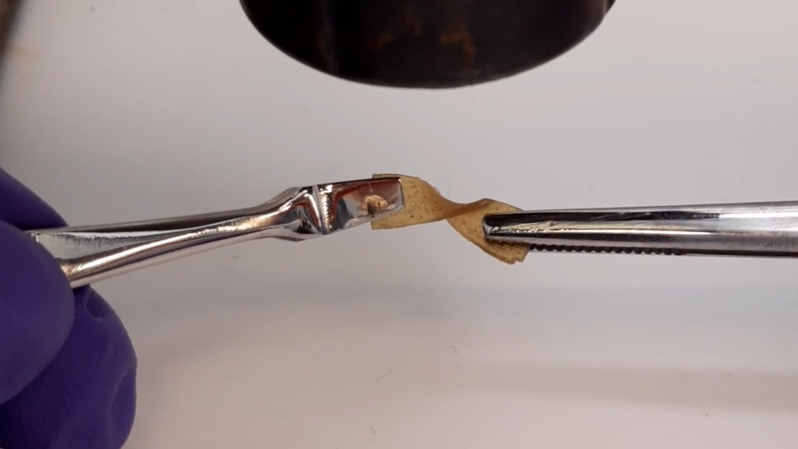
A small piece of brown plastic is held in two pairs of tweezers under a heat gun, and is being twisted.

A New And Strangely Strong Kind Of Plastic

As anyone who extrudes plastic noodles knows, the glass transition temperature of a material is a bit misleading; polymers gradually transition between a glass and a liquid across a range of temperatures, and calling any particular point in that range the glass transition temperature is a bit arbitrary. As a general rule, the shorter the glass transition range is, the weaker it is in the glassy state, and vice-versa. A surprising demonstration of this is provided by compleximers, a class of polymers recently discovered by researchers from Wageningen University, and the first organic polymers known to form strong ionic glasses (open-access article).

When a material transforms from a glass — a hard, non-ordered solid — to a liquid, it goes through various relaxation processes. Alpha relaxations are molecular rearrangements, and are the main relaxation process involved in melting. The progress of alpha relaxation can be described by the Kohlrausch-Williams-Watts equation, which can be exponential or non-exponential. The closer the formula for a given material is to being exponential, the more uniformly its molecules relax, which leads to a gradual glass transition and a strong glass. In this case, however, the ionic compleximers were highly non-exponential, but nevertheless had long transition ranges and formed strong glasses.

The compleximers themselves are based on acrylate and methacrylate backbones modified with ionic groups. To prevent water from infiltrating the structure and altering its properties, it was also modified with hydrophobic groups. The final glass was solvent-resistant and easy to process, with a glass transition range of more than 60 °C, but was still strong at room temperature. As the researchers demonstrated, it can be softened with a hot air gun and reshaped, after which it cools into a hard, non-malleable solid.

The authors note that these are the first known organic molecules to form strong glasses stabilized by ionic interactions, and it’s still not clear what uses there may be for such materials, though they hope that compleximers could be used to make more easily-repairable objects. The interesting glass-transition process of compleximers makes us wonder whether their material aging may be reversible.