The Engineering Of The Falkirk Wheel

We live in an age where engineering marvels are commonplace: airplanes crisscross the sky, skyscrapers grow like weeds, and spacecraft reach for the stars. But every so often, we see something unusual that makes us take a second look. The Falkirk Wheel is a great example, and, even better, it is functional art, as well.

The Wheel links two canals in Scotland. Before you click away, here’s the kicker: One canal is 35 meters higher than the other. Before 1933, the canals were connected with 11 locks. It took nearly a day to operate the locks to get a boat from one canal to the other. In the 1930s, there wasn’t enough traffic to maintain the locks, and they tore them out.

Fast Forward

In the 1990s, a team of architects led by [Tony Kettle] proposed building a wheel to transfer boats between the two canals. The original model was made from [Tony’s] daughter’s Lego bricks.

The idea is simple. Build a 35-meter wheel with two caissons, 180 degrees apart. Each caisson can hold 250,000 liters of water. To move a boat, you fill the caissons with 500 tonnes of water. Then you let a boat into one of them with its weight displacing an equal amount of water, so the caissons stay at the same weight.

Once you have a balanced system, you just spin the wheel to make a half turn. There are 10 motors that require 22.5 kilowatts, and each half-turn consumes about 1.5 kilowatt-hours.
Continue reading “The Engineering Of The Falkirk Wheel”

3D Printing Pneumatic Channels With Dual Materials For Soft Robots

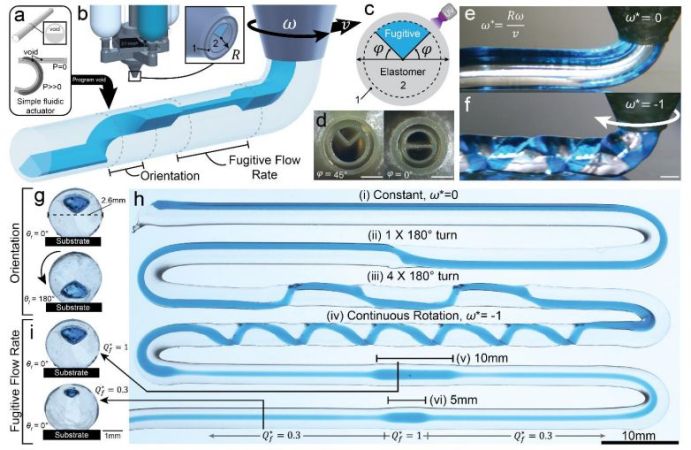
Pneumatics are a common way to add some motion to soft robotic actuators, but adding it to a robot can be somewhat of a chore. A method demonstrated by [Jackson K. Wilt] et al. (press release, preprint) involves using a 3D printing to extrude two materials: one elastomeric material and a fugitive ink that is used to create pneumatic channels which are dissolved after printing, leaving the empty channels to be filled with air.

By printing these materials with a rational, multi-material (RM-3DP) custom nozzle it’s possible to create various channel patterns, controlling the effect of compressed air on the elastomeric material. This way structures like hinges and muscles can be created, which can then be combined into more complex designs. One demonstrated design involves a human-like hand with digits that can move and grasp, for example.

In the demonstration the elastomeric material is photopolymerizable polyurethane-acrylate resin, with the fugitive ink being 30 wt% Pluronic F-127 in water. The desired pattern is determined beforehand with a simulation, followed by the printing and UV curing of the elastomeric resin.

As is typical of soft robotics implementations, the resulting robots are more about a soft touch than a lot of force, but could make for interesting artificial muscle designs due to how customizable the printing process is.

Continue reading “3D Printing Pneumatic Channels With Dual Materials For Soft Robots”

Restoration Of Antique Clock With Unique Oscillator

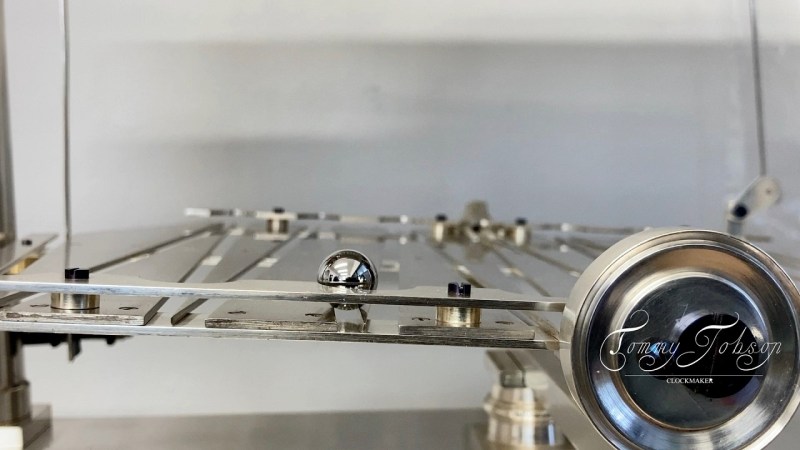
The classic design of a mechanical clock generally consists of a display, a way to store energy, a way to release that energy at regular intervals, and a mechanism to transmit it where it needs to go. Most of us might be imagining a pendulum or a balance wheel, but there have been many other ways to maintain a reliable time standard with a physical object beyond these two common methods. This clock, for example, uses a rolling ball bearing as its time standard and [Tommy Jobson] discusses its operation in depth during a restoration.

The restoration of this clock, which [Tommy] theorizes was an amateur horological project even when it was new, starts by dismantling the clock nearly completely. The clock was quite dirty, so in addition to being thoroughly cleaned it also needed a bit of repair especially involving a few bent pins that stop the table’s rotation. These pins were replaced with stronger ones, and then everything in the clock’s movement was put back together. The tray carrying the ball bearing needed to be cleaned as well, and [Tommy] also added a lacquer to help preserve the original finish as long as possible. From there it was time to start calibrating the clock.

The ball bearing itself rolls back and forth along an inclined plane on a series of tracks. When it gets to the end it hits a lever which lets a bit of energy out of the movement, tilting the table back in the other direction to repeat the process. This is a much more involved process for getting an accurate time interval than a pendulum, so [Tommy] had a lot of work to do here. But in the end he was able to bring it back to life with an accuracy fairly close to a pendulum clock.

Ball bearings are a pretty popular medium for clock builds even in the modern era. This one uses them in a unique display, and a more recent version goes even further by using marbles to display digits directly.

Continue reading “Restoration Of Antique Clock With Unique Oscillator”