
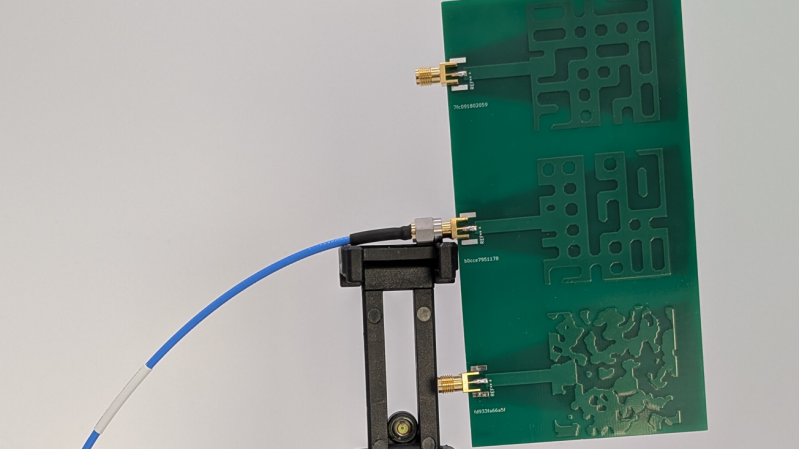
Antenna design is often referred to as a black art or witchcraft, even by those experienced in the space. To that end, [Janne] wondered—could years of honed skill be replaced by bruteforcing the problem with the aid of some GPUs? Iterative experiments ensued.
[Janne]’s experience in antenna design was virtually non-existent prior to starting, having a VNA on hand but no other knowledge of the craft. Formerly, this was worked around by simply copying vendor reference designs when putting antennas on PCBs. However, knowing that sometimes a need for something specific arises, they wanted a tool that could help in these regards.
The root of the project came from a research paper using an FDTD tool running on GPUs to inversely design photonic nanostructures. Since light is just another form of radio frequency energy, [Janne] realized this could be tweaked into service as an RF antenna design tool. The core simulation engine of the FDTD tool, along with its gradient solver, were hammered into working as an antenna simulator, with [Janne] using LLMs to also tack on a validation system using openEMS, an open-source electromagnetic field solver. The aim was to ensure the results had some validity to real-world physics, particularly important given [Janne] left most of the coding up to large language models. A reward function development system was then implemented to create antenna designs, rank them on fitness, and then iterate further.
The designs produced by this arcane system are… a little odd, and perhaps not what a human might have created. They also didn’t particularly impress in the performance stakes when [Janne] produced a few on real PCBs. However, they do more-or-less line up with their predicted modelled performance, which was promising. Code is on Github if you want to dive into experimenting yourself. Experienced hands may like to explore the nitty gritty details to see if the LLMs got the basics right.
We’ve featured similar “evolutionary” techniques before, including one project that aimed to develop a radio. If you’ve found ways to creatively generate functional hardware from boatloads of mathematics, be sure to let us know on the tipsline!












Good to know that even the AI’s find antenna design difficult.
When I was a kid, I used to buy at the local bookstore periodical book called “Antennas”. (In Soviet Union) and I didn’t understand anything what was in the book. I was trying to, but…
It seems the only thing that worked correctly was the off-the-shelf EM solver.
isn’t the “it has to be fractal” the answer as it is mathematicaly proven? check out the documentary about fractals, the section about antennas!
Nothing in RF design is ever that simple. Especially since EM radiation operates in 3D space.
That ground plane under the antenna, receding that back would help with radiation
At last, an explanation for the Aztec pattern for the Refit Enterprise from ST:TMP
Did you try to optimize for radiation pattern?
It looks like the main performance criterion for an antenna, radiation efficiency, has been glossed over?
Pattern is maybe second.
For all we know these are glorified 50 ohm loads!
The original post says
“The loss combines a return-loss term derived from S11 with penalty terms for impedance mismatch, low radiation efficiency, poor front-to-back ratio”
So it looks like fair amount of parameters was taken into consideration.
A dummy load also has excellent return loss (S11), near-perfect impedance match, and unity front-back ratio — It’s omnidirectional!
OK, a dummy load is not so hot on the radiation efficiency, but not that different from most of these fractal antennas…
Having been in the business of practical wireless for a decade or two, I would opine that these do indeed look like a complicated dummy load for transmit, or a rather corroded patch antenna for receive.. There’s nothing to impart any (obvious) directivity, and therefore gain. I’m sure they would ‘work’, because I have seen all kinds of crap (intentional and otherwise) ‘work’, but not well.
Is it omni, or unidirectional??? ;-)
Reminds me of the old NASA experiment with algorithmic antenna design. Looked like a haphazardly unfolded paperclip; but weirdly effective.
https://www.jpl.nasa.gov/nmp/st5/TECHNOLOGY/antenna.html
What the link doesn’t say is exactly what the goals of the antenna were, exactly why it met those goals, and why it met those goals better than conventional designs that were considered.
The assumptions I have for goals would be: 1) transmit and/or receive to/from a far antenna that was located [where?] that was equipped by [what type of antenna system and radio]? 2) stay within a power budget of [what]? 3) stay within a thermal budget of [what]? 4) fit in a confined space [describe the space]. 5) not get interference from other radiation, either from within the spacecraft or from outside [describe the conditions and interference tolerances]. 5) not cause non-tolerable interference to other systems on the craft [describe the conditions and interference tolerances].
If you want all those details there is a paper about the design: http://alglobus.net/NASAwork/papers/Space2006Antenna.pdf
They don’t understand antenna design.
They didn’t code the tool.
And they used GenAI garbage so the people who actually did the work can’t be credited because the LLM laundered it…
And in the end it didn’t even work.
Why are we applauding this on HaD?
Forget encouraging this theft, why aren’t people getting out the pitchforks?
Agree.
This is hacking the same way toddlers with crayons is museum quality art.
On the other hand there is an argument for these complicated topics being more accessible, but I think that needs to be tempered with some respect for what currently exists.
At least it got us talking about antennas!
There are plenty of antenna design programs out there that don’t require that kind of crunching.