
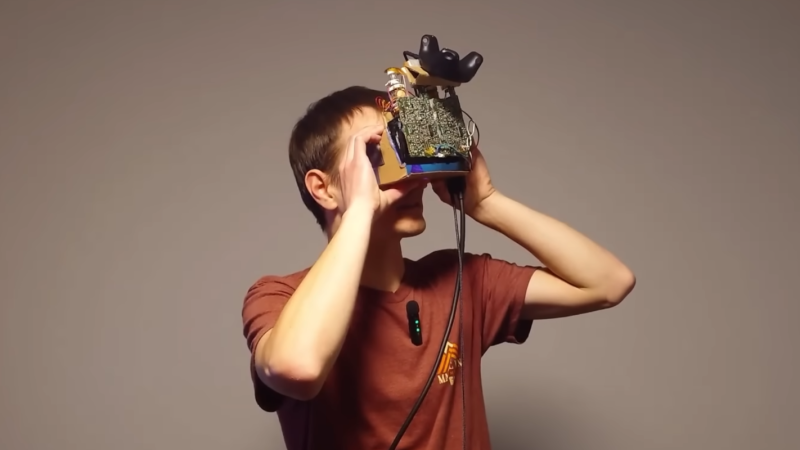
Cathode ray tubes (CRTs) are a fascinating display technology that has been largely abandoned outside of retro gaming and a few other niche uses. They use magnets to steer a beam of electrons rapidly across a screen, and while a marvel of engineering for their time, their expense, complexity, and weight all led to them being largely replaced by other displays like LCDs and LEDs. They were also difficult to miniaturize, but there were a few companies who tried. [dooglehead] located a few of the smallest CRT displays he could find and got to work putting them in the most unlikely of situations: a virtual reality headset.
The two displays for his headset come from Sony Watchmans, compact over-the-air black-and-white handheld televisions from the late 1900s. [dooglehead] had to create a method for sending video to these units which originally had no input connections, and then also used an FPGA to split a video signal into two parts, with one for each display. The two displays are placed side by side and attached to a Google Cardboard headset, with an off-the-shelf location tracker attached at the top. An IMU tracks head rotation while this location tracker tracks the motion of the unit through 3D space.
With everything assembled and ready to go, the CRT VR headset only weighs in a few grams heavier than [dooglehead]’s modern HTC headset, although it’s lacking a case (which is sorely needed to cover up the exposed high voltage of the CRTs). He reports surprisingly good performance, with notable interlacing and focus issues. He doesn’t plan to use it to replace any of his modern VR displays anytime soon, but it was an interesting project nonetheless. There are some rumors that CRTs are experiencing a bit of a revival, so we’d advise anyone looking to toss out an old CRT to at least put it on an online market place before sending it to a landfill.












I feel very old for making this critique, but I find it crazy that he seemingly didn’t know about (or at least address the choice not to use) CRT camcorder viewfinders, which offered the same or better quality in a genuinely tiny package, and could (at least in my experience messing with sony handycams) be driven with nothing more than a composite signal and a +5v (or at least no more than 12v) power source.
Ditto. Those were used in every DIY VR headset of the mid to late 90’s when VR hype didn’t match reality. Period research papers refer to these “Garage VR” headsets:
https://www.cs.uic.edu/~jbell/Professional/Papers/lowcosvr1.pdf
There was a book of the same name, though I haven’t found a scan of it online. IIRC, you could even order one from RadioShack for something like $80-100.
Thank you for the information. :)
Man, I really miss the 90s. The 90s were such fun, optimistic times!
Back then, the average PC builder knew how to use a soldering iron (more or less).
Probably because of the previus home computer era, where the skill still was sort of a requirement.
Too bad VR didn’t catch on as much as it should back then.
The time was perfect. The early internet and “cyber space” theme did fit nicely.
Speaking of 90s VR, the Forte VFX-1 and similar cyber helmets shouldn’t be forgotten, I think.
https://www.youtube.com/watch?v=y44pPRydc5s
This site has some more information about 90s era VR tech and standards: http://www.stereo3d.com/
Btw, the “PCVR Magazine” had published some articles at the time. IA has some issues.
https://archive.org/search?query=creator%3A%22PCVR+Magazine%22
Yeh, playing Doom with a Nintendo Powerglove left a lot to be desired. Descent using one of the commercial fresnel headsets was fun though.
I’ve seen a lot of projects using viewfinder CRTs, and think they’re pretty cool. The main reason I didn’t use them in this VR headset is that they would be too small, which would result in a narrow FOV. The 2.7″ display size on the Watchman CRTs I used is more similar to the size of the LCD/OLED panels used in commercial headsets and other DIY headsets. I wouldn’t be surprised if the image quality was better on viewfinder CRTs though. Element14’s Youtube channel has a video of a headset they made with viewfinder CRTs if you want to see what that would look like. https://www.youtube.com/watch?v=p12QaZUZDnM
Nice work bro
The lawnmower man featured the datasuit and eyephone which were real devices made by vpl research
Oh hey, it’s me! Thanks for the writeup Bryan.
the late 1900s?? You mean 1990s, surely
near the close of the 20th Century.
VR headsets have been a thing since at least the 70s
I don’t know how to break this to you, but 1900s can refer to the entire century, not just the first 10 years. The 1990s are in the late 1900s.
Well that’s a novel usage to me. late 20th century yes, late 1900’s no — likewise I wouldn’t consider 1890 to be the “late 1800s”.
+1
How would you refer to the latter part of a century? “Late 1700s” referring to the end of the 18th century is extremely common usage.
Imo ‘bi-weekly’ is much more ambiguous and confusing
Reminder that you can still find plenty of (slightly larger) new old stock black and white folded CRT monitors on the usual Aliexpress places