
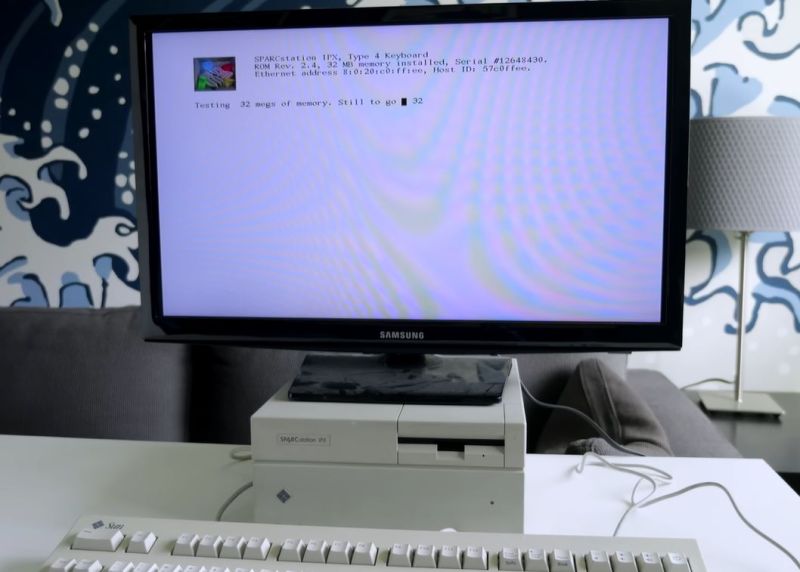
The best part about retro computing is the idea that you’ll save some poor system from being scrapped and revive it to a working state, at which point you can bask in the glory of a job well done. That’s when reality often strikes hard, and you find yourself troubleshooting a maddening list of issues as you question everything about your life choices. Such was the case with [This Does Not Compute] over at YouTube with a Sun SPARCstation IPX that decided to put up a big fight.
This is the second video of a series. In the first installment, the PSU was repaired, and a boot failure was diagnosed. The system’s onboard diagnostic led to the assumption that one of the 8 kB SRAM ICs was defective. You can readily get SRAM replacements, so it seemed to be an easy fix. Unfortunately, the fun was only beginning as the system reported the exact same error after the SRAM was replaced.
After flipping a virtual table, the mainboard was swapped with a donor one from a scrapped laptop system. With this, it booted, but the video output showed only vertical lines. Obviously, the solution here was to insert a replacement video card, which not only fixed the display output but also demonstrates once again that you can fix many vintage computing issues by simply replacing hardware.
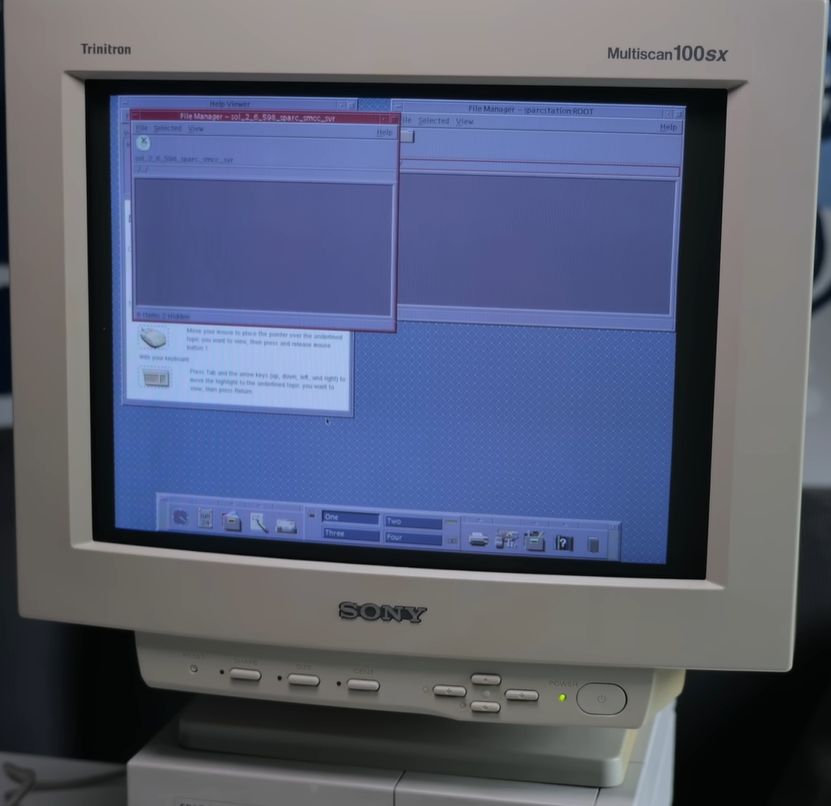
With the system now seemingly happy, a disk drive was added so that Solaris 2.3 could be installed. This turned into another confusing job. Getting into the GUI was seemingly impossible. Ergo, this virtual table got flipped, too, and Solaris 2.6 was installed. Finally, the system got to the desktop GUI. At this point it was clear that this 40 MHz mid-range SPARCstation from 1991 is no speed monster. Just drawing windows was slower than an X11 remote session over 9600 baud dial-up.
Installing more RAM might have helped here, but the system requires parity FP RAM, which could have been purchased, but at some point, you have to decide how much money you want to throw at an old system like this. Although these are still pretty interesting systems in their own right, it should be clear that they are not easy systems to repair or maintain.












Reviving a computer… by changing the mobo… and the GPU… and the drive. Yes, ok, I think that most of us could achieve that feat.
The Triggers Broom of computing…
Since the RAM wasn’t replaced…yeah probably…;)
LOL :)
I’ve always been a fan of the Sun/SPARC thingamajig despite never having used it. One of my friends who was working in Geographic Information Systems (GMS) [<– HaD authors take note because that’s how you introduce an acronym. Know It, Learn It, Live It, (KILILI).] and also an unreadable Perl guru, he used to send me quizzes like “874r4@#$%#)&&(*&^%$”. So….
Cricri is right. Just throw a Raspberry Pi into the box and be done with it. When I got to the “replace the motherboard part”…. Darmok and Gilad at Tanagra, Shaka his eyes open, Jodie Foster playing pool.
“GIS” of course. What an idiot!
Why would you butcher something like this with a Pi? The entire point is to run a period correct OS on period hardware. You can run linux on a dozen platforms today without ruining something.
A SPARCstation was way beyond my means, but I do now use SPARC keyboards – the later USB ones work fine with a modern PC, and I like dedicated keys for cut/copy/paste/find/save etc
If it’s anything like a Sparc 5, the replacement M48T08-150PC1 SRAM IC needs the MAC address reprogrammed otherwise the licensing system will not let it boot. There was a Google Groups post about it somewhere but I can’t seem to find it anymore – but I remember you could do it all in software.
Either that or you grind off the end of the SRAM IC case until you see the backing battery terminals and solder a new CR2032 to them.
Have used both options to revive a Sparc 5.
SunOS/Solaris does not use a license manager and has no such mechanism preventing boot. However, if the NVRAM contents are lost you will need to reprogram the MAC address and host ID. You can use anything for these, providing there is no MAC address clash on your LAN and you don’t have any application software licenses tied to the original host ID.
Yeah it’s been a while. For some reason I remembered it as licensing. Might have just been complaining of lack of MAC.
On my SparcStation IPX I always set it to 00:de:ad:co:ff:ee
I should get around to cutting open the IC and soldering a new battery.
modern text mode NetBSD would probably be a lot lighter. and more useful.
I found sun systems had the most horrible system administration. A command for everything. IBM aix had the best with Smit or Smitty for on-gui consoles. It was this exposure that made me choose SuSE. Vast is even better than Smit and can run on a console as well!
As for speed, what do you expect!
-joe
A command for everything you say? Sounds very UNIX-like to me! GUI and complex unified CLIs somewhat less so.
I cut my Unix teeth on an IPX, back when real men (and a few real women) dared to learn these beasts. Magical times, largely before the WWW had anything but technical websites and most information was gleaned from Usenet and the occasional gopher site.
Now we have … En****itification. sigh
I beg to differ. For many years I ran an UltraSPARC 10 here as a website, and general purpose box. It ran fast around the thing I used to support it. It even ran faster than the P3 Dell Dimension that it shared the apartment with.
Remember using it at work in 1997-98, booting Linux!
Or maybe it was IPC.
How is replacing hardware “fixing” a “vintage” computer?
Replacing capacitors, okay – other components too – but at what point is so much hardware replaced that the computer can’t be called vintage anymore? (Ship of Theseus argument?)
If your replace the whole ancient linear regulator PSU with an SMPS one – is it still a repaired vintage computer (isn’t this the case with some c64 repairs? I remember something like that).
Repairing PCB damage from a leaking cap or battery – fine. Replacing the whole board? debatable, even with all components transferret over (if “transfered” isn’t the right adj. I’m, going full ferret instead :-P).
That comment was obviously intended to be tongue-in-cheek :)