
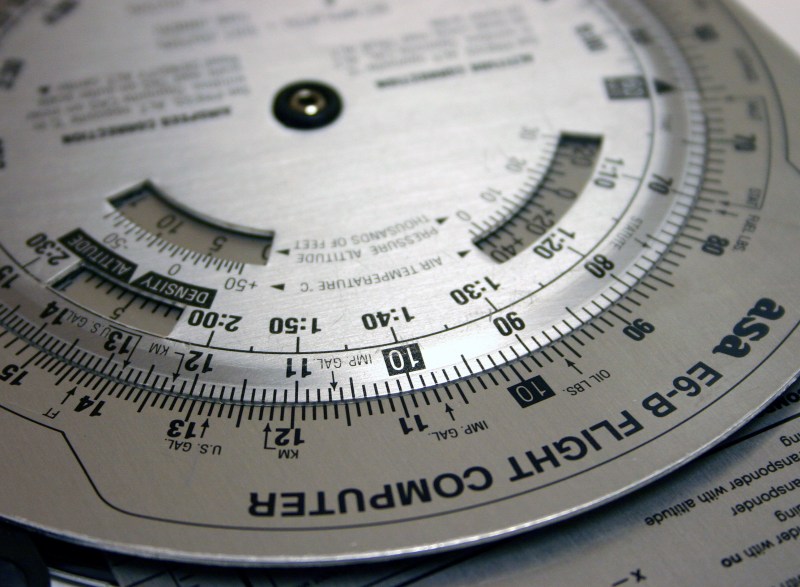
In the early days of aviation, pilots or their navigators used a plethora of tools to solve common navigation and piloting problems. There was definitely a need for some kind of computing aid that could replace slide rules, tables, and tedious dead-reckoning computations. This would become even more important during World War II, when there was a massive push to quickly train young men to be pilots.
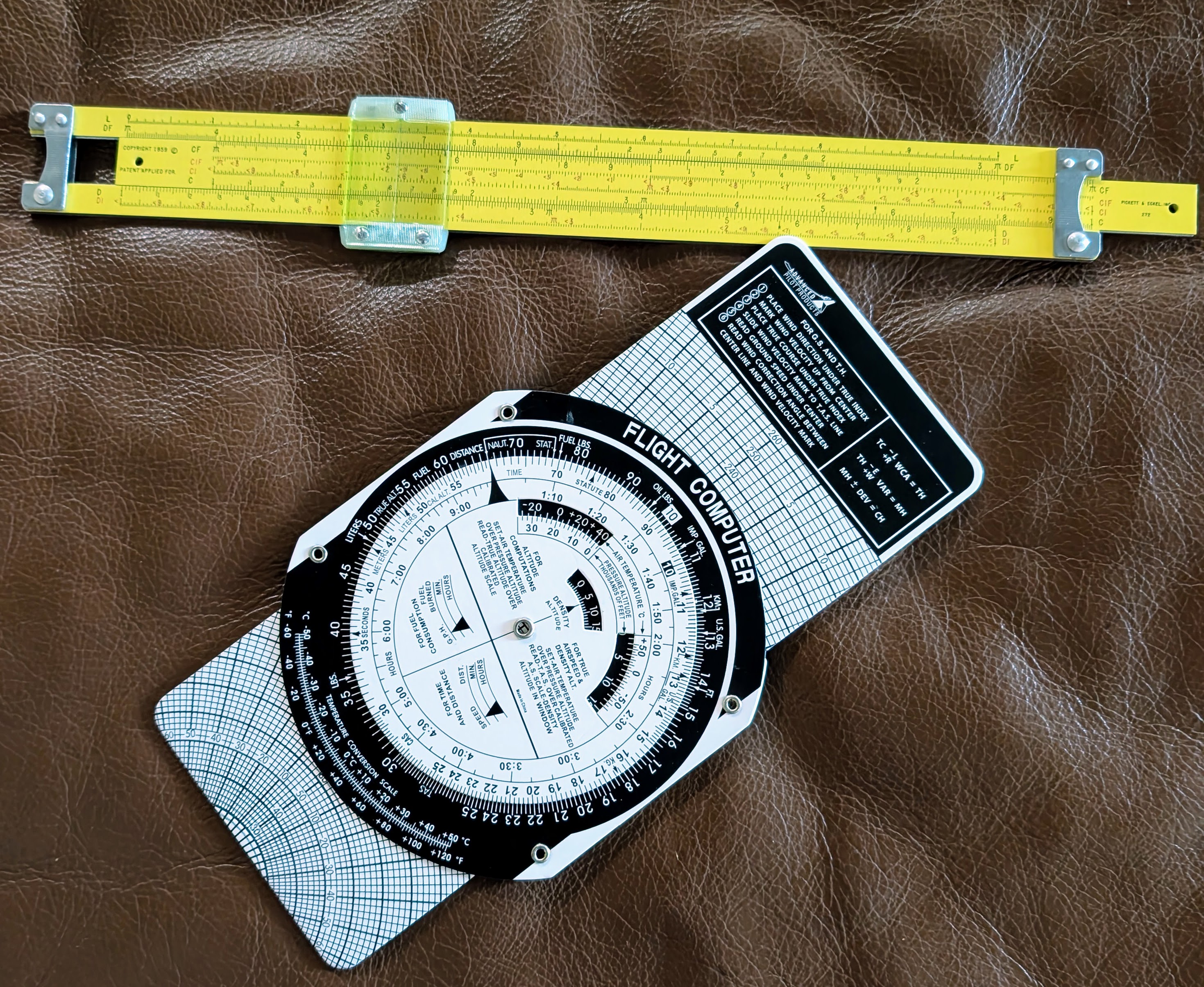
Today, we’d whip up some sort of computer device, but in the 1930s, computers weren’t anything you’d cram on a plane, even if they’d had any. For example, the Mark 1 Fire Control Computer during WW2 was 3,000 pounds of gears and motors.
The computer is made to answer flight questions like “how many pounds of fuel do I need for another hour of flying time?” or “How do I adjust my course if I have a particular crosswind?”
History
There were a rash of flight computers starting in the 1920s that were essentially specialized slide rules. The most popular one appeared in the late 1930s. Philip Dalton’s circular slide rule was cheap to produce and easy to use. As you’ll see, it is more than just an ordinary slide rule. Keep in mind, these were not computers in the sense we think of today. They were simple slide rules that easily did specialized math useful to pilots.
Dalton actually developed a number of computers. The popular Model B appeared in 1933, and there were refinements leading to additional models. The Mark VII was very popular. Even Fred Noonan, Amelia Earhart’s navigator, used a Mark VII.
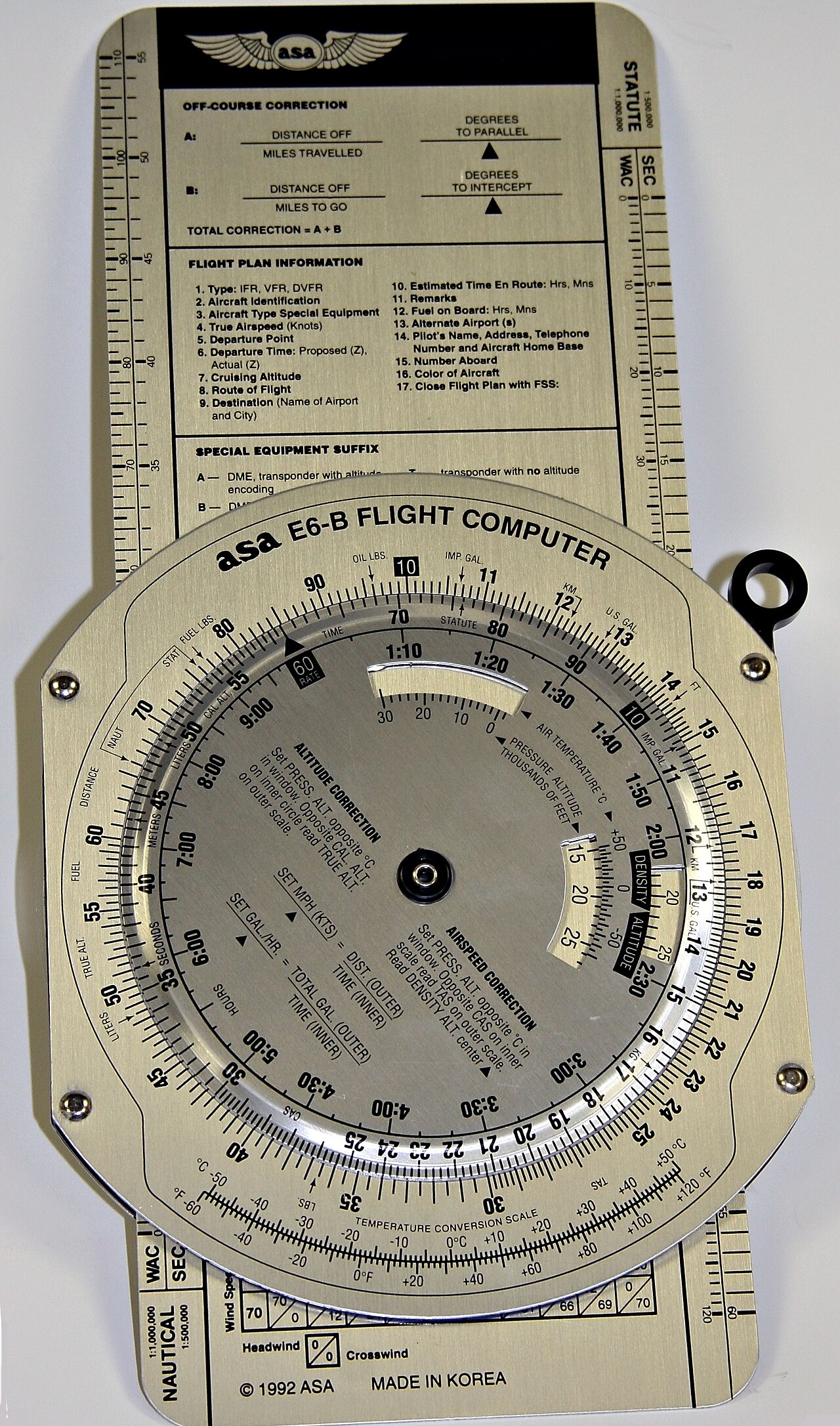
Dalton thought the Mark VII was clunky and developed a way to do vector calculations using an endless belt inside the computer. This proved to expensive to make, so he created a flat wind computer and put, essentially, the Model B on the other side. While he called this the Model H, the Army called it the E6A.
In 1938, the Army Air Corps asked for a few minor changes and adopted the computer as the E6B, although pilots often call it the “whiz wheel” or the “Dalton Dead Reckoning Computer.” Oddly enough, some pilots still swear by the E6B, and flight schools sometimes make you learn them because they help you develop a feel for the math you don’t get with a calculator.
Sadly, Dalton died in a plane crash with a student pilot in 1941. P.V.H. Weems, a well-known navigator and Fred Noonan’s mentor, carried on the work of improving the E6B.
Besides, they are almost a perfect backup computer. Small, light, cheap, not prone to breaking, and they need no power. Some are made of cardboard, some of metal, and others of plastic. Wartime E6Bs were on a plastic that glowed under cockpit illumination. Later, there would be electronic or software E6Bs (see the video below), but a real whiz wheel is something you can hold in your hand, and you never have to change the battery.
Not Just a Slide Rule
The front of the E6B is, essentially, a circular slide rule. What makes it unique, though, is that it has special scales and markings to deal with conversions of things like nautical miles or knots. Even the arrangement of the scales work to make a pilot’s life easier.
For example, the top of the wheel is a big mark that represents 60. Why? Because there are 60 minutes in an hour, and this makes it easy to compute things like pounds of fuel per hour.
It also lets you convert things like knots to nautical miles easily because the conversion factors are marked already.
If you know how to use a slide rule, you are almost immediately proficient on the front side of an E6B. Note that the sliding part of the computer is all about the wind computer (see below). All the calculation parts are just on the wheel, like a traditional circular slide rule.
The Back Side
The back side is a graphical vector solver for wind problems. You essentially use it to plot a wind triangle. You set the wind vector, the aircraft velocity vector, and you can read off the ground track. By moving things around, you can find your groundspeed, your wind correction angle, or your heading.On some E6Bs, you have to flip the slide to do low-speed or high-speed wind problems.
For an example wind problem, consider if you have wind at 200 degrees at 10 knots. Your true course is 150 degrees, and your true air speed is 130 knots. You would like to compute your ground speed, your true heading, and the wind correction angle.
One reason that the E6B remains useful for training is that it helps you develop intuition that is hard to get from a bunch of numbers on a calculator’s LEDs. You get a feel for how much wind will deflect your track 10 degrees, for example.
You can also use the E6B in reverse. If your groundspeed isn’t what you expect, you might set up the problem to put in your true parameters and solve for what the wind must be to make that result correct.
Sure, with GPS, you probably don’t need to figure out whether you have enough fuel to make it to another airport. But without GPS and a real computer, the E6B can do those things just fine.
Learning the E6B
If you actually want to learn how to use the E6B, we suggest watching a YouTube video. There are some short videos, and at least one that has 14 different videos. The good news is that the E6B hasn’t changed in many years, so any video you find should be just fine.
We like [Aviation Theory’s] two videos, which are worth watching (see part 1, below).
If you want to follow along and don’t have an E6B, you can try one virtually in your browser. Or, pick one up. The cardboard ones are fairly inexpensive and widely available.
The Legacy of the E6B
While the E6B isn’t the essential kit it once was, it is still a valuable aid for pilots. It is also a great example of how to turn an ordinary slide rule into something specialized.
We have a feeling Gene Roddenberry, an avid pilot, was very familiar with the E6B. He even thought they’d still use them in the 23rd century, as you can see in the video clip below.
You can also catch a glimpse of these in old US Army Air Corps films like the one below (about the 14-minute mark), although we couldn’t find any training specifically for the E6-B that survived.
If you like old analog computers, read [Nicola Marras’] book. Maybe Spock would have preferred a Star Trekulator.
[Featured image: “E6b-slide-rule” by [Duke]












When all your electronics go to sh*t the E6B will still work. THAT’s why they still teach it in flight school.
Same reason they still teach celestial navigation at the Naval Academy. When your GPS isn’t trustworthy, or when you don’t have one, you can still use a sextant.
I learned that stuff for my glider license (now expired, not enough time to spend all weekends at the airfield, we maintained all the stuff ourselves – yes, our head mechanic was certified (and worked for one of the aircraft companies in the region)) – not really all that applicable (yeah, the wind triangles, maybe a bit), but really not difficult at all. I’d rather use that one than a calculator app on the cell phone. I admit that I preferred the glide slope estimator and speed hints from the earlier GPS units to a McCready ring, though.
I think it takes about 20 watts to run it and if you include the manipulation mechanism, about 100 watts. I have an E6B from 1968 and training in an Aeronca Champ, where a light breeze can require a serious wind triangle. ($3 an hour – wet)
Same reason they still teach celestial navigation at the Naval Academy. When your GPS isn’t trustworthy, or when you don’t have one, you can still use a sextant. good discussion
Librascope built mechanical “balance computers” for various aircraft.
I recently dusted off my 30 year old E6B as my son started flying. Still works just as well as it did for me on day 1. These days not that many things are that reliable or come with that kind of longevity.
The perfect use for an E-6 now is to hand them to an engineering undergrad in an exam when they have forgotten their calculator – just to watch their eyes get wide. I actually had one kid go for it and do pretty well – the others got a “loaner” electronic calculator that I kept around for this purpose.
Good luck doing that when driving in a modern BMW down the autobahn at 300 km/h. You need to focus all eyes on the road, not play monkey looking at stars.
This is a nonsense comment, roads have signs (even more on the ones that allow you to go 300+), and if your GPS stops working, maybe you should release the throttle to start to focus more on your surroundings.
USNA discontinued classes on the sextant back in 1998 ….and still had not taught classes up until 2015 or so (when it was re-instated).
These are the same numb-nuts that declared fighter aircraft would not need guns. Why ? well, kiddies, we’ve got these here new fangled high-falutin space age missiles on our shiny new F4 Phantoms…you won’t need no stinkin’ guns !! …… WRONG !! The “art” of dog fighting never went away. They were forced to reintroduce air to air guns.
Even now, that same cabal that kept trying to bury the famed A-10 WartHog – is forced to (as Stewie Griffin would put it), stick their heads up their loins and eat some humble pie. The A-10 is again demonstrating it’s awesome capabilities.
By the way, the US Merchant Marine Academy, has always taught celestial navigation since it’s founding. They taught USNA how to regain that lost skill.
Agreed, that was a pretty odd comment. Obviously sextants and e6b aren’t replacement for turn by turn GPS.
I should also mention the excellent “Be Expert with Map and Compass”, a slim volume that explains how to use those tools to navigate the land.
Good skills to have, even if calculators and GPS make life much easier.
Maybe but if you’re in the middle of the Pacific it could come in handy.
Don’t forget the Breitling Navitimer…
I considered making a similar computer for my car once, because the fuel gauge was annoyingly non-linear. That way I could tell in the afternoon when I was driving home, whether I’d need to pick up more fuel for the next day or just drive straight home and save the detour.
The problem solved itself when I lost the job, so I didn’t need to drive that far anymore.
Just tape a new set of markings under the needle, tbh. Run your engine until it putters out, then add a gallon, make a mark, repeat.
That would require me to pull the instrument cluster apart. If I tape it on the glass, I would get bad parallax errors.
Besides, you don’t get constant mileage out of the car. The original idea was to have a cardboard dial that I could turn to point the same way the fuel gauge was pointing, and it would indicate the remaining distance.
I would have to add at least one variable for winter/summer conditions, then the expected average speed to account for city/highway mileage. If the cardboard disc has the distance numbers written in rings, then the other variables would select which ring to show.
I had to learn with an e6b when I got my fixed wing private in 1999. The faa examiner required it.