
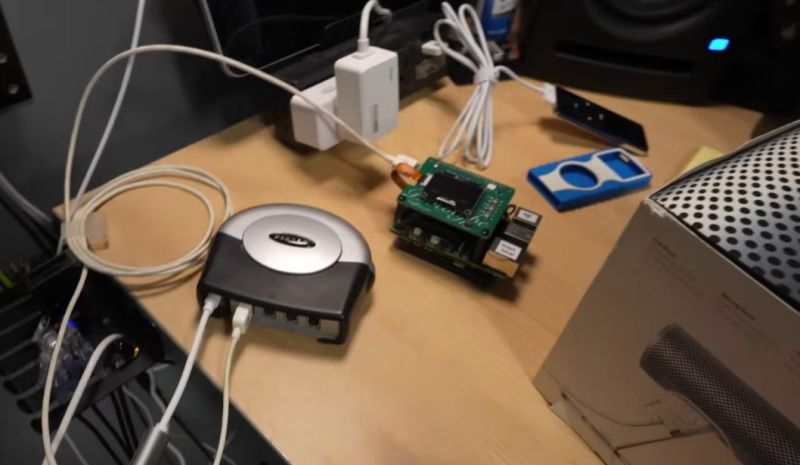
Recently [Jeff Geerling] has been tinkering with FireWire in order to use some older gear, which includes the use of a Raspberry Pi HAT called the Firehat. This provides a 6-pin FireWire port courtesy of the VIA VT6315N PCIe-to-FireWire chipset. As is typical with USB gear today as well, some FireWire gear requires more power than a port can provide, requiring the use of a powered hub. Unfortunately the use of a powered FireWire hub caused a bit of a conflagration event on [Jeff]’s desk.
Part of the issue appears to be that this Firehat board was designed as a companion to the Equip-1 DV capture device, with no attention paid to the idea that someone might be backfeeding power from an attached hub. As a result the VIA chip cried uncle and let out the magic smoke.
With this Firehat board taking its name clearly a bit too literal, [Jeff] will be reporting his findings to the developers, in the hope that perhaps some diodes or another solution against backfeeding can be added to the final design. Fortunately he was sent this board for testing prior to public release, so this definitely shows a clear flaw that can now be corrected.
We hope that [Jeff] has a good HEPA air filtration setup in his office to get rid of the acrid magic smoke, as it’s not meant to be enjoyed for long periods.












Firewire was also intended as a peer to peer Network among other things, so connecting two computers should be fine. Reality: Software wise, you can get that to work between older macintoshes and/or linux machines. Hardware wise, there are indeed many firewire cards which will literally explode in that scenario if not checked/modified beforehand (originally firewire equipped macintoshes will obviously be fine amongst themselves – and absolutely fry anything improperly designed connected to them)
In the time before WiFi and home routers, me and my Dad actually used a FireWire network connection under Windows to share the internet connection :) Worked quite well. Voltage was no problem as he was using a Laptop that only had the 4-pin connector.
Back when I was using Windows XP, I used the Firewire networking to transfer files between my laptop and desktop. It was a lot faster than the 100M ethernet. The laptop only had a 4 pin connector which doesn’t supply power, so there was no fire involved.
The burning smell is just weakness leaving the network.
And the fumes make you better at games, as proven by the Steam Deck.
It sounds like he did exactly what you want a beta tester to do (found a problem early, figured out what happened, and reported it). That’s great.
As for magic smoke, at one point I ran across a power MOSFET where the datasheet claimed the FET itself was rated for 200A continuous current but the package was only rated for something like 95A which got me curious enough about the mode of failure to sacrifice one and find out. (The answer apparently had to do with the thermal expansion coefficient since it built up stress until the package shattered explosively — I had to pick a shard of it out of the ceiling after the destructive test — but sometimes it’s actually satisfying to release the magic smoke). I suspect that had the bond wires not been ripped off during the shattering of the package the transister itself might still have worked, but part of the reason I found it so odd was that the manufactured didn’t, as far as I could determine, offer that FET in any package that’d allow it to reach its full rated current…
Active cooling?