
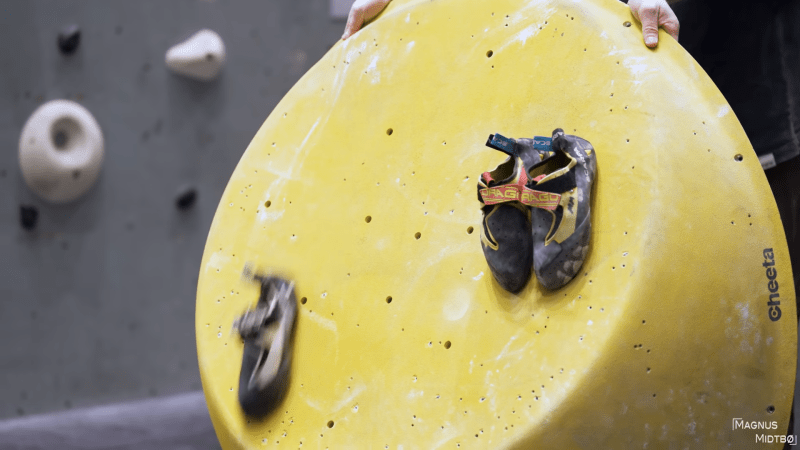
Walking on grass, it’s easy, no matter the shoe. How about an inclined trail? Some hiking shoes or nice tennis shoes will do the trick. How about climbing a mountain? Now we are gonna need something special. [Magnus Midtbø] is a professional climber with an acute awareness of this fact and has used shoes of all kinds; however, today is something special.
Imagine if you could use the technology of MotoGP to give you the same grip as a 1-liter bike. That is exactly what he tried out. RAToM is a company that has started to market a unique product, recycled MotoGP tires. Viral vids of this rubber being used have been going around with shoes even being able to stick to themselves. He decided to put it to the test by requesting some of this special rubber stock and applying it to his own shoes.
After extensive, though simple, testing along the bouldering wall he admitted to the effectiveness of the special soled shoes. This shouldn’t be too surprising with MotoGP’s intensive material science innovations involving their tire material. These tires include a variety of additives, from silicone dioxide to the traditional carbon black. What has not been able to be tested to its required extent is the durability of the material over long periods of bouldering.
Even though most of this specialized rubber material is primarily supplied by one company, the source material is recycled from any used MotoGP tire. This could mean DIY alternatives better than the current leading shoes could be possible with sufficient care if you get a hold of a tire or two… While this would not be an easy process, don’t be too scared to try! Maybe you could learn a thing or two from this case study on homebrewing a running shoe!












Try walking across grass in heels ;)
One significant difference is that your climbing shoes will most likely never reach the intended working temperature of the tire the rubber was taken from. That means the rubber will still be sub-optimal, and it could be even better if only someone would invest the insane amount of money they pour into the development of those tires.
Or get a shoe heater.
At this point you might as well start competing in chess tournaments with wireless haptic communication system embedded in your body.
Lol did they do that in Johnny Mnemonic?
It’s not like there’s a magical official temperature it needs to exceed to behave like rubber. It certainly won’t get up to the temperature needed for optimal results when racing motorbikes… but it’s not being used for that, is it.
The website says that they specific rubbers they choose don’t need high temperatures. But I agree that they will be suboptimal.
Is the MotoGP market that much larger than the climbing market, so that climbers need castoff MotoGP rubber? I don’t know much about MotoGP.
Their resoling service would be attractive to me were it not for two things. First, they don’t resole shoes that have holes all the way through, and I find that my climbing shoes have through-holes for about half of their useful lifespan (granted, in the second half of their lifespan, they are better for endurance work and warmup than for the harder routes). Second, the resoling costs close to and sometimes more than what I pay for climbing shoes. I have ebay watches set for shoes I like, and then when a brand new (or nearly so) shoe shows up that will work for me and has a good price, I buy it whether I need it now or not, since it’s always true that I will eventually need it–I end up pretty much never having to pay full price, and I pretty much always have the next pair of shoes (or more than one) ready to go in my closet. And lately the ebay market has been glutted with brand-new discontinued 5.10 Aleons that cost less than a MotoGP resole and are good enough for my foot shape and level of climbing.
What boots? I didn’t see any boots.
Ah man I was eating breakfast when I read this
Are you talking about the thumbnail? He’s just put some sort of goop on the bottom of the shoes for the thumbnail, that’s nothing to do with normal use.
On rubber
https://phys.org/news/2026-04-scientists-year-mystery-rubber-powers.html
I’m curious about this. I thought rubber was thermosetting. There are LOTS of uses for recycled rubber (one I was really interested in was the giant stall mats they use in horse barns, 3cm thick and a couple meters on a side) but my impression was that once rubber has been vulcanized that’s it. Clearly not, so yeah, really wondering how they get it loose and re-formed.
There are many methods for devulcanizing rubber, it’s not a permanent process. Even just mechanically pulling it apart can do the job to a certain extent.
For the last N years, MotoGP had Michelin. Before that was Bridgestone and before that, there was no spec tire. Overnight specials and special qualifying tires that last 2-4 laps were made. Next year is a switch to Pirelli.
In Moto3 and Moto2 they have Pirelli and used to have Dunlop. Those tires might be interesting too
First it was advertised as F1, now Moto GP. Never by the market btw, only by news outlets. You can’t devulcanize rubber so once it’s rubber, it’s rubber. This is not recycled race rubber. It’s a compound so soft it can be compared to that race rubber. I’ll believe it’s F1 or MotoGP rubber if the manufacturer says that, which they don’t