
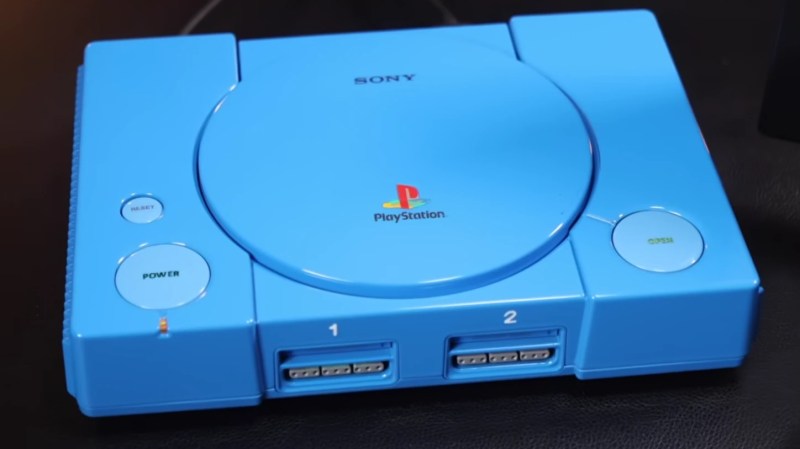
In a satisfying blend of classic console restoration and modern modding, [Elliot] from the Retro Future channel has transformed a broken, dirty PlayStation into what they call the “ultimate PS1.”
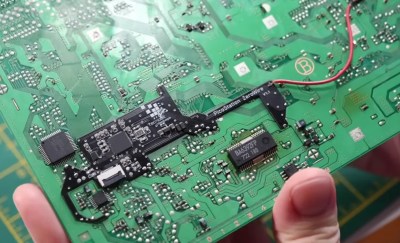
The first step was to deal with the really grungy case. The shell was soaked in dish soap and given a good brushing before being packed and sent to a collaborator. Upon inspection of the internals, several unknown modifications to the PCB were evident. These were likely to support playing home-burned copies of pirated games, as well as an NTSC region hack (for this PAL version of the console), courtesy of a dodgy-looking crystal oscillator hanging on the end of some wires.
Luckily, the PS1 product design is highly modular, giving excellent repairability, which made reversing this a doddle. The mod wiring was removed by simply desoldering it, but the cut traces needed to be cleaned up and reconnected to return it to stock condition.
After the first round of fixes, [Elliot] plugged into the TV for a test. It was still outputting black-and-white. Something was still amiss. He had simply connected one of the repair wires to the wrong spot on the PCB. After correcting that error (and getting lucky, no damage was done), the correct colour PAL output was seen.
Next, a PicoStation ZeroWire was soldered in place. This cleverly-shaped PCB hosts one of the Pico MCU chips and allows launching games from an SD card. Using a combination of large through holes on the PCB and a few castellated edge holes, installation looks very easy. ZeroWire is a bit of an unfortunate name, as it actually requires one jumper wire to be attached, but we’re just nitpicking here. Next, there was some really precarious-looking pin lifting on the CDROM controller chip. Cleanliness is in order here for a successful soldering mod. A special ESD toothbrush (not really) was pressed into service for cleaning with IPA. Proper ESD tools are not expensive, but you can get away without them.
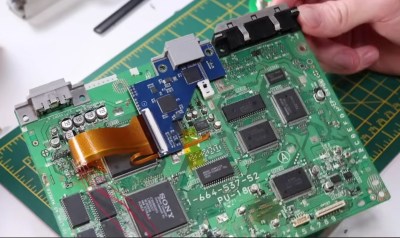
An Amazon-sourced PAL-to-HDMI adapter was tried to perform some 720p “upscaling”. This reduced the obvious jaggies a bit, but it was not really good enough for [Elliot]. So instead, he installed an HDMI mod board sourced from an Aliexpress store (listing now defunct). The metal shielding can was removed to reveal the video ICs. The serial port connector was removed, as this is the location for the new HDMI port. The ‘fun’ part of this particular mod is attaching the custom flex PCB to the video chip. This is quite a daunting task for those not comfortable with SMT soldering techniques. It may look hard, but it’s actually dead easy to drag-solder this, so long as you use plenty of good-quality flux and keep the heat under control. Once that was out of the way and second smaller cable was routed to the audio chip.
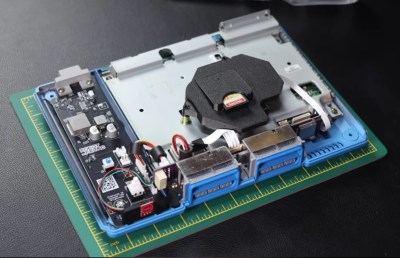
Next up was to deal with the old-school wired controllers. The TechnoBit Videojuegos Re-Live BT controller board allows the use of a modern wireless controller. Its installation requires disassembling the original controller connector module. The PCB from the rear of the module is removed along with the ribbon cable connector and a through-hole Zener diode, both of which are reused and soldered to the new controller board. This seems like an unnecessary faff and could have easily been pre-installed or at least included with the PCB. Also, soldering the through-hole beeper to surface-mount pads made us cringe. That looks like someone forgot to make the correct footprint for a part that normal humans can solder.
Finally, a Robot Retro USB-C power supply was dropped in to replace the original AC power supply, bringing this build’s connectivity into the current decade. USB power, HDMI ‘1080p’ output, SD card game loading, and a BT controller. Nice! The last part of the build features a custom respray of the enclosure, a nod to the original ‘dev kit blue’ version when the PS1 was first announced all those years ago. Ah, we remember it well!
Retrogamers familiar with PS1 hacks might recall we covered the PicoStation hack some time ago. You might also remember this hack that squeezes a complete PS1 emulator into a DS cartridge. Finally, hacks can be pure software, with nary a soldering iron in sight, like this one.
Thanks to [Keith] for the tip!












Worth watching and how much would one of them cost complete considering it take more to set up to make up then one would be worth and may not do another one.
Yeah, I’d rather use a PSIO Cartridge from Cybdyn Systems than absolutely butcher my console like this.
Take one look at the install guide for the PSIO and try to tell everyone that again with a straight face.
Ha, PSIO that has zero updates, poor software and you also have to deal with the carrot dangler Matt. It only got the recent updates
PSIO is dead, any experience left Cybdyn due to them not being paid. You would be a fool to buy one in 2026, unless its cheap and a clone from Ali.
Xstation or Picostation is where its at fam
I must confess that I never really liked the N64 or the Playstation and the likes..
They put an end to the beloved 16-Bit era,
which was about hand drawn pixels and beautiful, dreamy 2D graphics.
Instead, badly rendered 3D graphics became “in” and all the cozyness was gone.
I still remember how I felt how disappointed Lylat Wars (N64) was compared to Star Wing (SNES).
Or how beautiful the 3D game series Donkey Kong Country looked on SNES (nicely pre-rendered on SGI workstations).
Some positive exceptions, I think, were Mischief Maker (N64), Kirby 64 (N64), Pokèmon Snap (N64), Pokèmon Stadium 2 (N64, with RAM exp) or Klonoa (PS1).
To me, the majority of N64/PS1 felt like low IQ sport and FPS games, though.
A lot of magic went away when PS1 or N64 came along, I think.
In the west, I mean. I’m pretty sure the home land of Japan had gotten great exclusives for the new console generation.
But here in the west.. I remember how parents got attracted to PS1,
to play violent non-kids games in living room. Oh, well.. Sigh.
The transitioning time from early 90s to late 90s did really hurt people like me.
It’s as if the Saturday morning program was replaced by wrestling and a monster truck and demolition show.
PS: A positive aspect of the PS1 was its ability to play Audio CDs and Video CDs.
Maybe CD Text, too? Many Audio CDs had extra information stored.
Such as small pictures, lyrics etc. The Philips CD-i and similar consoles could display them.
Sybau
Huh? Why are you using my name to write comments like this? Or is this a Hackaday bug? For the record, I’ve never said such a thing but for some reason it says my name here.
Personally I don’t care for anything even remotely associated with nintendo. Even as a kid I thought I was too old for pokemon and other nintendo games. Don’t get me wrong, I had a gameboy with a bunch of games, but got rid of it when I left primary school. I’m personally glad we left the 16 bit era and 2d graphics behind. I probably spend 15k hours in counter-strike so I’m probably biased. That was before steam counted the hours played. A lot of that before steam even existed.
If you want to step back into that era, sort off, you might want to try cloudpunk. It’s cozy, looks vintage but futuristic, it’s just chill. I like to play a ton of action games but always fall back to cloudpunk when I want to just chill.
Thank you, I see you understand what I meant. 😟
The advent of PS1 (and N64 a bit later) was such a shift in gaming landscape.
In early 90s, Jump&Runs and Point&Click Adventures were still common genres.
Games that were like puzzles, all in all.
The more “edgy” players probably had a Sega console rather than a Nintendo.
It still was like this when 3DO, Philips CD-i, Atari Jaguar where out.
Then the PS1 came a long and Sony had a different vision here.
As an entertainment company, it didn’t limit itself to family friendly games.
The PlayStation rather was an unregulated platform with games that could break any taboos.
Blood, gore, violance and sports. Great for, let’s say, the drunk family fathers, too.
Again, the PS1 was such a shift in gaming landscape.
Like from a children cartoon to 18+ splatter movie.
Helplessly I saw the change in the 90s, already, when N64 and PS1 got more popular each time.
That’s when I decided to pause my console gaming for a few years.
Instead, I focused on shareware CDs and played some indie games on PC (mainly under DOS, but also Windows 3.1 desktop games).
By early 2000s, the Gameboy Advance and cellphone games begann to bring a bit of the 16-Bit era back.
So yeah, the saying is right: “One man’s joy, another man’s sorrow”
While a lot of players cherrish the PS1 era and feel nostalgic for it, not all do.
To some, it was the end of an era.
In retrospect, I think I now understand the pain and loss the Atari ST/Amiga users must have felt in the 90s a bit better.
Their platforms and genres went away, too, after all.
Except that their “enemy” wasn’t the PS1 but the PC.
Or Windows PC, in particular, maybe.
Consider ordering a R36S console with a preloaded SD card. It’ll have most, if not all, of the 2d games you fondly remember – and the system is inexpensive.
The early 90s were definitely better
The really nice we’re definitely better than the late 90s.
Don’t think we missed the Nintendo logo on the usb c. Ironic
All those fixes and upgrades are ment to recall and relive our youth days long gone. I understand this (bought myself two zx spectrums), but I suppose at this moment in life we should think more about the future and a bit less about the past. Just a bit less, not completely off.
A lot of PS mods are audio centric (understandably) and this one was refreshing. Yes literally as well 🤡
Shame he lost the serial port. I used to play Descent with a friend multiplayer. If I’m remembering correctly there was for a time a VHS rental place with TVs and game systems I remember you could play them linked up.
PS, Bleemcast beta and a Dreamcast with VGA cable are hands down the best way to play PS1 games. I never had the money for the PS to DC controller cord, but maybe GitHub has a project using Pi Pico to cross controller all the things.
There’s USB4Maple adapters to use a variety of USB dervices on a Dreamcast
USB4Maple is an adapter that lets you use a variety of USB devices on a Dreamcast, it’s a pretty simple adapter that just uses a pico and a dreamcast connection part.
How is complaining in a comment any more groundbreaking or a better use of your time? Got a better project? Please post it!
Brilliant job that. Well done