
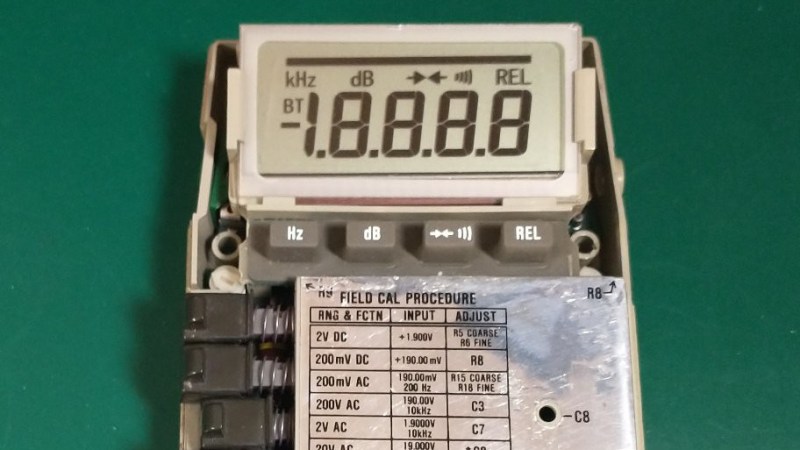
As a company, Fluke has been making electronic test equipment longer than the bipolar junction transistor has been around for. In that time they’ve developed a fairly stellar reputation for quality and consistency, but like any company they don’t support their products indefinitely. [ogdento] owns a Fluke meter that isn’t nearly as old as the BJT but still has an age well outside of the support window, and since the main problem was the broken LCD display they set about building a replacement for this retro multimeter.
Initially, [ogdento] had plans to retrofit this classic multimeter with a modern OLED, but could not find enough space for the display or a way to drive it easily. The next attempt to get something working was to build a custom one-off LCD using a drill press as an end mill, which didn’t work either. But after seeing a Charlieplexed display from [bobricius] as well as this video from EEVblog about designing custom LCDs, [ogdento] was able to not only design a custom PCB and LCD display to match the original meter, but was able to get a manufacturer in China to build them.
The new displays have a few improvements over the old; mostly they are more stylistically inspired by later Fluke models and have a few modern improvements to the LCD itself. There were are few issues during prototyping but nothing that was too hard to sort out, such as ordering the wrong size elastomeric strips initially. For anyone who needs to replace a custom LCD and can’t find replacement parts anymore, this project would be a great starting point for figuring out the process from the ground up.












I have a Heathkit DMM of similar form (1984 or so) and it still works. I guess. I retired it because the plastic parts had become brittle and were starting to fall apart.
Buying a 3D printer and figuring out how to make replacements seemed like way too much work so I bought a Fluke. :-)
Great! So you have a multimeter again, but no 3D modelling or fabrication skills.
Affluence is not having to do everything yourself.
Wow! Some thin-skinned readers in the house.
If you dislike or were put off by the usual 3D software for design you should give OpenSCAD a try. It is much less confusing because the learning curve isn’t steep and you’ll have done your enclosure pretty fast. The parametric approach is really nice. For very complex projects, you may still want FreeCAD.
Also Andrew is being kind of mean, because you were almost there. But I think that trying to help out would be more useful than sheer sarcasm, which only makes you feel bad.
Not really. OP could have used epoxy putty, sugru, or some other technique to repair the multimeter. This is a hackaday after all, not buysomethingbecauseimtoolazytofixitaday.
Hier hat ein Bastler das defekte LCD eines Tischmultimeters durch eine LED Anzeige ersetzt.
Dabei wurde die bestehende Ansteuerung durch einen ILC7107 kompatiblen Chip ersetzt.
https://www.youtube.com/watch?v=tO9PcrqU_S4
https://www.youtube.com/watch?v=kGXZfSynpbs
Цифровой настольный мультиметр Щ4313.
Props to them for doing the right thing and making a minimum order of 500. EEVBlog basically scammed the manufacturer into making samples, with no intention of ordering in bulk.
Thanks for the props kuro68k!.. (fwiw I thought eevblog made a large order for the u-current device??) But I absolutely agree with your point – the fabricator committed to make me the parts if I committed to buy 500… they did their part so I wasn’t going to stiff them.
Since my order was considered “small”, I did have to pay (up front) engineering and plating fees for both sets of 10 samples I got, which amounted to a few hundred USD – maybe not a bad way for the fabricator to recoup some costs if an unscrupulous buyer skips out after receiving samples?
Oh right, now that you mention it, there was this old wooden gauge multimeter from my gramps, about 10 years ago. It didn’t work and inside were just a bunch of resistors (boring), so i tthrew it away. Maybe i shouldn’t have?
ogdento here, thanks to Hackaday for featuring my project! As far as making the LCD, I’d also like to thank “The half baked maker” (on Tindie)… seeing the Radio Shack PC-3/Sharp PC-12x display he designed gave me confidence to try my hand at this.
Most of my rescued Fluke DMMs suffer from faint low contrast LCD digits. Easily fixable by replacing the top polarizer film. I just can’t pass them up when I find ’em on Craigslist for super cheap.
I bought a Fluke 8060A for my bench in 1983 and I still use it almost daily. My meter went back to Fluke in the late 1980s because the display processor quit working. Back then any repair which automatically included a recalibration was an affordable flat rate. My 8060A has been spot on ever since. The 8060A agrees with my 6.5 digit HP bench meter. What is special about the 8060A is that it can be set to read in dB which is great for communication work. It is no surprise that an owner would want to repair this particular 43 year old meter.