
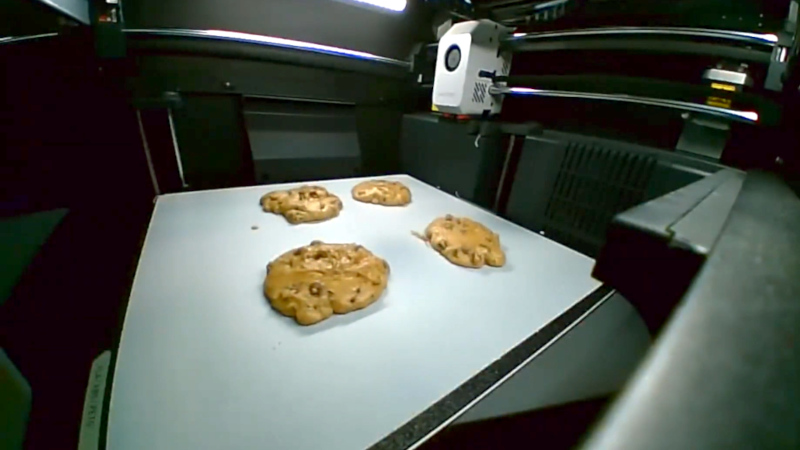
Imagine for a moment that the Cookie Monster is going to visit, but all the cookie baking utensils in your house have been mislaid. The horror! Fortunately [Startup Chuck] is here with a video showing the process of baking cookies in a 3D printer, and as an extra treat he’s using entirely 3D printed utensils too.
The utensils are comprehensive array of all you’d need for serious cookie production, even going as far as to print a mixing bowl and beater for a KitchenAid mixer. There are scoops aplenty, and something we’re particularly impressed with, a spatula with a TPU blade. We’re guessing that FDM prints might not be the best for cooking because all manner of food could get caught in those layer lines and go off, but let’s face it, this is a bit of fun rather than a forever cooking project. We like the AI generated spork for its near-flatness, reminding us of our AI-generated breakfast. Finally he even prints a cookie baking sheet using nylon filament.
An enclosed 3D printer makes a surprisingly effective low-temperature oven, with the heated bed as the element. It works, and makes recognizable cookies, though they’re not browned. As entertaining as this experiment may be, we can’t recommend following his example — at the very least, moisture and food ingredients in your printer probably aren’t conducive to good future printing.












I can hear the internet screaming “Food safe”
Luckily it’s not Reddit.
This isn’t food safe though I won’t stop you if you wanna poison yourself I’m a fan of letting people slightly stupider than me get taken out by darwinism
The food safety concerns seem to be more about the uncleanable gaps between layer lines. So, one time use is probably not going to do much damage.
There are epoxies that are rated as safe for constant contact with food. They seem to stick well to PA-CF, PLA, and PETG in my limited experience. They hold up well to mild abrasion. Words to live by: Don’t lick the spoon until the epoxy is cured.
(Plain) PLA and TPU are both considered food safe. As the article state problms may occur with potential food caught in layer lines and breading bacteria over time. For single use, not an issue.
I have made popsicle molds with TPU and cookie cutters with PLA for one off uses.
Plain PLA does not exist, as that is too brittle to print with (we had a sample roll at Ultimaker, it shattered in a 1000 pieces). And the additives do not have to be food safe.
They could be, but the filament you’ve got probably isn’t. Especially if it’s a cheap roll from our favourite online resellers.
And it’s worth noting that they’re not commonly used for food packaging or implements. HDPE and PET are the two I commonly see.
If you didn’t know that a silly face is a common condition with patients in YouTube’s nuthouse, you’d say that he just suffered a stroke or two. But I guess it’s a side effect of an overexposure to 3D-printer fumes in this case.
This, is why we live the Internet!
I just want the Cookie Monster to visit me!
have you tried Furry conventions?
Now I have an excuse to get that bigger printer
Iv’e proofed bread dough in my 3D Printer.
I did see someone 3D printing with chocolate at a convention… I think it melted chocolate chips, rather than a filament style feed and it had a large nozzle like 1mm. But…the print bed would need to reach at least 180°C for proper cooking (for browning), and remember the internal temp of anything cooked needs to be at least 75°C to kill any bacteria in the food. So…while feasible I think it’s a bad idea… You have time to make 1000 cookies in the oven while you are waiting for your Mandolorian mask to print…lol
Heh. I got a print bed that hot one time during a “runaway test” [1]. Hooked it straight to the PSU.
But it took a long time. Would need a higher power one than what I used…likely AC mat heater.
[1] https://flic.kr/s/aHsjJ3VtUb
Cocoa Press: chocolate 3D printer.
There is a woodworker on YouTube that 3d printed a sausage press, a lot of people tried tell him that it was not food safe. I can see maybe a one time use, but I definitely would not trust it after. There would be no way to to get everything from the layers, especially after it pressing sausage through it. He didn’t care one bit, yuck.
I definitely would not trust it for long term use unless it has been post processed, like covered in a food safe coating (which you should do for woodworking projects that come into contact with food too) or print it out of ABS, vapour smooth it and then clean it very well.
I was about to suggest “Ready to Bake Refrigerated Cookie Dough, Chocolate Chip™”, but they’re like 25 cents per cookie now. Then a heated bed, with actual parchment paper, could have worked in a pinch.
See also Ben/Applied Science’s Cookie Perfection Machine (link in username)