
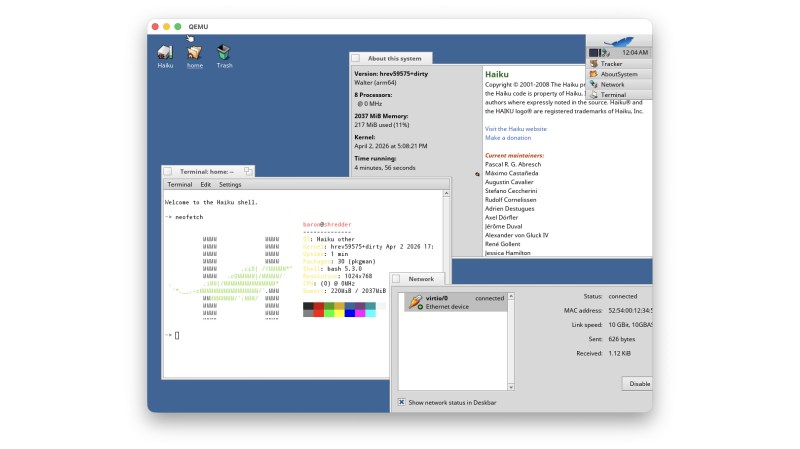
Ever since it was called OpenBeOS, Haiku has targeted the x86 platform. That makes good sense: it’s hard enough maintaining a niche system on ubiquitous hardware. But x86 isn’t the only game in town anymore. Apple’s doing very well on ARM, Linux runs on oodles of ARM SBCs, and even Windows uh, exists, on that architecture, so why not Haiku? That’s what [smrobtzz] figured, and thanks to his work you can now run Haiku on ARM, in QEMU.
There’s no image available as yet — you still need to bootstrap your own from a working system, and ironically that system cannot be Haiku. [smrobtzz] apparently used MacOS, which makes sense as his ultimate goal is apparently to go where only Aishi Linux has gone before and boot Haiku on his M1 MacBook. There had been previous efforts to get Haiku going on Raspberry Pi hardware, which seems logical considering how lightweight the operating system is, but they’re apparently nowhere near booting either. QEMU is a good start.
Interestingly, according to the ports page, Haiku is “functional” on both RISC V QEMU and the now-discontinued HiFive Unmatched SBC. We don’t seem to have covered it, but that milestone happened five year ago. Given how most RISC V boards currently available are a bit slow for modern desktop Linux, Haiku would likely be a breath of fresh air. The BeOS-descended system might be single user, but it’s snappy.
We reported a couple of years back that Haiku was daily-drivable on x86 ,it’s only gotten better since then, assuming you choose the right hardware. Hardware support is always the hard part about alternative OSes, but Haiku users are absolutely spoiled compared to fans of MorphOS, which still only runs on G4 or G5 PowerPC, and even then not only some hardware.












BeOS wasn’t intended for x86 to begin with
Besides define functional …
Will it run on an Arm Mac M1? Because -I want it to!
That’s the eventual goal of [smrobtzz]’s ARM-speriments, but with just a couple guys working on it its going to be a while.
beos no have multi user mode
Wake me up when Haiku no longer is a do everything as root OS.
Or is it here already and I just missed it?
Single-user is the name of the game and there’s nothing in the roadmap that would change that. If there’s only one user, they kinda have to have admin rights.
Who even needs multiuser on a desktop nowadays?
You might want separation of duties to help with, oh I don’t know, security.
While multiuser isn’t inherently required for separation of concerns it is a method that makes it easy to reason about and manage.
We need it (well want it). My wife can be working on a system, and I can login via SSH or RDP and do work in a GUI from another and not bother her. Even in the RPI world where I might have stuff running under user x 24×7, and doing some testing/code development as user y. Multi-user is useful for many things… The Unix/Linux world got it right … right from the beginning.
MP/M in the late 70s supported multiuser/multitasking, too.
Same goes for various DOS compatible operating systems from the 80s.
Strictly speaking, it always had been there. Just not common among consumers.
Well, BeOS was meant to be a fresh, new multimedia OS without the legacy of the Unix world.
So back in the 90s it made sense to focus on a lightweight, fast OS like BeOS.
That was before BSD and Linux creeped into desktop computing.
It can also work on RISC-V. One of the developers was running it on a StarFive Vision 2 possibly two or more years ago. Not everything worked due to lack of documentation, but it did run on actual RISC-V hardware and not just QEMU.
It was 3 years ago and development stopped. https://discuss.haiku-os.org/t/progress-on-running-haiku-on-visionfive-2/13369/267