
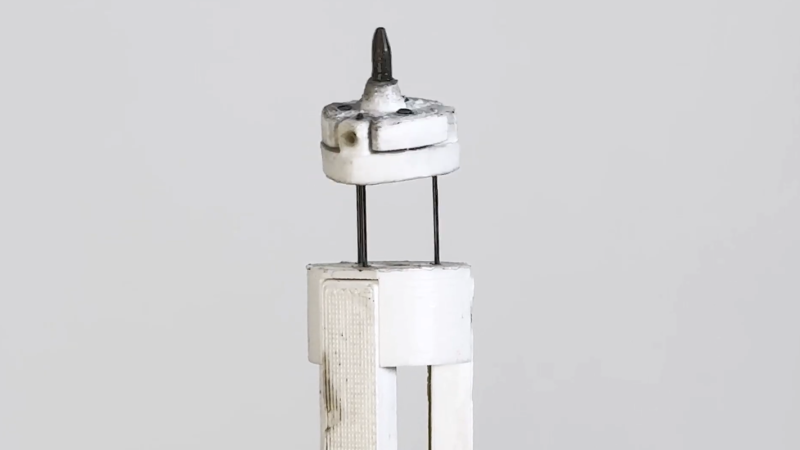
Emergent properties include examples like murmurations of starlings which can’t be predicted from looking at a single bird, weather which can’t be predicted by looking at a few air molecules, and consciousness which can’t be predicted by looking at a neuron. Likewise, when adding a new tool to a workflow, emergent properties can show up as well. A group at Chicago University developed a robotic drawing tool and a few artists developed some unique drawing methods using it.
The robotic pen uses a pair of tendons to extend the working end out a certain amount. From there it uses a set of servos to can be programmed to revolve around in a defined path, making repeating movements while the artist makes larger movements over the paper. Originally meant for shading, small circles or simpler back-and-forth movements were preset, but with full control over the pen’s behavior the artist can shift focus away to other tasks within the creative process. A study with ten participants was done which showed artists coming up with novel ways of using a tool like this, and others reporting that it’s almost like drawing together with another person.
Looking for novel ways that humans can interact with computers and robots can often lead to surprising outcomes like this. Members of this group aren’t new to novel human interface devices either; they’ve also built a squishy dynamic button as well.












Why not use a cheap 6-axial industrial robot instead? Those are commonly used in manufacture of cars and microprocessors where precision is important.
*University of Chicago
Any snark this article gets is richly deserved – it seems they’ve rediscovered the digital sketchpad, created a digital pantograph/Etch-A-Sketch/Autopen (3D capable!) powered by an Arduino running C++, subjected ten victims to using it and talked about it among themselves at great length. One wonders at the review process.
Most of the verbiage in the paper seems to come from http://www.artybollocks.com – great fun in itself and particularly relevant here. I think I’m going to put wires on things around here and see if I can get published by ACM, though coughing up the publication fees would be annoying.
Still, it looked like a fun hack!
I can tell you the review process!
It’s a conference paper. You plan to attend the conference. So you submit an abstract. Someone says “hey, at least one other person at the conference might like this” and boom, you get a poster slot. Or a 15m presentation. Or etc.
TLDR it’s — very deliberately — the lowest bar in academic publishing, because a “share it with your peers even if it’s a small idea” is a valuable thing to have.
That is not how conference proceedings in Computer Science work. For historical reasons, CS main publications are actually conferences.
I have been there, on both sides of the review process.
Wonderful woolly shaded sheep shadows.
For doing those Palmer Method handwriting practices without having a nun hitting your fingers with a ruler for holding the pencil wrong.
its like photoshop but irl.
stick a six axis imu in the tip and maybe you can add a copy paste feature.
I wonder if something similar could work like the Shaper Origin (the router-like CNC that you move manually but it adjust its path to follow the intended design). The goal being to let you draw perfectly straight lines or circular circles or whatever you set it to, with your own hand, but adjusting to compensate for your imperfections. Of course, that seems kind of opposite to what’s shown here, in a way.
might be a toy / tool for people with parkinsons desease or those in need of a drink.
There was a simple version sold as a toy in the ’70s, I think it just moved the pen tip in loops.
Did anyone see a project where a bot with a pen randomly moves and when it is in an area of paper that needs ink the pen goes down. So the image is built up by the random motion of the bot? or did I dream it.