
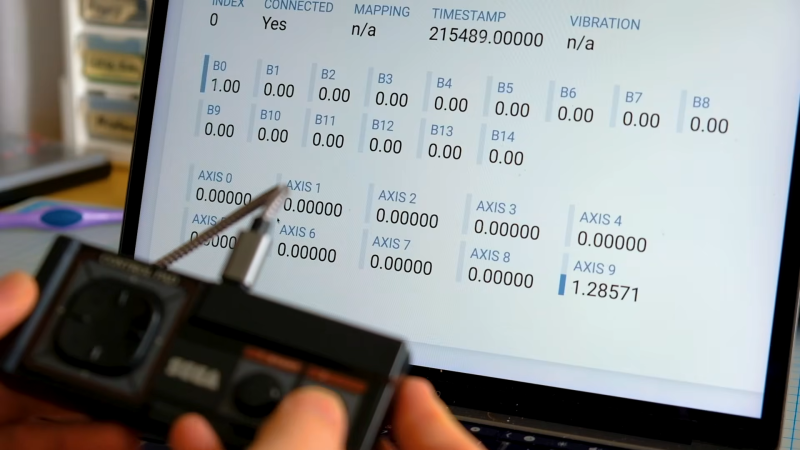
USB wasn’t even a gleam in an engineer’s eye when the Sega Master System hit the market in 1985. Today, we’re up to USB 4 or something, and the USB C connector is becoming a defacto standard for just about everything except desktop computers. [Retrostalgia] is embracing this by mating the control pad from Sega’s first international console with the connector of today.
Naturally, the Sega Master System did not use the Universal Serial Bus to talk to its controllers, so some conversion was in order. That’s achieved with the use of a RP2040 microcontroller, which reads the D-pad and action buttons via its GPIO pins. It then acts as a HID device when plugged into a computer or other USB host, showing up as a simple game controller. This is a particularly easy hack as the Master System controller is so simple, there’s no need to decipher any protocols or anything like that. It’s just about wiring up a few simple buttons. Beyond that, it’s just a matter of hot-gluing the RP2040 into the Master System controller housing, and making some room for the USB C port to sneak out the top. We’d have loved to seen a little extra hackery on this one, perhaps adding some rumble to a controller that was never, ever supposed to have it.
If you want to adapt authentic old controllers to work with modern computers and emulators, this project is a great place to start. It doesn’t get much simpler than the Master System, after all. You can always work your way up to more advanced feats later, like working with the beloved Wavebird. Video after the break.










Alex Kidd on Sega Master System, that was my only built-in game, my parents did not want to buy any game.
I played that game in a loop, never managed to finish it.
https://www.youtube.com/watch?v=uIaWg2oWuhE
Now there are emulators online, will give them a shot.
For me it was one of the first games I ever finished as a gamer. Granted, I took some help from a magazine that explained how to beat it, but it was still an accomplishment for me at the time.
Using a microcontroller that can emulate the Master System, where an ATTiny would suffice. slow clap
OMG, how dare he not do it with a 555!
I mean, seeing the price of the RP2040, it’s not like he’s wasting a lot here…
the miracle of the rp2040 / pico series is that your specific criticism is unjustified. it’s as inexpensive as the attiny was back in the era when you would have used an attiny.
There are places with harder limits(mostly related to power if it’s not a wired setup); but it really comes down to what part you actually find fun.
Using this as an excuse to go on a 5 cents and under microcontroller safari would have been perfectly legitimate, if you want to go futz with that interesting class of devices; but when you are sitting at or close to quantity 1 you have to really want to go on a given parts adventure in order to justify not just throwing whatever you find most familiar or pleasant to develop for at the problem and calling it good.
yeah you hit the nail on the head that’s exactly what i love about the rp2040…it’s cheap enough i can buy a handful of them speculatively and then burn them on whatever fool project crosses my radar. whereas before…i love the 8-pin PIC12 but it’s not sufficient for a lot of projects. and when you look at larger PIC16 or PIC18, it’s really very different (and at the time, seemed like a higher cost). and i loved the STM32 but it was too expensive to treat so casually, and the cheaper/knockoff STM32s had a whole list of minor downsides that upset me when i first was getting oriented to them, and so on. pico is a great ‘one dev board to rule them all’
Ya know, I understand, but the next hack could be programming a Master System emulator into the embedded RP2040. Not sure how to handle the video output, maybe force a terminal to open on the host computer, I dunno.
Or, it could have used some shift registers and serial to USB like some of the old emulator docs described back in the day.
RP2040 costs the same as an ATTiny for orders of magnitude better specs in all areas that’s why
For something actually cheaper for less performance a modern option is CH32V003
No, but its spiritual predecessor, ADB, was. :)
https://en.wikipedia.org/wiki/Apple_Desktop_Bus
Atari SIO was much closer and considering one one of the designers went on to help create usb after it …
Thank you, it’s impressive for ’78!
I wasn’t aware of this before to be honest. 😅
The reason I made this comment is because the media in general tends to downplay the achievements of the past (I don’t mean HaD in particular, article is fine).
In today’s world there’s too much “see how far we’ve come” when things start to look different on a closer look.:
Way back in the 70s, 80s or 90s many things we do cherrish about now did already exist in a slightly simpler form.
Sometimes in a more elegant form, too.
And that should make us think sometimes and become a bit humbler. IMHO.