
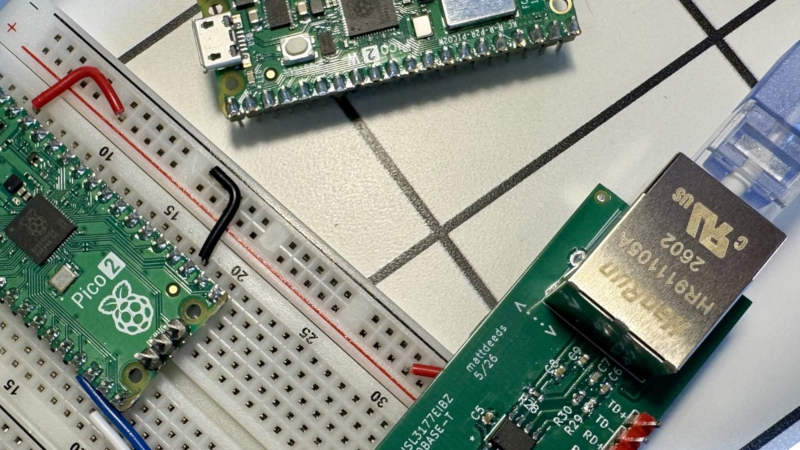
We are all in search of the fastest in a wireless router, to give ourselves the best connectivity to the world. But what about the slowest? Gigabit Ethernet may not be for everyone, as Matt Deeds demonstrates with bit-banged 10baseT Ethernet on a Raspberry Pi Pico 2W.
The project is written in Rust, and is in part a port of an earlier project. It makes use of Ethernet magnetics, but the rest of the works is all done in software. He says it’s full-speed on transmit and reduced speed on receive, but we’re guessing if you’re using 10baseT in 2026 then speed isn’t your number one concern anyway. It provides a WiFi router as well as a wired connection, making it possibly the cheapest Ethernet to wireless solution possible.
We like projects that extract the last ounce of power from a part to make it do something its designers never intended. In this case we’ve seen a few other bit-banged Ethernet projects before, even another on the Pi Pico.












There’s no such thing as a Pi Pici 2W. It could be a Pi Zero 2W. If you’re talking about a Pi Pico, that’s a basic microcontroller, not a SBC. While it is powerful, and has some powerful architecture, esp compared to many other uC, it cannot do the job you described.
C’mon!
https://www.raspberrypi.com/products/raspberry-pi-pico-2/
According to The Pi Hut, it does exist.
https://thepihut.com/products/raspberry-pi-pico-2-w
The manufacturer disagrees: https://www.raspberrypi.com/products/raspberry-pi-pico-2/
Burn!
If you care to properly look at the product page for the Raspberry Pi Pico you can see quite clearly it says “now with added wireless”. So it would seem RPi does make a Pico 2W.
“The job you described” means bitbanging 10BASE-T?
People have done way crazier things with the Picos, using the PIOs and stuff
can’t even tell if this is bait or stupid lmao
I remember when 10-Base-T (or 10-Base-2) was fast. Compared to serial… I might have a use for this.
Receive is only around 100 kB/s with this implementation. Transmit can go up to 1 MB/s, so if your application is mostly sending data, it could certainly be useful.
Reminds me of the “high speed” internet I had in 2005.
now that’s a hack!
Vey cool!
What I’d love to see is a pio implementation of SPE (single pair Ethernet). It’s in theory perfect for devices like this. Let’s you connect multiple devices to the same did pair like for ex. on a CAN bus while still being a full IP connection.
It’s starting to have good support from chipmakers, and has seen some great adoption in the factory automation space where it’s used to network sensors and actuators.
There are several standards for spe: 10BASE-T1S for short range multi point, and 10BASE-T1L for long range up to 1km point to point, as well as 100 and even 1000 versions. iirc. The physical layer is different for them, and I don’t know of easily available line interface like the integrated magnetic RJ45 this project uses.
Still, it can’t be that hard, and these standards look useful so I hope peeps will figure how to make them cheaply and easily, because right now they’re neither.
I like my wifi on serial better https://github.com/techomancer/serpico