
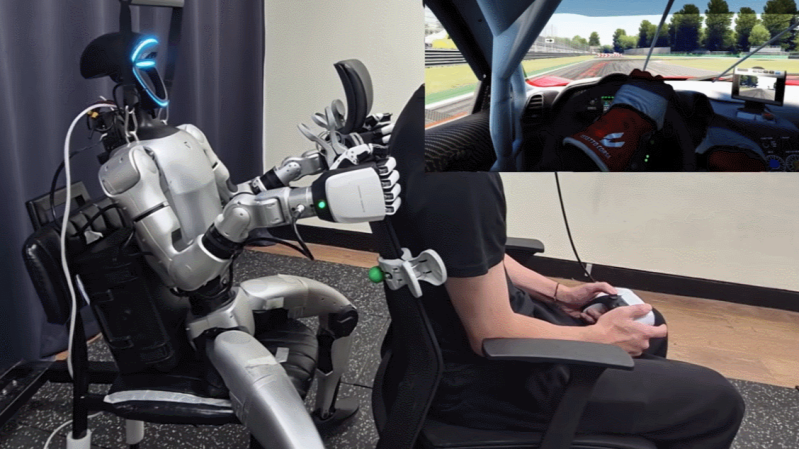
Humanoid robots are a thing now, and here’s an interesting research project that explores using one as a form of haptic media. Specifically, using a humanoid robot to move a chair while one plays a VR driving simulator.
Here’s how it works: a Unitree G1 robot sits behind a player’s chair and grasps it with its hands. Spherical markers on the chair help the robot’s depth camera know the chair’s position, and real-time G-force signals fed from the simulator (Assetto Corsa, running on PC) tell the robot how much and in what direction to shift the chair to match in-simulator events.
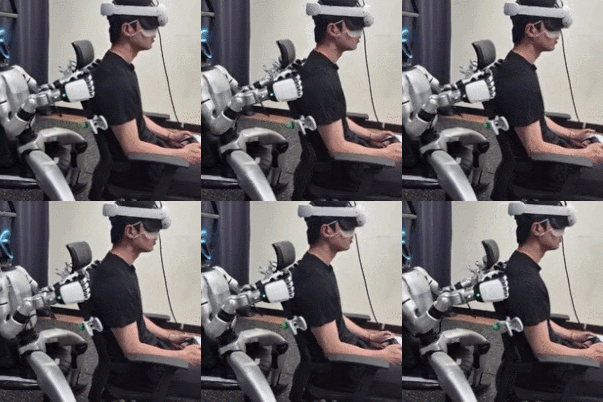 While a humanoid robot (especially one equipped with articulated, human-like hands) makes for an awfully expensive force feedback chair, this approach is interesting because it specifically explores using an already-existing humanoid robot as a general-purpose device. It sits in a chair, looks with its camera, grasps with its hands, and moves the player’s chair in response to game events; no hardware modifications required.
So how well does it work? Pretty well, apparently! Participants found the synchronized motion feedback accurate and highly enjoyable, although it does seem like there were some rough edges. Some testers reported that the sustained motion and constant vibration were tiring, and in some cases seemed to worsen VR sickness.
Still, using a robot in this way seems to be a conceptual success and showcases the potential of humanoid robots as flexible, general-purpose devices. We’ve seen a robot used to provide interactive force feedback in VR before, but a driving simulator makes for a pretty fun demonstration.
The video is embedded below, and for more information, check out the team’s research paper.












Wait until the Mormons hear about the idea of a robot “shaker”…lol
This must be the first part of the tech enthusiast meme right? The one that ends in “the most recent piece of technology I own is a printer from 2004 and I keep a loaded gun ready to shoot it if it ever makes an unexpected noise”.
What could possibly go wrong.
I mean, it’s not a lot different than the ful-blown simulation rigs that pop up occasionally. This one just looks different but would have the same faults that a dedicated platform would have as well
Never ride a motorcycle if your goal pal suffers from grand Mals.
Don’t ask.
This is just replacing the motion system of normal VR with a remote controlled robot doing the same thing. When one of them can do this without external control it will be something to talk about.
Because they can be mass-produced like cars and cell-phones, general purpose robots like these will probably become pretty commonplace. I just hope they’ll look friendlier…
I hope they continue to look like the heavy, powerful, barely-controlled machine tools that they are, so people don’t get too complacent.
‘Humanoid’ is the form factor you choose for your robot when the task is attracting investor money (and, I guess, internet clickbait). Any other use-case, incredibly dumb and inefficient and pointless.
Unless you are really referring to something as anthropomorphic as possible (where I’d agree, its of limited utility up & until full ex machina where it becomes just straight terrifying)
“Humanoid” refers to something bipedal, with arms, and primary a/v senses located in head-ish thing superior to the arms/torso
That let’s it both fit in, and interact with, a world shaped for human bodies. That hardly sounds inefficient, and certainly isn’t pointless.
Or when you intend for it to operate tools and in environments designed for the humanoid form factor. Why would you design a specific machine for every use case and environment? Two legs can act as both locomotion and 4 DOF positioning axes, able to operate on a wide range of surfaces. The inefficiencies in cost and strength will be mitigated by economies of scale.
uh, no….
Feels like someone with access to a robot was just goofing around, having fun. Hats of to you young person.
But then mr marketing/product manager came in, “oh oh oh, we have something!!!” and made this terrible video.
Now it would come in “subscriptions” of operating modes.
Cooking $199/mo
Cleaning $100/mo
Gaming assist $50/mo
…
You work for the humanoid subscription now.
“Thank you for making a simple door very happy”
Hope your diodes rot.
I could calculate your chance of survival, but you won’t like it.
Brain the size of a planet, and they ask me to shake a chair around.
I don’t care for these kind of articles: taking an expensive, exclusive, corporate product–and trying to find astroturfed hacker’esk applications for it.
I would rather see anything that a few friends made in their own garage, using their own funds.
feel free to submit a tip with contents of your liking:
https://hackaday.com/submit-a-tip/
Then go to your garage and build something like it. There are certainly plenty of open source humanoid robot designs you can chose from as a starting point. I look forward to seeing what you post in a couple of years.
At last… a “Are we there yet?” simulator, with obnoxious child mode included.
Kicking the back of the seat while you drive…
Some Mormons are going to be getting some pretty wild ideas right about now.
I lol’d.
Iykyk.
I mean. It is obviously a joke, don’t you see it? Have you seen the User study a and Expanding roles pages? I mean it is subtle and great joke for my taste.
This sounds very Asimovy.
where is the “not a hack if its a general purpose robot” comment.
New meaning of back-seat driver!
It’s hilarious that the human chair shaker did as good or better in most categories.