Want Driving Simulator Feedback? Make The Robot Do It

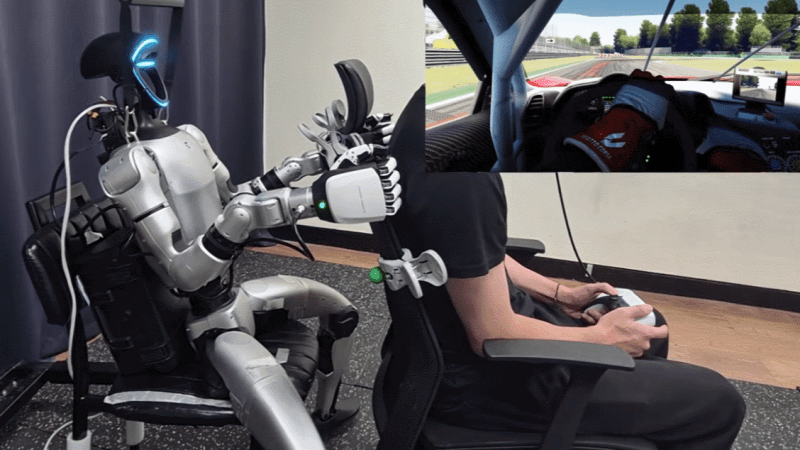
Humanoid robots are a thing now, and here’s an interesting research project that explores using one as a form of haptic media. Specifically, using a humanoid robot to move a chair while one plays a VR driving simulator.

Here’s how it works: a Unitree G1 robot sits behind a player’s chair and grasps it with its hands. Spherical markers on the chair help the robot’s depth camera know the chair’s position, and real-time G-force signals fed from the simulator (Assetto Corsa, running on PC) tell the robot how much and in what direction to shift the chair to match in-simulator events.

Continue reading “Want Driving Simulator Feedback? Make The Robot Do It”

Handheld Steering Wheel Controller Gets Force-Feedback

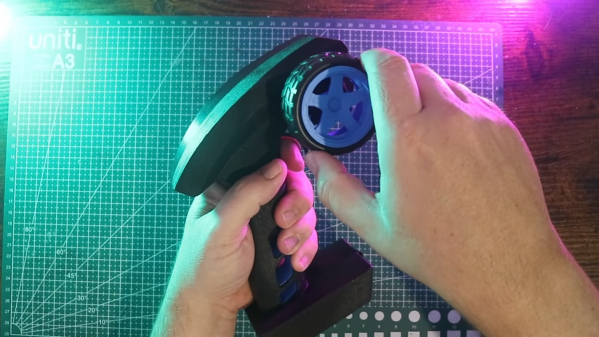
For a full-fledged, bells-and-whistles driving simulator a number of unique human interface devices are needed, from pedals and shifters to the steering wheel. These steering wheels often have force feedback, with a small motor inside that can provide resistance to a user’s input that feels the same way that a steering wheel on a real car would. Inexpensive or small joysticks often omit this feature, but [Jason] has figured out a way to bring this to even the smallest game controllers.

The mechanism at the center of his controller is a DC motor out of an inkjet printer. Inkjet printers have a lot of these motors paired with rotary encoders for precision control, which is exactly what is needed here. A rotary encoder can determine the precise position of the controller’s wheel, and the motor can provide an appropriate resistive force depending on what is going on in the game. The motors out of a printer aren’t plug-and-play, though. They also need an H-bridge so they can get driven in either direction, and the entire mechanism is connected to an Arduino in the base of the controller to easily communicate with a computer over USB.

In testing the controller does behave like its larger, more expensive cousins, providing feedback to the driver and showing that it’s ready for one’s racing game of choice. It’s an excellent project for those who are space-constrained or who like to game on the go, but if you have more space available you might also want to check out [Jason]’s larger version built from a power drill instead parts from an inkjet.

Continue reading “Handheld Steering Wheel Controller Gets Force-Feedback”

Build Your Own Force-Feedback Joystick

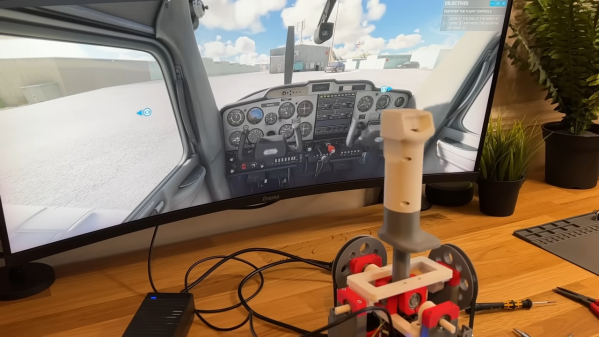
Force feedback joysticks are prized for creating a more realistic experience when used with software like flight sims. Sadly, you can’t say the same thing about using them with mech games, because mechs aren’t real. In any case, [zeroshot] whipped up their own stick from scratch for that added dose of realistic feedback in-game.

[zeroshot] designed a simple gimbal to allow the stick to move in two axes, relying primarily on 3D-printed components combined with a smattering of off-the-shelf bearings. For force feedback, an Arduino Micro uses via TMC2208 stepper drivers to control a pair of stepper motors, which can apply force to the stick in each axis via belt-driven pulleys. Meanwhile, the joystick’s position on each axis is tracked via magnetic encoders. The Arduino feeds this data to an attached computer by acting as a USB HID device.

We’ve seen some other great advanced joystick projects over years, too. Never underestimate how much a little haptic feedback can add to immersion.

Continue reading “Build Your Own Force-Feedback Joystick”

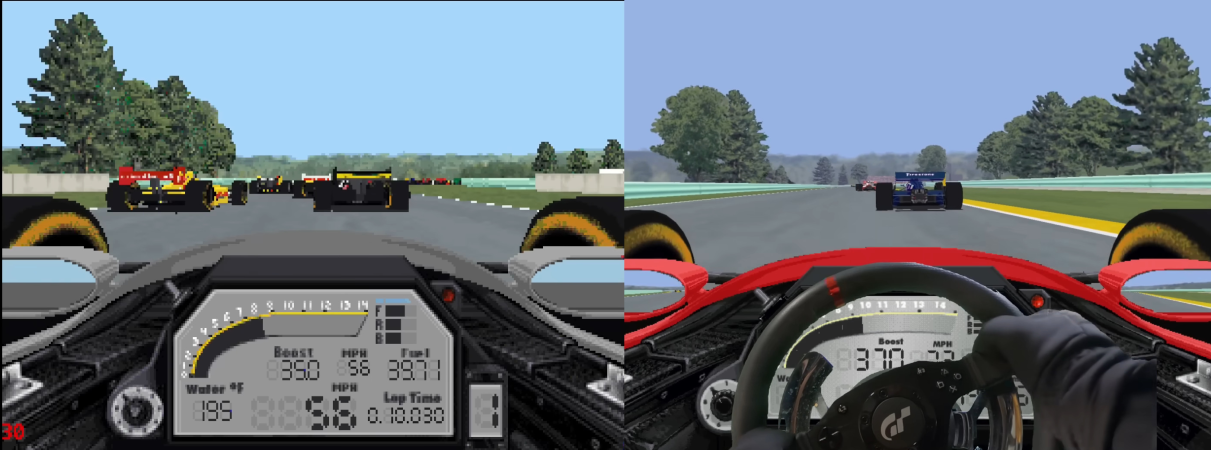
Left: old and busted. Right: New hotness.

Game Of Theseus Gets Graphics Upgrade, Force Feedback 30 Years On

Indycar Racing 2 was a good game, back in 1995; in some ways, it was the Crysis of the Clinton years, in that most mortals could not run it to its full potential when it was new. Still, that potential was surely fairly limited, as we’re talking about a DOS game from 30 years ago. Sure, it was limited– but limits are meant to be broken, and games are made to be modded. [TedMeat] has made a video showing the updates. (Embedded below.)

It turns out there was a 3D-accelerated version sold with the short-lived Rendition graphics cards. That version is what let the community upscale everything to the absurd resolutions our modern monitors are capable of. Goodbye SVGA, hello HD. Specifically, [sharangad] has created a wrapper to translate the Rendition API to modern hardware. It doesn’t sound like higher-res textures have been modded in, in which case this looks spectacular for graphics designed in 1995. It’s not the latest Forza, but for what it is, it impresses.

The second hack [TedMeat] discusses is a mod by [GPLaps] that pulls physics values from game memory to throw to a modern force-feedback wheel, and it shows just how good the physics was in 1995. You really can feel what’s going on– stopping a skid before it starts, for example. That’s normal these days, but for the kids playing with a keyboard in 1995, it would have been totally mind-blowing.

As tipster [Keith Olson] put it: “What can I say? Fans gonna fan!” — and we’re just as grateful for that fact as we are for the tipoff. If you’re in a fandom that’s hacked its way to keep old favourites alive, we’d love to hear about it: submit a tip.

Continue reading “Game Of Theseus Gets Graphics Upgrade, Force Feedback 30 Years On”

RC Car Gets Force Feedback Steering

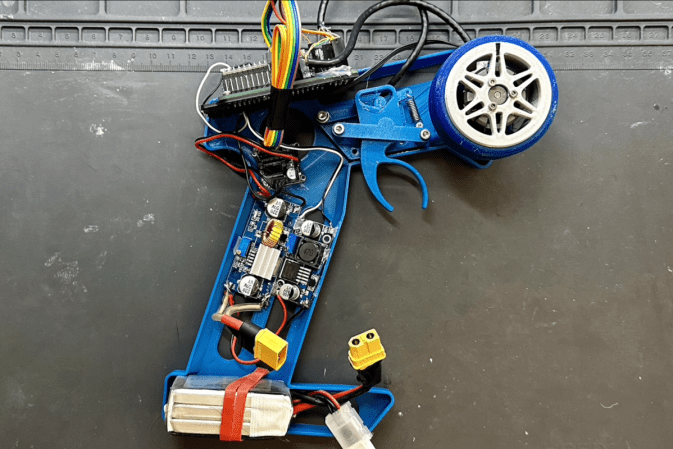
Remote-controlled cars can get incredibly fast and complex (and expensive) the farther into the hobby you get. So much so that a lot of things that are missing from the experience of driving a real car start to make a meaningful impact. [Indeterminate Design] has a few cars like this which are so fast that it becomes difficult to react to their behavior fast enough through sight alone. To help solve this problem and bridge the gap between the experience of driving a real car and an RC one, he’s added force feedback steering to the car’s remote control.

The first thing to tackle is the data throughput required to get a system like this working wirelessly. Relying heavily on the two cores in each of a pair of ESP32s, along with a long-range, high-speed wireless communications protocol called ESP-NOW, enough data from the car can be sent to make this possible but it does rely on precise timing to avoid jitter in the steering wheel. Some filtering is required as well, but with the small size of everything in this build it’s also a challenge not to filter out all of the important high-frequency forces. With the code written, [Indeterminate Design] turned to the 3D printer to build the prototype controller with built-in motors to provide the haptic feedback.

The other half of the project involves sensing the forces in the RC car which will then get sent back to the remote. After experimenting with a mathematical model to avoid having to source expensive parts and finding himself at a deadend with that method, eventually a bi-directional load cell was placed inside the steering mechanism which solved this problem. With all of these pieces working together, [Indeterminate Design] has a working force feedback steering mechanism which allows him to feel bumps, understeer, and other sensations, especially while doing things like drifting or driving through grass, that would be otherwise unavailable to drivers of RC cars. The only thing we could think of to bring this even more into realistic simulation territory would be to add something like a first-person view like high-speed drones often have.

Continue reading “RC Car Gets Force Feedback Steering”

Force Feedback Steering Wheel Made From Power Drill

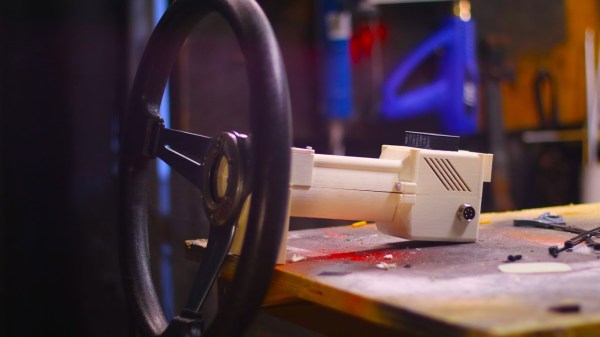
When it comes to controllers for racing games, there is perhaps no better option than a force feedback steering wheel. With a built-in motor to push against the wheel at exactly the right times, they can realistically mimic the behavior of a steering wheel from a real car. The only major downside is cost, with controllers often reaching many hundreds of dollars. [Jason] thought it shouldn’t be that hard to build one from a few spare parts though and went about building this prototype force feedback steering wheel for himself.

Sourcing the motor for the steering wheel wasn’t as straightforward as he thought originally. The first place he looked was an old printer, but the DC motor he scavenged from it didn’t have enough torque to make the controller behave realistically, so he turned to a high-torque motor from a battery-powered impact driver. This also has the benefit of coming along with a planetary gearbox as well, keeping the size down, as well as including its own high-current circuitry. The printer turned out to not be a total loss either, as the encoder from the printer was used to send position data about the steering wheel back to the racing game. Controlling the device is an Arduino, which performs double duty sending controller information from the steering wheel as well as receiving force feedback instructions from the game to drive the motor in the steering wheel. Continue reading “Force Feedback Steering Wheel Made From Power Drill”

DIY Haptic-Enabled VR Gun Hits All The Targets

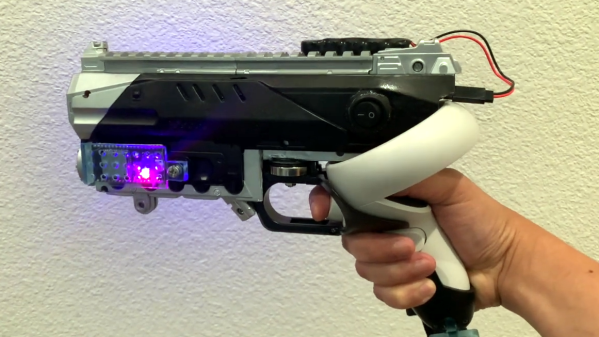
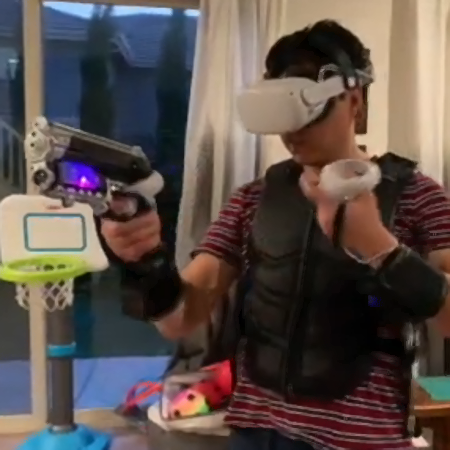
This VR Haptic Gun by [Robert Enriquez] is the result of hacking together different off-the-shelf products and tying it all together with an ESP32 development board. The result? A gun frame that integrates a VR controller (meaning it can be tracked and used in VR) and provides mild force feedback thanks to a motor that moves with each shot.

But that’s not all! Using the WiFi capabilities of the ESP32 board, the gun also responds to signals sent by a piece of software intended to drive commercial haptics hardware. That software hooks into the VR game and sends signals over the network telling the gun what’s happening, and [Robert]’s firmware acts on those signals. In short, every time [Robert] fires the gun in VR, the one in his hand recoils in synchronization with the game events. The effect is mild, but when it comes to tactile feedback, a little can go a long way.

The fact that this kind of experimentation is easily and affordably within the reach of hobbyists is wonderful, and VR certainly has plenty of room for amateurs to break new ground, as we’ve seen with projects like low-cost haptic VR gloves.

[Robert] walks through every phase of his gun’s design, explaining how he made various square pegs fit into round holes, and provides links to parts and resources in the project’s GitHub repository. There’s a video tour embedded below the page break, but if you want to jump straight to a demonstration in Valve’s Half-Life: Alyx, here’s a link to test firing at 10:19 in.

There are a number of improvements waiting to be done, but [Robert] definitely understands the value of getting something working, even if it’s a bit rough. After all, nothing fills out a to-do list or surfaces hidden problems like a prototype. Watch everything in detail in the video tour, embedded below.

Continue reading “DIY Haptic-Enabled VR Gun Hits All The Targets”