
The world of open source — and in particular open source licenses — is something we cover regularly here at Hackaday with respect to hardware and software, but it’s not so often we find open source data stories. Today’s case of the open British address data then is a bit of an outlier, but it may have implications for open source data further than British counties.
UK government data is released under the Open Government Licence, which is why we Brits can peer into all sorts of datasets our taxes paid for. This includes data from local government, so English counties release data sets of local addresses as part of their auditing of council taxes under the licence.

[Owen Boswarva] has been collating these databases in order to produce a national open source address database, but has found himself at the receiving end of a legal threat from the Ordnance Survey, the UK mapping agency. They claim the data is theirs, not open.
British address data is in a sense open to all, in that there’s nothing to stop anyone walking down Acacia Avenue and noting the position of Number 1, Number 2, Number 3, and so on. This is what happened with OpenStreetMap worldwide, as people with GPS devices contributed their data and mapped the UK and everywhere else. The Ordnance Survey used to have a nice little earner charging top dollar for UK geospatial data which has been slashed by the arrival of OpenStreetMap, and we’re guessing that the prospect of losing another income stream to an open source equivalent has them worried.
The question of whether the councils should have released the data is one which will no doubt be settled at some point by the courts, and [Owen] goes into some detail on the subject in his analysis. There’s a good case to be made that the mapping agency are pushing it a little, but whatever the outcome it could set a dangerous precedent for open source data. We’ll keep you posted if there’s more on this story.
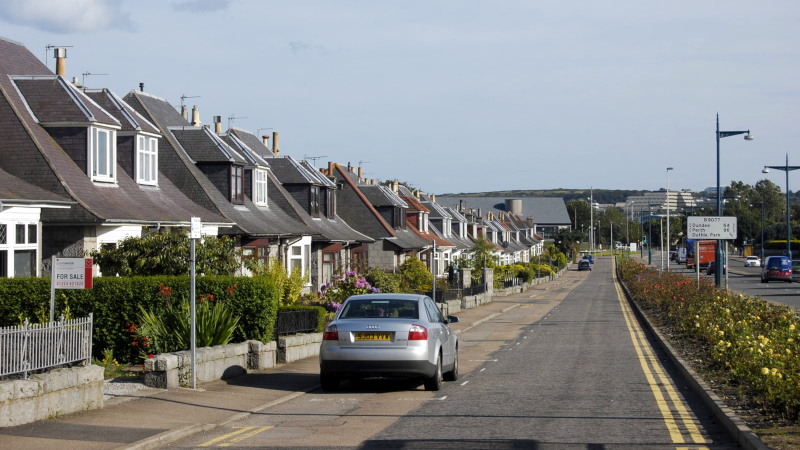
British street: Bill Harrison, CC BY-SA 2.0
Barbra Streisand: Unknown author, Public domain












The photo for this article was taken at Great Southern Road, Aberdeen, AB11 7XY, will that get me in trouble with OS?
Aye, Fit like min?
You will be in trouble!
The postcode is proprietary information and thus must not be displayed, referred to or in any other way disclosed, including but not limited to for the purpose of transmitting information, whether electronically (e.g. a route-planning system or a landmark identification) or in paper form (e.g. added to letters and parcels for the routing to a specific location).
OK, just kidding — but it is concerning that most non-governmental users of the postcode information have to pay twice for it, first via taxes to Ordnance Survey/GeoPlace (+ Royal Mail?) and then for the use of the information
The data comes from Royal Mail and the local councils originally – in some kind of weird undecipherable mash up. Either of these organisations can change house info whenever they want and they dont necessarily talk to each other. Some addresses even have 2 street names. Some houses dont have an address at all eg ’round the back of the toll house’.
Oof. Try getting a ln automated system like google verifications sent to an address that doesn’t have a street name. Sheer pain.
Eventually managed to get something they’d accept and a postie recognised where to deliver, but took at least half a dozen attempts.
BTW …. anybody seen my cat anywhere?
Name your house something unique.
Trademark that name.
Update your address with the council.
Leave to cool for 5 – 10 months….
Have fun sending your own legal threats to Ordnance Survey.
Plenty of trademarked names in addresses, especially company HQs. No case there.
There would only be trademark infringement if OS decided to take the trademarked name of your house, and then use it to do business of some kind, which infringed on the types of business that your trademark covered.
Would might be more interesting legally speaking, would be if you changed the name of your house HYPOTHETICALLY to “I support Palestine Action” and actually had that name accepted by the local council…
IANAL, but I have been involved in some data rights managements. Postcodes are just data that can not be copyrighted. But there’s an often overlooked property right in European Law (which the UK still largely follows) which is database rights – which basically protects the right someone has put into collecting a large set of otherwise uncopyrightable data.
Basically, if I make a website with a large set of data (such as addresses and their associated post code) and I put this open on the internet, implicitly giving the data away for free, you are still not allowed (unless terms say otherwise) to copy and use or redistribute the whole set (or large subsets).
The bar is basically whether collecting the data is your “main occupation”.
This means, you can scrape the data from http://www.albertheijn.nl (a supermarket chain’s site) to scrape their stores, opening hours and telephone numbers for openstreetmap because their main occupation is selling food.
But you can not scrape the same data from the site http://www.openingstijden.com (openinghours.com) because their main occupation is collecting addresses and opening hours for stores.
This jurisprudence arose in a case I was a technical partner in, where a website trying to claim airline delays (for delayed passengers on a no-cure-no-pay basis) scraped the websites of airlines, the airline claimed they had the database rights on these data and a judge said “you are in the the business of flying, showing delays is just a consequence of that business and you have no right to bar parties from collecting that data” (provided it does not excessively use server capacity, which the judge said it did not).
I don’t know who creates the postal code data, but I would say scraping it from the postal office or from the municipalities seems to be allowed, but scraping it from the Ordnance Survey (who went at considerable length to collect this data) would not be allowed.
So it seems what [Owen Boswarva] did is legal, and the Ordnance Survey has to deal with having a competitor.
Royal Mail creates the postcode data. Often some time after a new set of houses is built, which causes issues when you’ve got no postcode, or your postcode isn’t in people’s datasets!
Oh, I know all about that too.
I bought my current appartment dec 1st, 2006, and dec 20 that same year (due to the renovation from rental to bought appartments being completed – even though I was the second buyer) it changed adresses. I had been aware that the house number would change, but all of us only learned that day the post code would change too.
So I had to call up companies that I wanted an address change. “But your move is still in progress, I can’t process a new one” or “Do you want me to send a mechanic – no I’ve not moved – but your address has changed? – Yes! – But you’re not moved? – No!”
Worst was my employer (a bank with severe anti-fraud-systems) where I could not put in my new address in the HR system because it didn’t exist. I tried a few times, called HR who said they couldn’t do anything, then forgot about it. Until more than half a year later I could not pay in the supermarket and found out I had not gotten my wage that month.
I called up HR and they said that because my wage slip had returned as undeliverable – a hint at fraud – they stopped my payment, and … drumroll … they had sent me a letter about that!
The next day, I changed my “home” address to my work address, which according to HR was “Not allowed” so I challenged them to change it to my proper address then, which they couldn’t. My boss intervened and said “So the office address stays”.
Fortunately I could change my address my last day of work – they had not renewed my contract despite their promise they would. But I think I would’ve quit quickly after anyway.
Serious question: is “the mapping agency are pushing it a little” British English? “The Parliament are taking a break”?
“The Royal Family are supercool”? <–here the verb almost sounds right to my ear.
American here, so I may be wrong on the exact details, but my understanding of British English is that if a noun represents a collective group, the verb is plural.
Ex. “Microsoft are releasing the next version of Windows.”
In American English, it would be like saying “The Los Angeles Lakers are in the NBA playoffs.” But other cases we treat as a singular: “Microsoft is releasing the next version of Windows.” I don’t know why the distinction exists in American English where some nouns for collective groups get an “s” added versus not.
In American English it depends on whether you’re referring to the institution as an entity or the people who make up the institution. Also, a lot of Americans just don’t speak English well. How many times I’ve heard people use the subject pronoun instead of the object pronoun when the person in reference is the object of the sentence! (As in, “They gave the money to my friend and I.” This is prescriptively incorrect.)
At this point none of it really matters. We’re mashing up our dialects and even languages to such a degree these days thanks to the internet, we’re all well on our way to losing a large portion of our linguistic culture. Of course we’re replacing it with new linguistic culture, so again, it really doesn’t matter.
Most of it originates with Noah Webster and his crusade to remove all traces of French influence from the English language.
The official version is that he was opposed to all foreign influences, particularly French which was the dominant influence on English at the time.
As is usually the case with history. The real reasons are complicated, messy, and not widely known outside of Academia. In this case a rather smaller circle than usual.
We need a new Webster that’s removing all the traces of American from the English language. And also all the emojis.
Ordance Survey would have charged top GPB not dollar surely?
The problem was privatizing Ordnance Survey in the first place. In order to make that sale attractive to investors it had to include both the map making capability and the data that the maps were formed from. This might have seemed reasonable at the time because government had an effective monopoly on such data but it proved to be a misunderstanding. Mapping data is essentially public property — the embodiment of that data, the maps, might be Crown Copyright but the actual data is owned by all of us. This gets a bit tricky for a privatized OS because a large part of the IP that the investors thought they paid for doesn’t exist.
OS being private is complicated further by their maps being not just monetized public data but a really important part of British history. Its an important record of land use that goes back literally hundreds of years. You just can’t lock national history behind a paywall.
That is just one argument for making the data free. Anyone who has taken the effort to collect and publish any data, such as for example the number of places with intact playground equipment per village for example, will grasp, that the data is not free. I know its a frivolous example, but maintaining the data is from a safety point of view, worth far more than making it free. To convince a court, you tend to need more than one pillar. Although postcode changes throughout history sounds novel and interesting as a case. What do the code changes tell us Martin?
Privatizing your national map service is kinda dumb indeed. But then again, the British never suffered Napoleon’s rule, which introduced a centralized land (and buildings) ownership registry in most European countries.
Fast forward 2 centuries, and the Dutch mapmaking service is part of that ownership registry.
And for us that led to https://www.topotijdreis.nl, 200 years of historic maps of the Netherlands, down to 1:25000.
Addresses are public: https://bagviewer.kadaster.nl/?objectId=0363010000758545 is the royal palace on Dam Square, Amsterdam.
And of course, all this data is incorporated in Open Street map too: https://www.openstreetmap.org/relation/3580875
I wish it was like that in the US too. We shouldn’t have to rely on volunteers or corporations like Google to give users up-to-date and accurate maps.
From the bottom up, we should have all cities providing maps of themselves up to the states who collate it and add information outside of cities, then pass it up to the federal level who combines it all and keeps it up and freely accessible.
Throw in some methods for businesses to post hours or other information and we could almost completely free ourselves from the various corporate mapping sites.
Well, governments (whether its city-, state- federal or whatever level) provide roads, and in order to do so must know where each road is located, what type of road it is and perhaps also its name, as the provider of the road is usually also the authority on its name.
Organize your country in a way that allows for country-level rules that require that information to be made publicly available, and >poof<! OSM has all relevant road information.
Well, that’s how it was implemented in the Netherlands.
So the British may crack down on using open source databases. Why the surprise?
They already have jailed folks just for their private thoughts… no really!
It’s such a bitter irony that we defeated Hitler only to become nazis ourselves.
What’s with the weird a in nazis?
Thanks for your interest in my recent blog post, but there are various errors in your coverage: much UK government data is released under the Open Government Licence, but that is not automatic. Local address datasets are not released proactively by councils, and this has nothing to do with auditing of council tax. Some councils that hold this data (for purposes of billing for Council Tax) are unitary counties but most are not counties.
I have been publishing local Council Tax property lists where they have clearly been disclosed with permission for re-use under the OGL, but I have not been “collating these databases in order to produce a national open source address database.”. I will be surprised if any of this makes it into the courts, though I am of course taking defensive actions.