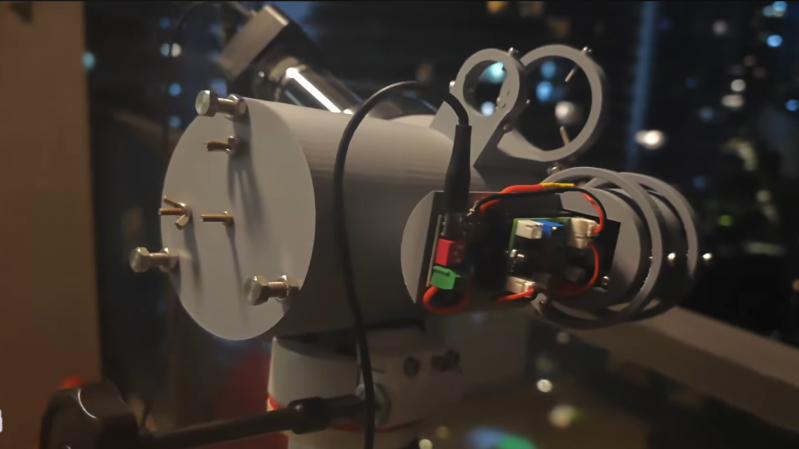
A 3D-printed telescope with an infrared laser on the side is pointed out the window of a building at night.

Long-Range Night Vision With An Infrared Laser

Most consumer-grade night vision devices are basically a standard camera without the usual filter to block near infrared (NIR) light, which are then paired with a NIR light source that’s not visible to the human eye. Unlike the passive night vision provided by an image intensifier tube, these can’t resolve objects beyond the beam of their illumination source. On the other hand, if, as [Project 326] did, you use an infrared laser to illuminate the scene, you can still get a very long range out of these devices.

[Project 326]’s device consists of a previously-built reflecting telescope focusing a distant scene in to a webcam with the infrared filter removed, with the infrared laser illuminating the scene. Finding a suitable laser took some effort: the first option, a secondhand fiber-coupled industrial laser, was accidentally over-volted and destroyed during testing. The second had a fiber output which proved extremely hard to terminate, and a third laser couldn’t be collimated correctly. The final laser was a Vertical-Cavity Surface-Emitting Laser (VSEL) diode array element driven at about two Watts and collimated by a small lens.

This illumination setup is safe at a long range, but only at a long range. The laser was strong enough to burn cardboard at close range, but out at about 500 meters, the beam had spread until it was less than a hundredth of the standard safety limit. To make sure that nothing else would get in the way of the beam, it was shone down from the top of a tall building. Testing with a power meter also showed that at a long range, the beam was weaker than expected. It turned out that the wavelength used (940 nm) is attenuated by water vapor, to the point that up to 70% of the beam’s strength was lost before reaching the target. Despite this, and despite a rather linear beam profile, a somewhat dark image was still visible at 650 meters.

If you’re looking for a somewhat more versatile long-range night vision device, check out one based on an image intensifier. Another approach is to use a very high-sensitivity camera.

Continue reading “Long-Range Night Vision With An Infrared Laser”
DIY electronic eyepiece viewfinder for telescope

Low-Cost, High-Gain: A Smart Electronic Eyepiece For Capturing The Cosmos

We’ve all seen spectacular pictures of space, and it’s easy to assume that’s how it looks to the naked eye through a nice telescope. But in most cases, that’s simply not true. Space is rather dark, so to make out dim objects, you’ll need to amplify the available light. This can be done with a larger telescope, but that’s an expensive route. Alternatively, you can observe objects for longer periods. This second approach is what [Jordan Blanchard] chose, creating a budget electronic eyepiece for his telescope.

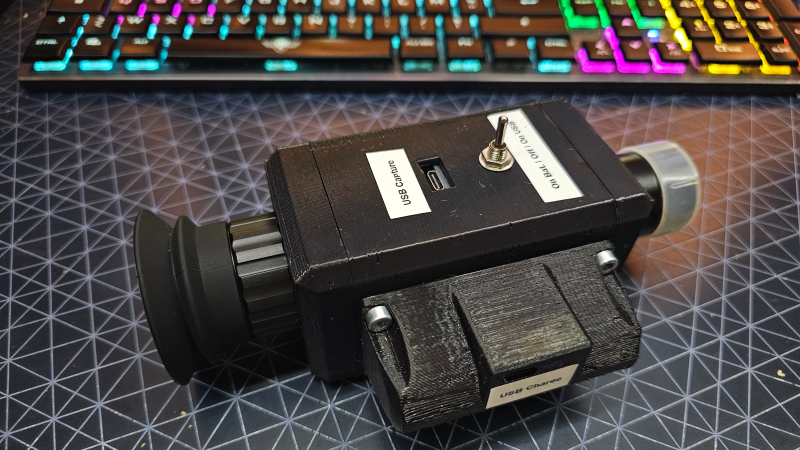
This eyepiece is housed in a 3D printed enclosure designed to fit a standard 1.25″ telescope focuser. The sleek, ergonomic enclosure resembles a night vision device, with a 0.39″ screen for real-time observation of what the camera captures through the telescope. The screen isn’t the only way to view — a USB-C video capture module lets you connect a phone or computer to save images as if you were peering through the viewfinder.

The star of this project is the IMX307 camera module, which supports sense-up mode for 1.2-second exposures and increased gain to capture dim objects without post-processing. This sensor, commonly used in low-light security cameras and dash cams, excels at revealing faint celestial details. All combined, this project cost under 200 Euros, an absolute steal in the often pricey world of astronomy.

Don’t have a telescope? Don’t worry, you can build one of those as well.

Bust Your Own Ghosts With A PKE Meter

You know, we wouldn’t be that surprised if aliens or ghosts show up for real before this year is out. If paranormal becomes part of the new normal, it might be nice to have a PKE meter that can detect spirits and help get a head start on figuring out what they want from us.

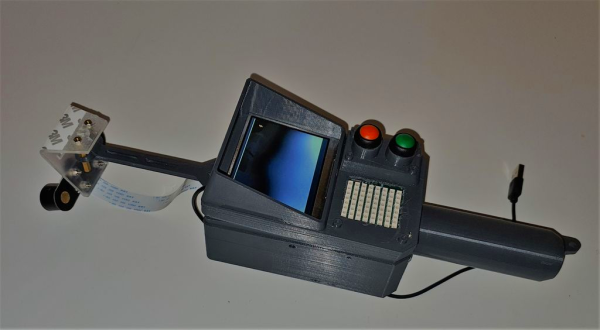
Yes, that’s right — instead of just lighting up whenever ghosts are near, [starscream205]’s meter goes the extra yard and translates spiritual energy into English words that scroll across the LED matrix. Inside is a Raspberry Pi 3B+ and a sense HAT, which takes spatial and environmental readings and assigns different words based on the results.

Now [starscream205] can go fearlessly into the night, guided by the night vision camera on the end, and watch for ghosts on the screen. Instead of a typical Pi-compatible screen, this is from a car back-up camera system and has been modified to work with the Pi.

We’ve seen a few PKE meters around here before, but they usually do things such as detect radiation. It’s nice to see one that’s faithful to the original purpose.