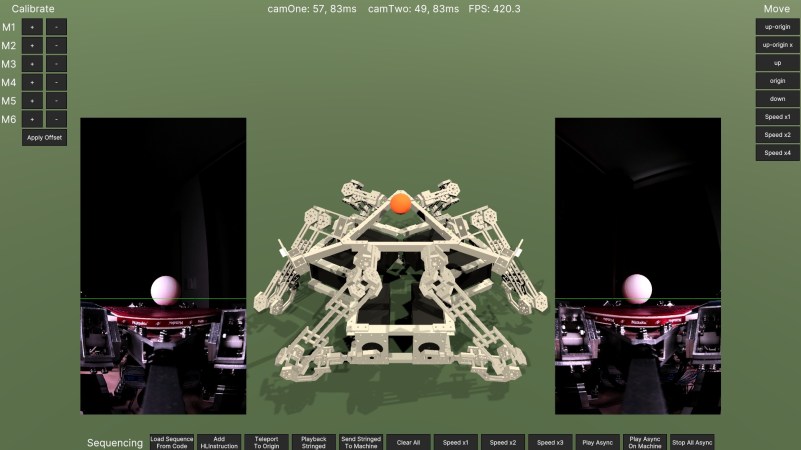
Sometimes, you want to build a simple project– the minimum viable product that solves your problem and nothing else. Other times you might be feeling a little extra, and want to use oodles of machined aluminum, six steppers, two cameras, a Teensy and a PC with a GPU just to bounce a ball. That’s the mood behind [T-Kuhn]’s hexa-bouncer, a Stewart Platform on steroids. You can read all about it on his blog or witness it in action in the video below. Trust us, really have to see it in action.
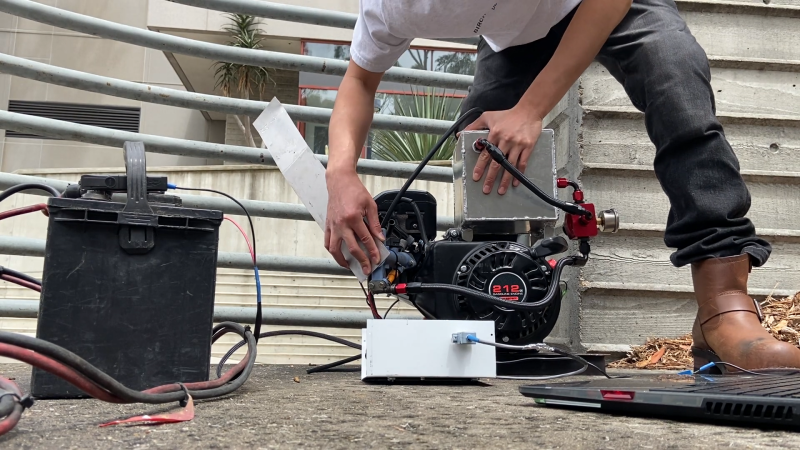
The build began with a Predator 212, a popular gasoline engine from Harbor Freight. [Carlos] set about kitting it out with a missing tooth trigger wheel to measure the crankshaft position with a hall effect sensor. The engine also scored a custom-built aluminium fuel cell, complete with a high-pressure fuel pump and regulator suitable for driving the solitary fuel injector installed in the custom intake manifold. A Teensy 4.0 is charged with monitoring a manifold air pressure (MAP) sensor and the crank position, and choosing when and how long to fire the injector to dose the engine with the correct amount of fuel. Files are on GitHub for those eager to dive deeper.
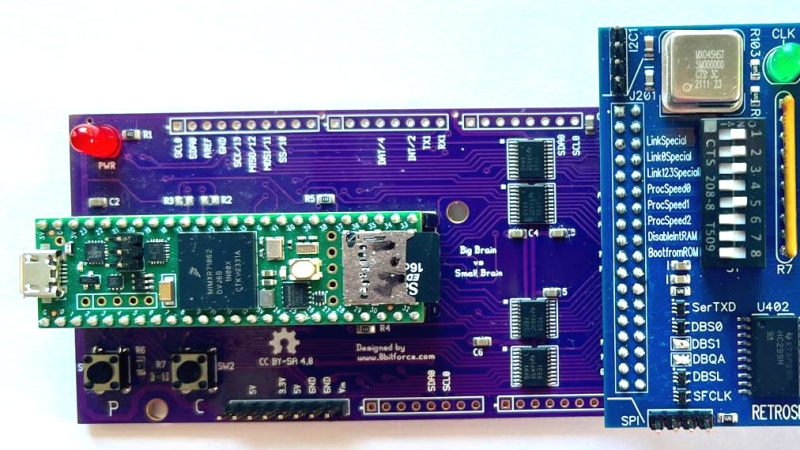
One downside of working with the old Inmos Transputer devices is the rarity and cost of the original silicon. Obviously, you can’t sidestep the acquisition of the processor—unless you emulate—but what about replacing the IMS C011/C012 link chip? You need this (expensive) part to interface the transputer to the programming host, but as [Erturk Kocalar] discovered, it’s perfectly possible to coax a Teensy to do that job for you just as well.
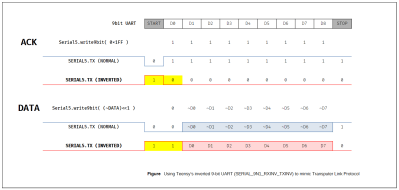
The unusual two-bit start sequence differentiates a data packet from an ACK. It’s simple to emulate if you use the LSB of a 9-bit word as a dummy start bit!
Transputers work by utilizing an array of bit serial interfaces to connect a network of devices, allowing for cooperative computation on tasks too large to fit on a single device. This protocol is, at its link level, a simple asynchronous bit serial affair, with 11-bit data messages, and a raw two-bit frame for the acknowledge. The C011 device at its heart is just a specialized UART—it takes 8-bit parallel data from the host, dealing with handshaking, and pushes it out to the first transputer in the chain at 5, 10 or 20 Mbps, but inverted and with two start bits and a single stop bit. In parallel, it performs the same task in the reverse direction.
[Erturk] realized that the Teensy UART has an inverted mode and, crucially, a 9-bit data mode. This allows the second start bit to be generated as bit 0 of the word, with the remaining eight bits forming the payload. Simple stuff. Additionally, the Teensy UART is capable of the maximum transputer bitrate of 20 Mbps, without breaking a sweat.
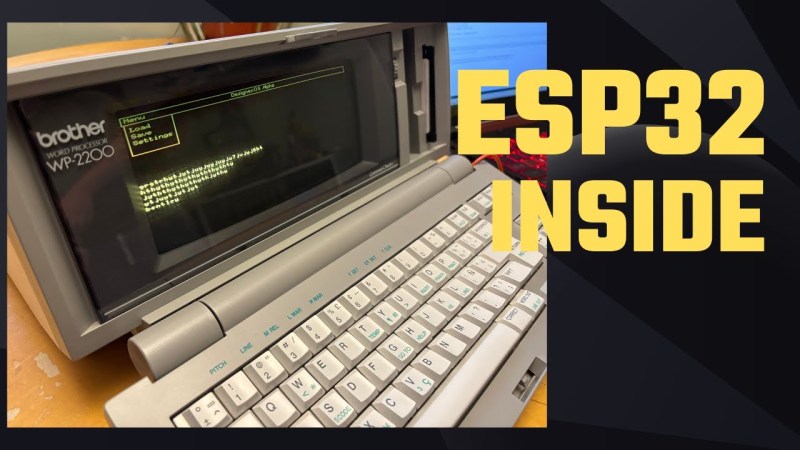
Dedicated word processors are not something we see much of anymore. They were in a weird space: computerized, but not really what you could call a computer, even in those days. More like a fancy typewriter, with a screen and floppy disks. Brother made some very nice ones, and [Chad Boughton] got his hands on one for a modernization project.
The word processor in question, a Brother WP-2200, was chosen primarily because of its beautiful widescreen, yellow-phosphor CRT display. Yes, you read that correctly — yellow phosphor, not amber. Widescreen CRTs are rare enough, but that’s just different. As built, the WP-2200 had a luggable form-factor, with a floppy drive, ̶m̶e̶c̶h̶a̶n̶i̶c̶a̶l̶ clacky keyboard, and dot-matrix printer in the back. Continue reading “O Brother, What Art Thou?”→
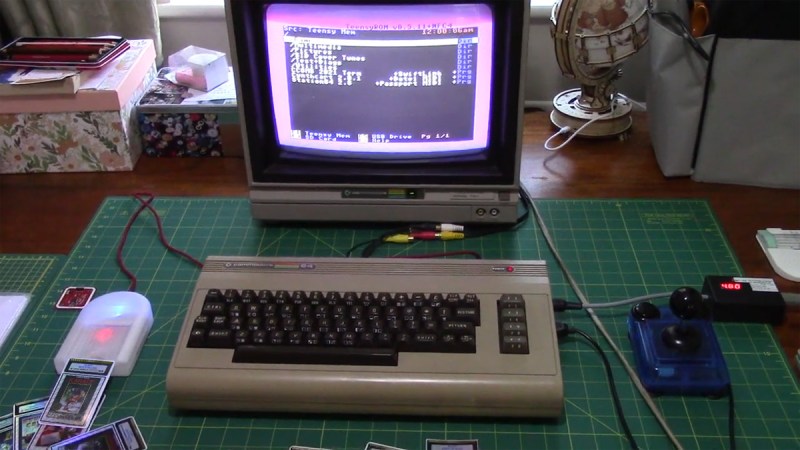
When retro computing nostalgia meets modern wireless wizardry, you get a near-magical tap-to-load experience. It’ll turn your Commodore 64 into a console-like system, complete with physical game cards. Inspired by TapTo for MiSTer, this latest hack brings NFC magic to real hardware using the TeensyROM. It’s been out there for a while, but it might not have caught your attention as of yet. Developed by [Sensorium] and showcased by YouTuber [StatMat], this project is a tactile, techie love letter to the past.
At the heart of it is the TeensyROM cartridge, which – thanks to some clever firmware modding – now supports reading NFC tags. These are writable NTag215 cards storing the path to game files on the Teensy’s SD card. Tap a tag to the NFC reader, and the TeensyROM boots your game. No need to fumble with LOAD “*”,8,1. That’s not only cool, it’s convenient – especially for retro demo setups.
What truly sets this apart is the reintroduction of physical tokens. Each game lives on its own custom-designed card, styled after PC Engine HuCards or printed with holographic vinyl. It’s a tangible, collectible gimmick that echoes the golden days of floppies and cartridges – but with 2020s tech underneath. Watch it here.
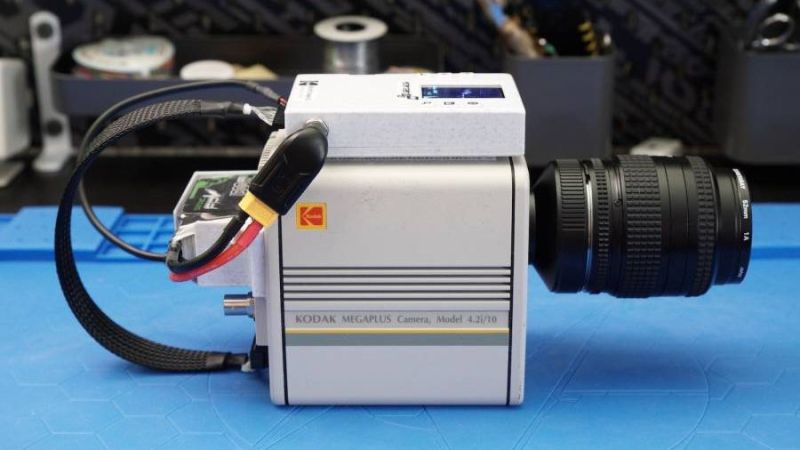
At least that’s what [Frost Sheridan] did with a vintage Kodak MegaPlus 4.2i, a camera that was aimed at the industrial and scientific market at a time when everyone was still using film for snapshots. Making this workhorse ride again meant diving into the manual, luckily still available after all these years, and figuring out what pins on the 68 pin connector would be useful. [Frost] worked out the pins for serial commands plus the 10-bit parallel interface, although he settled for the eight most significant bits to make things simpler. A Teensy with some extra RAM and a serial interface chip takes care of sending commands to the camera and pulling pixels off the parallel interface, and a 128×160 LCD provides a much-needed viewfinder.
With a battery pack mounted the whole thing is reasonably portable, if a bit of a chore to use. It’s worth the effort, though; the picture quality is fantastic, with a wide dynamic range and plenty of contrast. Hats off to [Frost] for bringing this beauty back to life without making any permanent modifications to it.
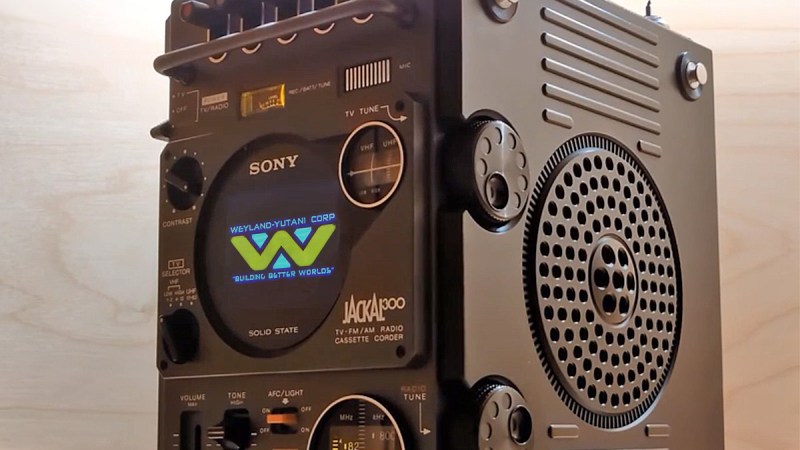
When it comes to hacking niches, breathing new life into vintage devices is always an exciting challenge. [t0mg]’s recent project exemplifies this with his 1978 Sony FX-300 ‘Jackal’ radio. He’d already upgraded the radio in 2021 and turned it into a feature-packed marvel, but there’s always room for improvement.
[t0mg]’s initial 2021 build had its quirks: noisy sound, a subpar display, and a non-functional radio module. Determined to enhance these aspects, he sourced an IPS version of the original 3.2″ ILI9431 LCD, significantly improving viewing angles. To tackle the audio issues, he integrated an M5Stack Atom microcontroller, utilizing its Bluetooth A2DP capabilities to deliver cleaner digital sound via I2S to the Teensy audio board. The Teensy itself got a complete wire overhaul just for the sake of good craftmanship.
The new setup also enabled the display of song metadata. Additionally, [t0mg] incorporated a dedicated Arduino Nano clone to manage inputs, streamlining the overall design. The revamped ‘Jackal’ now boasts a bunch of impressive features such as displaying RDS data for FM stations, voice recording, and an NFC reader for personalized playlists.