
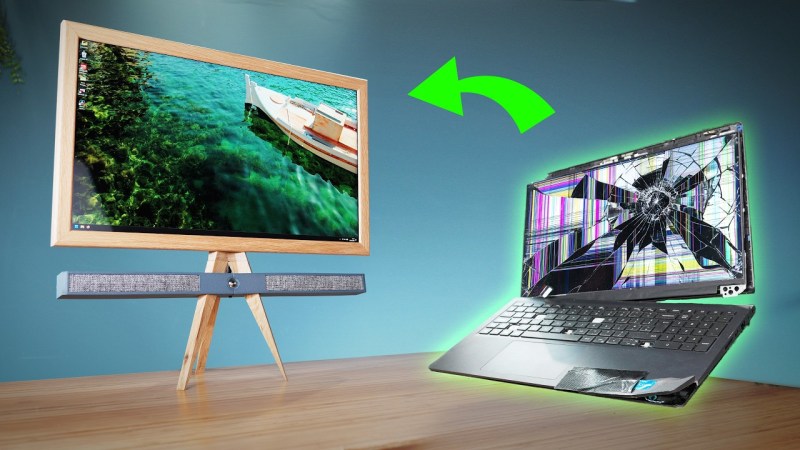
Building a PC used to be a fun adventure — what’s the latest, what’s the greatest, what can I afford? Well, that last question seems to have taken over and sucked all the fun out for a lot of people. [Matt] from [DIY Perks] on YouTube has hit upon a solution that’s brought back the fun, at least for him: recycling! The video is embedded below, and he runs a forum whose thread has more details.
Long story short, though, he’s flagging recycled laptop components as both good value for money and a fun rabbit hole to go down researching parts. The best part, of course, is that you can get a mobo with 32GB of RAM soldered on, and embedded RTX graphics, and a decent processor for about what you’d pay for that RAM on sticks these days. The big hack is getting the dang thing started: he needed to make a single-pin ribbon cable after identifying which pin on the keyboard membrane hit the power button. If you can score a laptop that does not power on from the keyboard, you’ll have an easier time in that regard.
To take recycling further, he shows how to delaminate cracked glass from an old Intel iMac to get a better-than-4K retina screen for nothing but sweat equity. The unit was heading for the bin, and his only cost was the effort it took to extract the LCD panel. Some of us might be able to skip the laptop and just use the iMac; it depends on how much compute is enough for your use case. Maybe a 10-year-old iMac’s guts will do; maybe last year’s gutted laptop isn’t enough.
We have to admit, the oak-and-aluminum all-in-one tripod he makes is very snazzy, though it may have too little brass to be on-brand for [DIY Perks]. The speakers, in case you were wondering, are also e-waste, recovered from an old TV. Perhaps the accent colour should have been green instead of blue!
Thanks to [Keith Olson] for the tip.












Calling it affordable does feel like a stretch, given all the extra materials you have to buy in too (even if you call your time free – which given the fun of the project I would). I’d go for less cripplingly expensive…
Still not a bad concept and the end result looks pretty practical.
It’s a DIY all-in-one computer.
There’s a reason why AIO systems aren’t popular: the laptop based hardware runs into thermal limits and starts to throttle under load, and the embedded GPU isn’t powerful enough for gaming, so it’s just a wheezy old laptop that isn’t portable.
The particular system he used has likely better cooling than the system originally did I’d suggest, and has more than enough power for gaming – got a dedicated (if still mobile version) 4060 GPU that is better performing that the majority of gamers cards judging by steam survey – heck from a quick skim it appears a higher % of gamers are still using 10 series than using this laptop GPU, and its actually currently the most popular GPU in the survey. Along with a very modern capable AMD CPU…
Also the AIO systems these days are getting very popular and really not very ‘laptop based’ any more – the convergence between high end performance laptop and desktop stuff is very much there now. Not to mention all the gaming focused handhelds that are by their very definition AIO and gaming…
Even before Strix Halo and whatever Intel called its new monster APU there has been a huge number of pretty darn capable, efficient, and small form factor capable chips out there. Strix Halo is roughly in the same ballpark as a desktop 4060, in some ways better performing and comes with pretty monster overkill CPU for gaming needs and all in a smaller power budget than just that dedicated GPU (also a whole system generally costs in the same ballpark as just a better GPU would, and less than a new completely discreet but comparable system). And if you get it in desktop format you’ll still have PCIe lanes available for extra GPU if you really want them later.
Available in laptop or desktop form factors – the only thing that might hold you back with strix halo is the cooling in the smallest form factors, but being impressively efficient that isn’t very likely. The laptop fans might be screaming, but cooling 120w in a laptop form factor isn’t a particularly novel or huge challenge – heck I had a Pentium 4 desktop chip laptop of similar TDP a depressingly long time ago, and it was other than being a battery hog and very very heavy for laptop (neither of which mattered to me much at the time) a great machine for the period.
AIO systems represent about 6% of the PC market (desktop+laptop) and are projected to reach about 8% in the 2030’s. I don’t know where you’re getting the idea that they’re “very popular”.
That’s the other thing. There’s only so much you can do with 100-120 Watts total power budget for the entire system, so the CPU+GPU performance is limited even if you fix the cooling system. With an AIO you’re simply paying more for gimped hardware.
In gaming terms its way way more than 6% – Nvidia laptop GPU make up well north of 13% of the steam hardware survey alone with the 4060 laptop at about 4% single handedly… The integrated AMD and Intel options are significant enough no doubt too, especially with the Steamdeck being so very very popular…
Yes power budget is limiting but for that 120watts you are getting a gaming system with performance that often matches/exceeds the 200W GPU + 120W CPU at gaming anyway – tighter integration and the faster interconnect between the different types of compute is a huge boost in performance often in the real world. Even in workstation tasks that tend to be less balanced loads that don’t suit the APU systems as well it often outperforms as that shared pool of fast memory and dynamic allocation makes a huge difference in many tasks far exceeding the compute difference – soon as you have to keep on swapping what is in memory you bottleneck in real world tasks and it doesn’t matter if your GPU compute could go harder, it just doesn’t have the data to work on!
Yes the 5090 cranked to 800W fed by a CPU cranked up so it has a few cores running fast enough to keep it fed reliably and the system draw is well over a kW is going to outperform it by miles, and outperform the more reasonably 500 odd watts 5090 a little, though way into diminishing returns. But at insanely higher power consumption and upfront costs!
Compared to something similarly affordable hardware wise you just are not loosing very much if at all with the AIO these days – that regular 4060 is generally in the same ballpark of performance as Strix Halo but only has a paltry 8GB of memory, and even the 50 series till you get to the insanely expensive 5090 is 16GB – not enough to really make use of the compute available for many things including plenty of games these days. Where even a base model AIO system tends to have 32GB of RAM to share – so as long as you don’t have a super bloated browser instance, and swap/paging turned off while you try to game that is way more available VRAM and that boosts the quality and frame rates you can expect to see above the in theory more potent discrete GPU computing potential.
That’s both laptops and AIOs that use the same laptop GPUs. You can’t differentiate between the two kinds of systems from the Steam hardware survey. With a 13% cap on BOTH, we can say that neither are a popular option among gamers. It’s rather plausible that AIOs would actually amount to much less than 6% of systems in the Steam survey.
The reason is simple: laptop hardware is specially designed and integrated for each machine and you do not get to choose between parts from competing manufacturers, so you’re paying a big premium to have that form factor. To the tune that on average, laptop hardware costs the same money for half the performance of a desktop PC.
Dollar for dollar, you’re getting half the value. People pay the premium for the laptops because they’re portable, but the AIO form factor doesn’t do that, so there’s very little point in it.
In the real world, laptop hardware usually sports narrower data buses and slower clock speeds with less throughput to conserve power instead. After all, the point is to make the battery last for 8-12 hours instead of 12 minutes.
The desktop vs. laptop game begins to even out at the very top end with systems that cost $3-4k and above, but there too the laptop hardware lags 30-40% behind the desktop system performance for the same price, while the laptops themselves become less portable and more “luggable” with batteries on board just for the excuse.
You absolutely do – there are thousands of combinations of hardware out there from the varied vendors. But most everyone picks much the same thing, as its just the best price to performance and power consumption sweet spot!
Its not the same as desktop, and the extreme portability, built in UPS, etc of the laptop does quite obviously add costs but also provides functionality. But the AIO desktops are pretty cheap (most of the time) for what you get compared to the nearest desktop, while being smaller, more energy efficient and much much quieter… Not everyone cares but these days the price differential for relatively comparative performance is pretty darn tiny (baring lots of searching for second hand deals – in which the AIO smaller system tend to hold value better).
That’s not the same thing. Of course the OEM picks the cheapest components, but that’s not the price they offer to you.
The cheap ones don’t even advertise what graphics card they have, because they don’t really have one (CPU/IGP), yet they still cost more than a thousand dollars. For the same money you could build a much better system.
For example, I’m looking at a HP 27″ AIO on on sale for €999.99 and it’s got a friggin AMD Radeon 610M for graphics. That’s 7.5% of the performance of a GeForce RTX 4060. It’s just enough to watch Youtube without lagging. The only game you’ll realistically play on this thing is Mahjong.
On another point, for the regular desktop system, you don’t have to keep throwing away a perfectly good monitor and buying yet another one every time you upgrade, so you basically save €300 that you can put on an actual mid-range GPU that beats the pants off of the shared memory IGPs.
I’d personally not consider being built into the monitor shell essential to be called an AIO – for that term every time I’ve seen it used just being the all in one compute device you connect you HID to, that is usually small enough to have a VESA mount.
Meanwhile, mini-PCs (with no dedicated GOU) get more and more popular.
Thermal-throttle, what is it, the 2000s? Your phone has more computing power than you need.
Thanks for clickbait warning in the YT thumbnail. I’m delighted not to watch the whole video (or even read the HaD summary) 😛
Saw the thumbnail and thought “That must DIY Perks”, and sure enough, the blurb verified in the first paragraph. Good.
Still waiting for that killfile option HaD, right after the edit button. Maybe I should write that browser plugin after all. Or maybe tweak some adblocker rules.
I watched a few of his videos awhile back and I don’t fully remember but the feeling that I get thinking back is that his channel is basically a “life hacks” channel for people with a few extra IQ points.
Not anything useful but something that might trick a few people into thinking it is.
That feels a bit unfair in the phrasing to me – I’d phrase it more as his channel is something inspiring that might just give you the idea for your next fun project, presented in a way that lets the uninitiated hacker feel they have a chance, and unlike most of us he finishes every project he documents at least with style. You may not like the design language he does, but its always well finished rather than bodge wires hanging out, wood screw jammed in haphazardly to limit motion, and woodwork/3d prints you haven’t bothered to finish at all..
Don’t watch much of his stuff, but there have been some fun ideas like the bellows and lake cooled PC’s or the using mirrors on the ceiling to send high quality audio to your speakers Spdif style but without the wires. Not the most practical perhaps, but fun idea that might well find a niche with all the house renters out there that can’t make changes to the building to run wires neatly.
The projects are mostly impractical and made for looks and clicks only, or have design flaws and errors that make them not worth replicating, and the design language is “green-screen-modern”, which is stuff made to look nice in a white box environment, lifted out of context in a highly polished and edited video where you don’t notice how wobbly and wonky the real thing actually is, and how out of place and janky it would look in a real environment.
It’s “inspiring” in the sense that it’s selling the illusion of quality to people who watch these sort of DIY videos instead of actually trying to make their own. If they did, they’d be quickly disappointed by the results.
Correct. Couldn’t have said it more acerbically myself.
Also, I almost forgot about the forums:
No they don’t – the search works just fine. Your adblocker may just break the affiliate links he’s peddling to get kickbacks from eBay. That’s the real deal with most of these “maker” videos: they’re a form of guerilla marketing.
https://en.wikipedia.org/wiki/Guerrilla_marketing#Stealth_marketing
Personally, he seems a bit full of himself (his way of talking). And practically, he tends to vastly overengineer (gearbox to turn multiple potentiometers) and often does identical thing different just because. But he has some nice brass soldering tidbits here and there.
How does the power consumption compare to that of a similar product designed specifically by a brand that specializes in the same field?
If it results in a higher electricity bill, there isn’t much point in it.
Probably the same amount of power as an old laptop plugged into an external monitor, because that’s what it is
Its a recycled laptop, at its heart the power consumption is going to be very much laptop like, and the vendors of those systems tend to care way way way more about power efficiency than a desktop AIO/Edge computing platform as laptops have to care about battery life.
So it might have slightly less performance potential, though quite possibly not as these days the same silicon is in that sort of desktop and laptop form factors fairly often, but it will almost certainly be more power efficient. Certainly won’t be enough in it to make a real difference either way though for this use case – the desktop probably comes with an always powered USB chip, perhaps a PCIe redriver, and a default power/cooling profile that is more power hungry. Combined that will be eating those few watts extra, but also makes the system more expandable with better I/O options – the laptop you might well need a powered dock/USB hub that ends up wasting just as much power…
Yeah, USB-hubs tend to get hot even if nothing is plugged in and USB-power-saving is enabled. I mean, USB relies on polling (which is stupid) but why can’t they just switch to pin detection mode if nothing is plugged in?
And yeah, display eats way more power than the computer.
Here is the one i am looking at now…. 7th gen i5… HP laptop.
Works great, Got it for almost free.
Plastic case, total basket case… every screw is knocked loose, Cracked parts galore…
Took a fall down some stair as i heard.
I am going to transform this touch screen into a Maple and Oak Tough Book replica.
Every part i replace is going to be wood.
Are you going to keep it in a laptop clamshell form, or turn it into a tablet?
One issue that could come up is whether the LCD cable will be long enough, since you’re replacing the thin plastic body with thicker wood pieces.
Like, thermally conductive wood?
Who said it has no cooling holes/slits?
I remember an article in an old magazine, MacUser or MacWorld talking about turning an old Powerbook into digital picture frame with serial port access for uploading pictures.
I don’t know… I mean, what is wrong with the people at those magazines?
Isn’t that pretty disrespectful? 😟
How is that any different from using old vinyl records as Frisbees
or turning an old SCSI CD-ROM drive into a fancy coffee cup holder?
Where is the respect for old hardware? After all, that’s not how people treat vintage cars. Those petrol stinkers.
I actually get extra enjoyment out of desecrating rare old hardware. The sacrilege… it excites me… I crammed a Raspberry Pi and an LCD screen into an old Apple Lisa the other day, just to see if I can still feel anything
Hm. I remember reading stories about how tube radios had been smashed for fun
at ham faires in the US when solid-state radios were new and when transistors were hyped.
These things remind me of that.
I wonder how many other precious things had some monster truck rolling over. Just for fun.
45 or so years ago when I was doing consumer electronics repair, I had several customers bring in antique tube based radios and try to talk me into gutting them and converting them to solid-state. I talked all of them out of it, as the desecration would have been horrible. Several of them paid to have me restore the original chassis. It wasn’t cheap, but the results were so much better than swapping in modern guts. If they took good care of them (and done a second recapping of the electrolytics) they are worth more now than the were then, instead of the garbage they’d be if they had been converted.
You cannot offend an object. You can only offend people who are suffering from the illusion that something being rare or old makes it valuable.
Venerating old vinyls is like selling glass beads to Indians, except you’re doing it to yourself.
But everything and everyone it stands for.
An old tube radio or an old PC, Amiga etc. is a product of human ingenuity.
The microchip is a technological miracle.
If we treat it like garbage then it’s like peeing on the tomb stones of their creators.
Even if we recycle it or simply have to discard it, we should do it with a minimum of respect, at least.
With grace, basically. Not simply ripping out the microchip with force or by the use a hammer, but carefully removing it. With a cutter or a soldering iron.
If that doesn’t work, other methods are still an option, including force. But they shouldn’t be first choice.
In order to act in a humane way, in order to be civil and be respectful to the accomplishments of their creators and humanity, as such.
I know, that’s heavy. But I hope that the idea is still conceptually tangible.
“Illusion”.. Please do yourself a favor and go study some philosophy.
Or go travel to other countries and study other cultures if there’s a chance.
It may help you to evolve from plain consumption and money thinking.
Hm. I see. I’ll try to explain it to you how someone would explain it to a child.
The point is that our behavior and mindset shapes our character.
People who are materialistic, who only see usefulness in things,
who think the whole is just the sum of its parts,
who throw away things instead of trying to fix it, will apply this behavior to living beings, too.
They ask themselves “is it worth?” to care about someone,
about trying to heal a relationship, about paying for medical treatment for a family member or a pet.
This happens subconsciously, the process is insidious.
Their rating system for everything is not based on an emotional bond and empathy anymore but pure calculation.
They become bad people, in short. Superficial, self-centered people. Like so many nowadays.
I recommend watching the children film “The Brave Little Toaster”.
It humanizes inanimate objects very well. :)
PS: Sorry for my poor English. I need more practice.
Why should they be offended? If I’m offending someone by throwing away a paper cup, please hang me right now!
Materialists respect material, for what it is in itself. People who are idealists don’t truly care about the object, they just project mental constructs and hold the material as symbols. The object is actually irrelevant to the point – it would be properly called a “fetish”.
That’s why it’s “selling glass beads to indians”. The American natives didn’t realize that glass beads from the Europeans weren’t rare or hard to come by. They were cheap mass produced trinkets from Italy, and their use as money collapsed once they figured out that the supply was essentially endless.
At one moment, the glass bead is the most valuable object in the world – the next moment it’s trash – yet the glass bead remains the same glass bead. There’s no intrinsic value in it – it’s just what you want to tell yourself and other people about it.
It is an observation that people hold rare items valuable due to supply and demand – it does not justify the notion, philosophically or otherwise. It’s just a common bias or flaw in thinking in cases where rarity is the only remarkable thing about the object, hence why I call it “illusion”.
For the true materialist, the ends of the means isn’t the material itself – that would be a circular argument. The end of the means is the people, because that’s what defines the value of the material – what use is it to me, to us?
The materialist keeps count of their resources and recognizes that throwing them away to lost causes ends up hurting people just the same. The idealist keeps going for the lost causes and justifies the harm as a sacrifice for attaining the ideal, no matter how ill conceived or impossible it would be.
The idea that by hanging on to a particular object and acting “reverently” towards it, you would have some positive effect on the world, is like holding a voodoo doll and sticking needles into it.
Peeing on someone’s grave will simply make the flowers grow better. The symbolism of the act depends on who’s there to witness it and how they choose to interpret it. Believing that the act itself can cause something to happen is just magical thinking.
They wan to make money. Upcycling old computers makes them less money. There’s no respect here.
Oh but it does make them money: through people clicking on affiliated eBay links to buy the parts to “recycle” these machines at some serious markup.
It’s kinda like how someone figured that you can make cool recycled jewelry out of beer can tabs, so other people started selling beer can tabs in arts and crafts stores, fresh out of the factory. They even come anodized in different colors now.
You say that but plenty of classic cars get the Hayabusa or similar high performance racing bike engine treatment, or electrification now. And that is still preserving much of a relic that would otherwise be scrap, and giving it one more story of repair and reuse visible if you know what to look for.
Nothing wrong with reusing something the way you want to really, especially if at the time it is so so so common there is very little need to preserve it (also old records might well sound so bad as to be basically unplayable – they don’t last forever). If you are taking nearly the last surviving something that could be restored and irreversibly mangling it I can see why folks would get upset, but most of the time it is old common junk or wrecks that are not really saveable in the first place.
A vinyl record lasts maybe 60 plays. Less if your turntable is not adjusted correctly or you’re using the wrong needles. To preserve an old record, you should never play it, but then there’s the paradox that if you can’t play it, what’s the point of it?
You shouldn’t use it, and eventually it’s going to degrade to the point that you can’t use it, so it’s just an inert piece of old plastic whose only value is bragging rights and/or finding a bigger fool to sell it off for more money than you paid yourself.
It’s a greater insult for an object to be treated as a relic, because that is desecrating it by mental masturbation and profit seeking. It’s no less absurd to put an old vinyl record on a pedestal than a piece of someone’s used toilet paper. Sweat of Elvis in a bottle.
That was the style!
And als, undue respect to objects is the antithesis to hacking it.
You can tell the character of someone by observing how he treats things he considers worthless.
It makes no sense to discuss this, just take it as really quick indicator who is worth hanging out with. A friend who is only a friend when you are not useless to him is no friend, and you will be treated very similar as observed in times when you are considered useless.
I’ve been running an old HP ProBook 6440b with a broken screen as my daily driver desktop computer for the past 15 years. Upgraded just about everything (CPU to an i7, maxed out memory, SSD, etc.) with no problems.
I’m using a Dell Latituude 7480 as my travel laptop. Linux Mint makes it quite zippy. SSD and maxed out RAM.
Couple of older Latitudes are used as lab computers at home, currently FreePBX.
Don’t think I have ever bought a new computer.
makes me sad about my dead laptop pile. i have 5 laptops with screens and motherboards that are good enough to be my daily driver (every laptop i’ve bought since i discovered sub $300 laptops in 2013). but it’s still a pain in the butt to mix and match components. like i have a motherboard that eats batteries, and switching to a different battery controller is impossible for me. i have another motherboard where the wifi went bad, and it’s so old that it’s a pain to build a kernel for it. and only one of the 5 of them comes paired with a decent keyboard, wouldn’t it be great if we could mix and match keyboards on laptops?
so much incredible power and no way to use it to meet the needs i actually have and basically just because small connectors and laptop cases are hard to work with.
all of them together cost less than one framework laptop though
I’m saddened that I can barely work on laptops (and other things) with tiny fiddly scews and other tiny parts. It would have been trivial for younger me, in fact, in the ’90s I repaired quite a few laptops, but in my mid 60s, with an essential tremor, it’s almost impossible. It’s very frustrating.
Perhaps, but they probably never performed as well in the first place and that budget differential won’t last – the framework is likely to last from what I’ve seen of the construction quality longer without needing new parts than all of those cheapo ones combined, and when you do finally upgrade or need repair its going to be around the same price as the not quite e-waste when you buy it, but it will be soon quality of machine to make it good as a brand new machine…
TCO really should end up categorically in Frameworks favour in the end, assuming the company really will survive long enough term for parts to be available for the framework you buy, which seems like a fairly reasonable bet at this stage of their life. But with the AI bubble crap trying to drive all the normal people out from being able to afford a new computer who can tell – I’d still back them to survive over many others though, as offering quality and repairability in an age of scarcity will keep those that can afford the upfront cost interested.
a framework laptop is not going to last 15 years! the framework company has barely been around for 5! i think your TCO estimate is wildly inaccurate. the argument “makes sense” but it doesn’t take into account reality. for example, a motherboard failure on the framework laptop costs as much as 2 or 3 cheapo laptops.
but my practical problem is bigger than that. first, it’s not a very high quality laptop by my metric. the number one thing i shop for is fanlessness, followed by battery life. i don’t see any fanless entries in the framework line up, and the battery life is only so/so except in the ‘pro’ model. the other thing is, the keyboard…you’re stuck with the framework keyboard, which might be good or might not be but you can’t change it, you’re stuck with it, because your TCO formula has insisted on keeping the same laptop for 15 years. and as an aside, they only come with premium high-res displays, which i don’t want and only decreases battery life sigh.
my difficulty is really intrinsic to laptops and unfortunately can’t be resolved by throwing more money at it. even apple makes expensive laptops with garbage keyboards, for example. very hard to get a good solution.
I’d be willing to bet it does last at least close to 15 years, considering the construction quality looks rather better than most of my laptops and all of them are over 15 years old (though my most used one is a toughbook, so not the fairest comparison). But all have been good enough thanks to Linux for what I needed on the move, and right at the point I wanted more computing horsepower in a portable box again Steamdeck came along at a price you just can’t beat.
Also whole new motherboard for the framework is actually cheaper than your cheapo laptop at least here – looking right now a motherboard replacement is anywhere from £150 to £500 cheaper than the cheapest similar cheapo machine I can find… Not looked at every option, as they do many now across many generations of CPU for each chassis option. But remotely comparable just buying the Framework motherboard is pretty darn cheap assuming you have everything else you need to wrap around it already.
A better for almost everyone’s needs high res screen shouldn’t cost you meaningfully in battery life if you drive it like the VGA screen you apparently want – most of the cost is in computing the frame not the display changing pixels, so as long as you are happy with rendering at some nice round pixel count number to the display for the best clarity at that potato resolution, or have eyesight bad enough you can’t tell the scaling is somewhat problematic…
Fanless I can understand, It is something I appreciate too at least till the darn things case gets hot enough to burn you which my old toughbook will if you work it hard in anything but the most Arctic of rooms. But unless you really really really need fanless that is hugely limiting, both in likely computing performance (as these days legally its got to thermal throttle to buggery to keep the case temp down) and choice available. Really sounds like you should look at Toughbooks latest lineup to me though (not that I have) but they do traditionally have fanless designs built to last, with great battery life and usually hotswappable paired battery so you could if it really matters to you have functionally infinite battery life. Certainly not cheap though, but TCO might well end up in your favour still, certainly going to end up with less e-waste as the darn things just don’t die (at least all the old ones I’ve got, some of which have been really quite abused, maybe they have dropped in quality recently I wouldn’t know).
Though arguing being stuck with a keyboard is a problem seems bonkers you are always stuck with your laptop keyboard, and if its a cheapo laptop it is likely crap, as built down to the tiny budget means every corner cut possible, so shortly followed by broken/unpredictable on top of feeling crap… If that really really matters to you and you won’t/can’t use an external keyboard you are going to have to actually test in person before buying any laptop as you’ll always be stuck with it for years…
yeah i don’t need compute performance. i said that. the cheapest laptop i could buy in 2013 still has more compute than i want on my lap.
Have you considered the shudder Apple Neo? It might well be best machine for your needs unless Windoze is essential to that no compute performance required tasking.
I see spare screens as perfect for museum displays and media centers.
One shows images of only UFOs, starship combat on loops. The guts on the opposite side of a wall where you can plug in smartphones for control.