
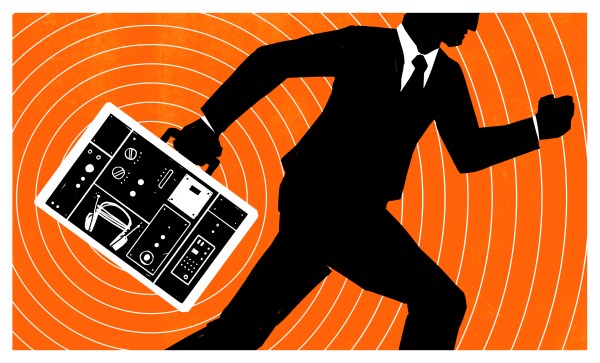
Normally, when you think of a radio transmitter, you want the strongest signal and range. But if your radio operator is secretly operating as a spy, broadcasting their position isn’t a feature; it is a liability. This fact didn’t escape World War II radio designers.
In late 1942, the British realized they needed a way for Special Operation Executive agents, resistance members, and other friendly forces to communicate with an aircraft without attracting undue attention. Two engineers from the Royal Corps of Signals developed a pair of transceivers — the S-Phone — operating around 380 MHz just for this purpose. Frequencies this high were unusual at the time, which further deterred enemy detection.
The output power was below 200 mW, and the ground equipment consisted of a dipole strapped to the operator. No transistors, so with rechargable batteries, the rig weighed about fifteen pounds and reused some parts of a paratrooper radio, Wireless Set Number 37. The other side of the connection was installed in an airplane.









