Testing LFP Battery Failure Modes With Overcharging

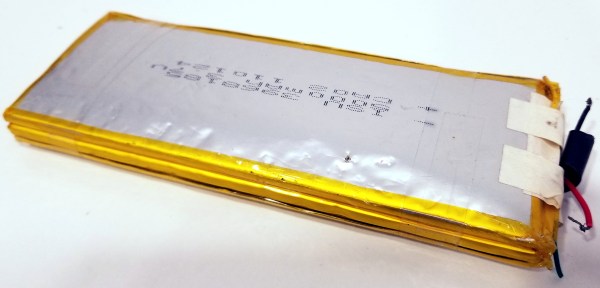
As great as batteries are, it’s essential to understand their risks and how to keep them from going spicy. Recently there has been a bit of a fuss about the dangers of LiFePO4 (LFP) batteries after someone’s dedicated LFP battery shed got shredded into matchsticks by a hydrogen explosion, following said LFP batteries having a thermal event. The thing about the LFP chemistry is that if it suffers such a thermal event, it generates hydrogen gas, which is one of the most explosion-happy gases known to man. This is demonstrated in a recent video by [Will Prowse].
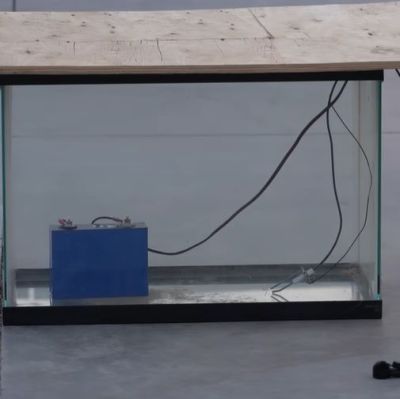
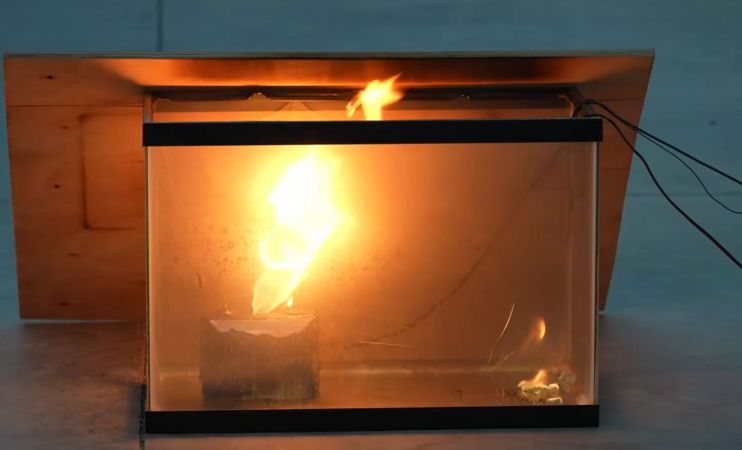
To kick things off, a single prismatic LFP cell is overcharged for half an hour after it was already at 100% state of charge. This ultimately pops the vent as the cell begins to release hydrogen gas into the aquarium that the cell was placed in. Using a spark generator it’s then attempted to ignite the gas, which initially takes a bit as enough hydrogen has to collect first.

Once there’s ignition, however, it happily keeps burning as more and more hydrogen pours out of the by now bulging cell’s vent. If any other LFP cells had been nearby these too would be at risk of suffering thermal runaway, showing how just one bad LFP cell is enough to potentially set an LFP battery bank ablaze.

In a commercial setting you will have precautions such as hydrogen sensors, ventilation and spark generators to deal with any generated hydrogen gas, as well as blow-out panels in case things end up going squirrely in a hurry.

While a benefit of LFP chemistry is that it does not generate its own oxygen as with other lithium-ion chemistries, hydrogen gas is a major problem due to how incredibly volatile it is. It’s not just a headache with battery storage, but also in the nuclear power sector, where zirconium fuel rod cladding can very efficiently turn steam into hydrogen and oxygen. This was the reason why some of Fukushima Daiichi’s buildings suffered detonations, with the nuclear plant operator opting to not install recommended hydrogen gas mitigation systems.

Continue reading “Testing LFP Battery Failure Modes With Overcharging”
The Deadliest Project On The Internet?

Before deciding whether the headline of this article is clickbait, please take a moment to watch the excellent video by [BigClive] below the break. And then, go to your local search engine and search the phrase “fractal burning death”. We’ll wait.

With that out of the way, we have to admit that when we saw the subject “The most deadly project on the Internet” on [bigclivedotcom]’s YouTube channel, we were a bit skeptical. It’s a big claim. But then we watched the video and did some googling. Sadly, there are over 30 documented cases of this project killing people, and more cases of permanent grievous injury.

The results of Fractal Wood Burning with High Voltage

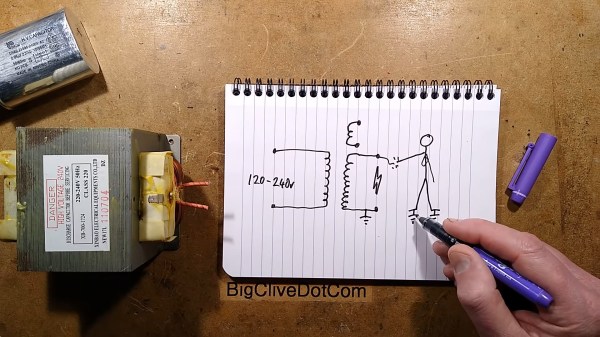
Fractal Burning is a hobby where wood is burned by slathering wood in a conductive slurry and then applying high voltage to either side of the wood, usually using something not rated for high voltage, such as jumper cables. The High Voltage is supplied by an unmodified Microwave Oven Transformer. Other projects using MOT’s typically rip out the high voltage secondary windings and re-wind them as low voltage, high amperage transformers, and are using in Spot Welders and even arc welders.

As laid out by [BigClive], the voltages coming from an unmodified MOT, ranging from 2-3 KV (That’s between two and three thousand Volts) at a very low impedance are right up there in the “Don’t go near it!” territory.

Continue reading “The Deadliest Project On The Internet?”

pierced puffed exposed leads lithium ion battery

Lessons In Li-Ion Safety

If you came here from an internet search because your battery just blew up and you don’t know how to put out the fire, then use a regular fire extinguisher if it’s plugged in to an outlet, or a fire extinguisher or water if it is not plugged in. Get out if there is a lot of smoke. For everyone else, keep reading.

I recently developed a product that used three 18650 cells. This battery pack had its own overvoltage, undervoltage, and overcurrent protection circuitry. On top of that my design incorporated a PTC fuse, and on top of that I had a current sensing circuit monitored by the microcontroller that controlled the board. When it comes to Li-Ion batteries, you don’t want to mess around. They pack a lot of energy, and if something goes wrong, they can experience thermal runaway, which is another word for blowing up and spreading fire and toxic gasses all over. So how do you take care of them, and what do you do when things go poorly?

Continue reading “Lessons In Li-Ion Safety”

Fail Of The Week: Solid State Relay Fails Spectacularly

A lot of times these days, it seems like we hackers are a little like kids in a candy store. With so many cool devices available for pennies at the click of a mouse, it’s temptingly easy to order first and ask questions about quality later. Most of the time that works out just fine, with the main risk of sourcing a dodgy component being a ruined afternoon of hacking when a part fails.

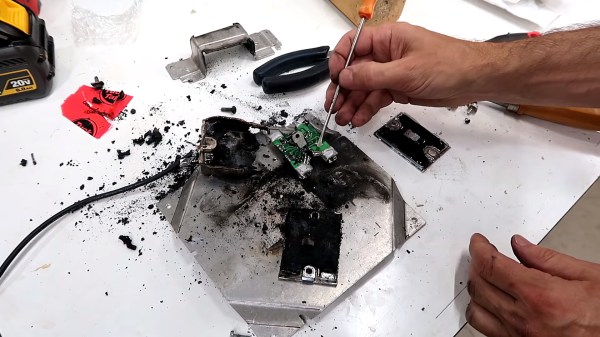
The stakes are much higher when you’re connecting your project to the house mains, though, as [Mattias Wandel] recently learned when the solid-state relay controlling his water heater failed, with nearly tragic results. With aplomb that defies the fact that he just discovered that he nearly burned his house down, [Mattias] tours the scene of the crime and delivers a postmortem of the victim, a Fotek SSR-25DA. It appears that he mounted it well and gave it a decent heatsink, but the thing immolated itself just the same. The only remnant of the relay’s PCB left intact was the triac mounted to the rear plate. [Mattias] suspects the PCB traces heated up when he returned from vacation and the water heater it was controlling came on; with a tank full of cold water, both elements were needed and enough current was drawn to melt the solder build-up on the high-voltage traces. With the solder gone, the traces cooked off, and the rest is history. It’s a scary scenario that’s worth looking at if you’ve got any SSRs controlling loads anywhere near their rated limit.

The morals of the story: buy quality components and test them if possible; when in doubt, derate; and make sure a flaming component can’t light anything else on fire. And you’ll want to review the basics of fire protection while you’re at it.

Continue reading “Fail Of The Week: Solid State Relay Fails Spectacularly”

The Essential List Of 3D Printer Accessories

You’ve acquired your first 3D printer and are giddy with excitement. But like all new additive manufacturing adventurers, the more you do with your printer the more questions arise. Don’t worry, we’ve got your back.

Getting the most out of your time with a new 3D printer has a lot to do with the tools and accessories on hand and what you do with them. Let’s take a look at a few of the accessories that should accompany every 3D printer, be it in your home, school, or hackerspace. There’s already enough potential aggravation when it comes to 3D printing, the goal here is to ensure you won’t be without a tool or supply when you need it the most.

Continue reading “The Essential List Of 3D Printer Accessories”

Hazardous Dollhouse Teaches Fire Safety

Fire safety is drilled into us from a young age. And for good reason, too, because fire hazards are everywhere in the average home. Even a small fire can turn devastatingly dangerous in a matter of minutes. But how do you get kids to really pay attention to scary (and often boring) adult concepts? You can teach a kid to stop, drop, and roll until you’re blue in the face and still might not drive home the importance of fire prevention. Subjects like this call for child-sized visual aids that ignite imaginations.

That’s exactly what firefighters in Poznań, Poland did in collaboration with mlabs, a local software company. They built a mobile, interactive fire safety education tool that simulates common household fire hazards in great detail (translated). This is easily the most tricked-out dollhouse we’ve ever seen. The many different hazard scenarios are controlled via touchscreen using a custom-built application. At the tap of a button, the house becomes a total death trap. The lamp-lit hazards glow realistically and with varied intensity, and there is actual smoke coming out of them that triggers smoke detectors. Cameras embedded throughout the house provide a first-person view of the terror on a nearby monitor.

Almost no room is safe for the figurine family that lives inside this intricately detailed 1:12 scale dwelling. Dad’s in the kitchen standing idly by while food scorches on the stove. Grandma’s sitting on her bed upstairs, her forgotten cigarette burning a hole in the duvet. Daughter is overloading the electrical outlets in her bedroom with all her gizmos. Smoldering coals have spilled out from the toppled stove in the utility room.

This isn’t the first smart dollhouse we’ve seen, but it’s probably the most intriguing. The fire safety dollhouse was on display this week at POL-EKO-SYSTEM, an annual environmental fair in Poznań. Nowhere near Poland? Check out the video after the break.

Continue reading “Hazardous Dollhouse Teaches Fire Safety”

North Carolina Hackerspace Destroyed By Fire, Members Vow To Rebuild

There’s something about old industrial buildings that just seems to attract hackerspaces. It could be the open floor plans typical in buildings that used to house big manufacturing operations, or it could be a desire to reinvigorate places where machines once hummed and skilled hands plied their trades. Whatever the attraction, the relationship is not without risk; old buildings with wood floors and frames can be tinderboxes, and tragedy can strike at any moment.

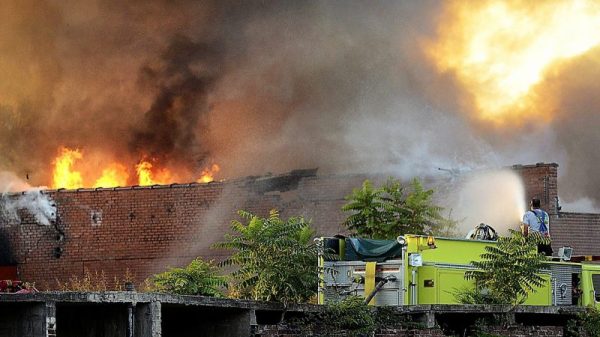
Such a fate befell The Foothills Community Workshop in Granite Falls, North Carolina, this past Friday. Details are still sketchy as the remnants of the 75,000-square foot former Shuford Mills textile factory are still smoldering, and the Fire Marshal’s investigation is not yet complete. Thankfully, no lives were lost, and injuries were limited to heat exhaustion of several of the firefighters from 16 counties who battled the blaze in the hot and humid North Carolina Piedmont.

Continue reading “North Carolina Hackerspace Destroyed By Fire, Members Vow To Rebuild”