Be Your Own Oil Company With Desktop Fischer-Tropsch Process

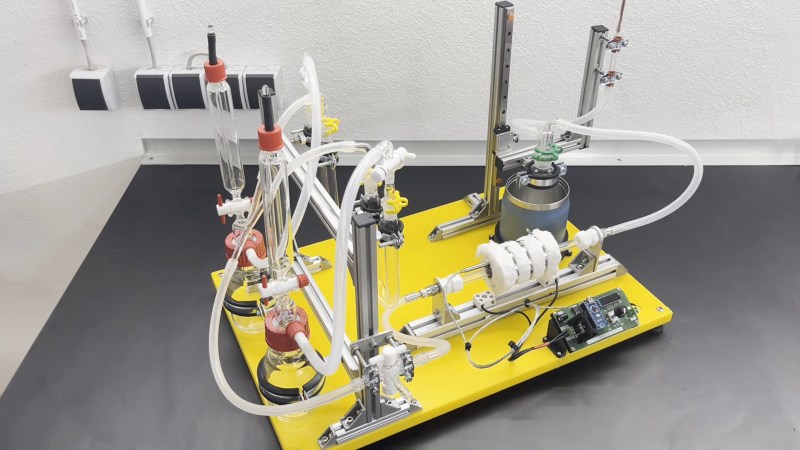
Plastics, oil, petrol– the modern world is entirely dependent on hydrocarbons. The good sources are slowly running low and supply is increasingly complicated by geopolitical factors we really don’t want to get into, but hey! It’s just hydrogen and carbon, right like it says in the name. How hard could it be to roll your own at home. Well, if you’ve got a lab like [Marb]’s Lab on YouTube, it might just be doable, as he demonstrates in his latest video.

The Fischer-Tropsch reaction was discovered back in 1925 in Germany by a couple of gents named Fischer and Tropsch. In the unpleasantness that followed later, Germany made good use of their process on an industrial scale, since they had ample coal and no oil on hand. Coal-rich South Africa has also made us of it, particularly during the Apartheid-era trade restrictions. Every so often the idea of industrializing the process comes up in the USA, but there’s still enough oil there it doesn’t make sense economically.

Those nations all have something in common: they’re all coal-rich countries, and that makes sense because coal is easily converted to carbon monoxide and hydrogen– a combo known as syngas– and it just so happens that those are the feedstock for this reaction. The actual chemistry going on inside is quite complex, but conceptually it is pretty simple: hydrogen and carbon monoxide mix over a hot metal catalyst, and combine to form various hydrocarbons.

In [Marb]’s glassware-based demonstration, the catalyst is Cobalt (III) Oxide on silica gel– a lovely, cancer-causing substance that must be prepared for each use, as it lasts but 24 hours before further oxidization ruins it. That’s in spite of purging the system with argon– a necessary step if one does not wish to explode. The yield isn’t amazing, and [Marb] isn’t sure exactly what mix of hydrocarbons he has created– although they smell like gasoline and burn like the dickens, so mission accomplished.

This might seem like the furthest thing from green, but if you use solar power to run the process and something like woodgas– which is syngas by any other name– as a feed-stock, then you’ve got a carbon neutral energy storage medium.

Thanks to [Markus Bindhammer] for the tip!

Continue reading “Be Your Own Oil Company With Desktop Fischer-Tropsch Process”
Benchtop Haber-Bosch Makes Ammonia At Home

Humans weren’t the first organisms on this planet to figure out how to turn the abundance of nitrogen in the atmosphere into a chemically useful form; that honor goes to some microbes that learned how to make the most of the primordial soup they called home. But to our credit, once [Messrs. Haber and Bosch] figured out how to make ammonia from thin air, we really went gangbusters on it, to the tune of 8 million tons per year of the stuff.

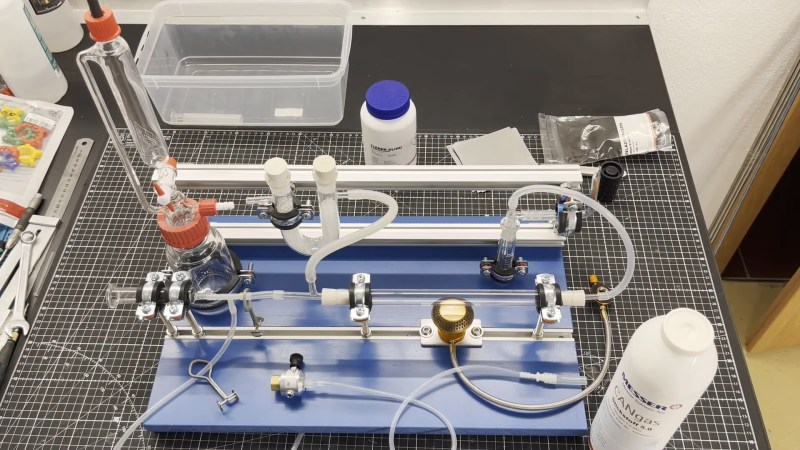
While it’s not likely that [benchtop take on the Haber-Bosch process demonstrated by [Marb’s lab] will turn out more than the barest fraction of that, it’s still pretty cool to see the ammonia-making process executed in such an up close and personal way. The industrial version of Haber-Bosch uses heat, pressure, and catalysts to overcome the objections of diatomic  nitrogen to splitting apart and forming NH3; [Marb]’s version does much the same, albeit at tamer pressures.

[Marb]’s process starts with hydrogen made by dripping sulfuric acid onto zinc strips and drying it through a bed of silica gel. The dried hydrogen then makes its way into a quartz glass reaction tube, which is heated by a modified camp stove. Directly above the flame is a ceramic boat filled with catalyst, which is a mixture of aluminum oxide and iron powder; does that sound like the recipe for thermite to anyone else?

A vial of Berthelot’s reagent, which [Marb] used in his recent blood ammonia assay, indicates when ammonia is produced. To start a run, [Marb] first purges the apparatus with nitrogen, to prevent any hydrogen-related catastrophes. After starting the hydrogen generator and flaring off the excess, he heats up the catalyst bed and starts pushing pure nitrogen through the chamber. In short order the Berthelot reagent starts turning dark blue, indicating the production of ammonia.

It’s a great demonstration of the process, but what we like about it is the fantastic tips about building lab apparatus on the cheap. Particularly the idea of using hardware store pipe clamps to secure glassware; the mold-it-yourself silicone stoppers were cool too.

Continue reading “Benchtop Haber-Bosch Makes Ammonia At Home”

21st Century Light Bulbs Using 3D Printer And Chemistry Equipment

lab-equipment-light-bulbs

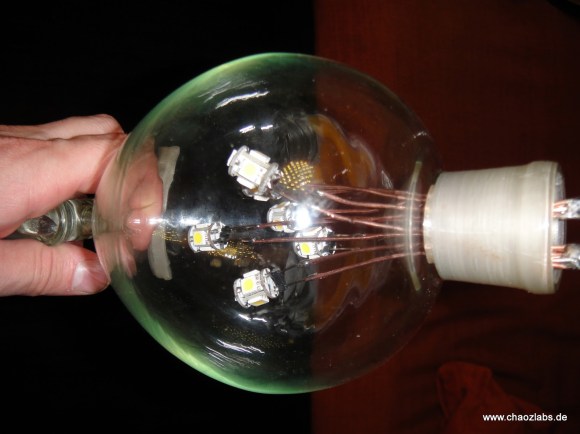
[Andreas Hölldorfer] brings his light fixtures into this century by using a couple of modern technologies. The fixtures combine LED modules, 3D printed pieces, and laboratory glassware to give his room a unique look.

The glass enclosure is something he’s had on hand for quite some time but they never actually got used. There is an opening at one end which is meant to receive a stopper. He modeled one including holes for the wires and printed the piece with a 3D printer. Also fabricated in the same way is a bracket that is used for mounting the fixture to the wall. The blossom of components inside the glass are each made up of five LED modules. There’s no word on what he’s using for a power supply or how he managed the cable runs, but he did post an image of two of the fixtures installed in his living room.