
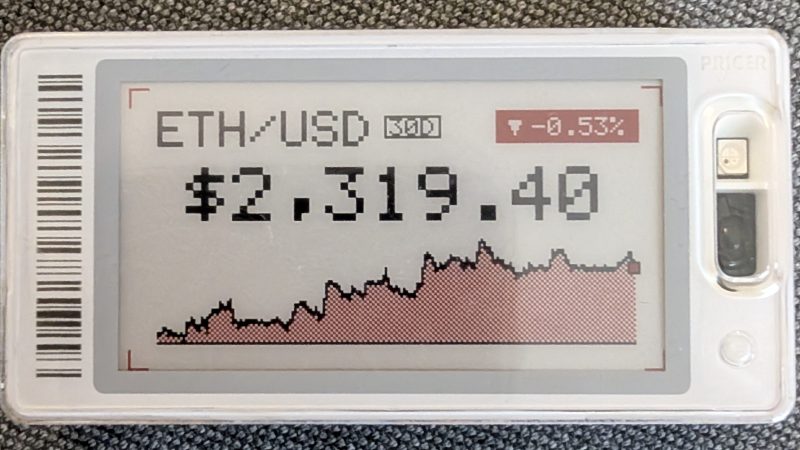
Was there ever anything wrong with simple paper price labels? Absolutely not. And yet, the world invented the electronic price tag anyway. If you happen to come across some of these devices and want to hack them, you might like TagTinker from [i12bp8].
TagTinker is a Flipper Zero application specifically built for talking to infrared electronic shelf labels (ESLs). These are e-paper devices that receive commands and updates via an infrared interface, and they’re relatively simple to talk to. [i12bp8] built upon previous work from [furrtek] which revealed the protocols used to update these devices, and implemented it into an app that runs on the Flipper. It can do neat things like scan the NFC tags built into ESLs to ID them, deploy bitmap images to the tags, or run live-updated dashboards on the devices with the aid of a Flipper WiFi devboard.
If you’ve always wanted to play with these tags but didn’t want to do the grunt work yourself, it just got a whole lot easier to mess around. Though, it’s worth noting, [i12bp8] has strictly prohibited any illegal uses of this app, so be good out there. We’ve seen these tags repurposed before, too – who knew they could make such good conference badges?












[i12bp8] has strictly prohibited any illegal uses of this app, so be good out there.
Yea ok
Mucking with displays you don’t own is a scummy move, anyway. It’s no more interesting than scribbling on a paper tag with a marker.
Also, don’t be doing security via obscurity, tag makers.
When stores twiddle the prices hourly to rake in as much as they can from whoever they think is shopping, they also update the prices loaded by the checkout counter. The only thing you can do is trick people into overpaying when they get to the register.
Then go shopping anywhere else.
That doesn’t work when the market is basically a giant collaborative oligopoly.
Amen brother.
Fortunately, it isn’t.
There’s no “vote with your wallet” solution when they’re all doing it. Every store faces the same incentives and the equipment is both available and cheap.
That leaves regulation as the only option. If there’s no market solution, then you need an outside force.
Hm.
Do crowbars have to be distributed with a strict prohibition by the manufacturer against using them to commit crimes?
Bolt cutters?
Lock picks?
Surveillance cameras?
Often, yes. Many products have a line in their T&Cs (that we all click through or throw away without reading), that says something along the lines of “don’t use this product to do anything illegal”, to give the manufacturer a legal fig-leaf, in case someone tries to sue them for (eg) selling their ‘Burglar-tron 200’ which is then used to commit burglary.
I don’t know about crowbars and bolt cutters, but Covert Instruments, seller of lock picks founded by Youtubers Lock Picking Lawyer and McNally, have this to say in their terms of service. A lock pick is a sufficiently specialized instrument that it makes sense to put a clause in there to shield themselves somewhat from civil liability. A crowbar for example is much less specialized and is useful for things like pulling up floor boards when renovating a house.
which funny enough is not permitted by the GPL
We’ll be good. We promise!
The problem with paper shelf tags is the cost of updating them. Every week, at every store, people have to replaces hundreds of tags to reflect updated prices from sales, supply issues, etc. Electronic shelf tags aren’t completely maintenance free, but price changes can be automated and reliable.
This sounds like a pitch line that has been practiced 1000 times.
If the return on investment wasn’t there, then large companies wouldn’t continue to buy them year after year, and new companies wouldn’t be steadily increasing adoption.
Walmart uses them, and they’re about as ruthlessly penny pinching as an asshole can get.
So presumably it ACTUALLY IS cheaper at scale than paper.
Or, presumably, it allows retailers to scale up their targeted individualized pricing schemes they have such boners for.
Get back to us when you have video evidence of a price tag changing as different people walk by.
@jeffB You mean when they actually deploy the pricing schemes they keep drooling over and telling us that they look forward to deploying?
Nothing wrong with preemptive outrage about this
It does a bit. I did this in my first full time job out of college for a year. Twice a week in an electronics store. Printing the updated tags (on thicker paper which occasionally jammed and was a pain to reprint from our old system), cutting them out and going around to each item and making sure it was on the right item. It took 1 person half a day to do over the entire shop and if you made a mistake and put the tag on the wrong item it could be costly when a customer would tell you it was labelled for less, especially after sale seasons. The sales people always caught the big premium items but there was a €100 difference on a fridge or a vacuum cleaner that was missed and had to be honoured.
As soon as they released the electronic tags I knew they would catch on. The labour costs alone that’s saved and it’s a menial thankless job, and if you’re the one who mislabelled you’d hear about it for a long time after.
One of our customers at work has a system for generating new shelf edge labels as a pdf to be printed on perforated paper to make them easy to be ripped to the correct size. I’ve billed so many hours of work dealing with problems in that system. Although a lot of them have come down to the customer either changing the printers without testing or telling anyone, or someone thinking they’re being smart by buying the perforated paper from a different (cheaper) supplier, which turns out to very inconsistent in where it puts the perforations.
Printing always seems to throw up issues.
The problem with paper shelf tags is that they can’t be updated on an hourly basis to reflect the people shopping. Aka algorithmic price discrimination.
Oh, it’s 5:45 and you’re a desperate soccer mom with a screaming kid and you need to buy tomato paste so you can get home and start making dinner? That’ll be an extra $5.89.
I’m not sure if this wouldn’t fly here (Poland). We have laws stating that the item must to be sold for the price stated on the shelf (“we forgot to change the tags” is not defensible). Having the shelf price change between the customer picking the item and paying for it would be a big no-no, and it would be only a short time before someone took notice and brought down the Office of Consumer Protection on them.
In the united states walmart has been caught over and over and over under weighing their meat. 5lb ham is actually 2lbs. they’ve been sued numerous times and pay some small fines. they make way more money than they lose in fines. our country is very anticonsumer because corporations fund our politicians luxury lifestyles.
I would be shocked if we don’t see pricing based on times in the near future here in the US. eventually it will be pricing based on the individual. these companies can’t make any more profit by doing good business. walmart and pepsi were caught colluding and price fixing. pepsi punished any retailer that sold pepsi for below walmart’s price. we are no longer dealing with a free market.
They don’t have to change it while you’re holding the item. They just have to jack up the price at 5:00 when people with jobs (with more money and less time) get off work.
Yes, but the issue would be that the only legal times to change prices would be when you’re definitely sure nobody in the store has it in their shopping basket. Like when the store is closed.
You change prices at 5pm? Great, but if someone picked it up off the shelf at 4:45 and checked out at 5:05, you’d be in violation
How is this any different than all of the gas stations out there doing the same thing?
Gas stations change their prices based on the oil market, not how expensive your car is. The prices don’t rise and fall based on how much money visiting customers have at a particular time of day.
No they don’t
They don’t want to update them every week. They want to update them every hour.
Oh, it’s 5:45 and the desperate soccer moms have arrived with kid in tow looking for tomato paste so they can get home and immediately start making dinner? That’ll be an extra $5.89.
How can that possibly be done? How would they know what the shelf edge price was when you picked up the item and how much to charge you at the till? Maybe you went straight there. Maybe you wandered around for 30 minutes. And whilst a shelf edge price isn’t legally binding (in the UK at least), it’s awful customer service to charge you a different amount at the till to what it said when you picked it up.
ESLs are just about flipping prices when the store is closed.
Plus counting people emass to not notice, including HaD shoppers.
Stores would use cameras with facial recognition and the like to build profiles on customers using whatever data they can access and discern the maximum amount they think you’d be willing to pay for an item. The tag would then reflect that price when you’re passing near an item. Or something like that. Not sure how it works when multiple people are near an item, maybe it just defaults to the higher price.
Simply not true. The price for things changes before work hours during and after, along with late night. Go watch the French fries Isle at any Loblaws owned store. I’ve seen them change while I was shopping at around 3pm more than once. One time the register updated and tried to charge me more. I have to photograph everything I buy now, I might as well make it as annoying for them as they make it for me.
You you’re misunderstanding the situation. They don’t need to change the price on a per-person basis (though amazon has tried this in real stores).
They start the day in the early morning at a low price, when seniors on fixed incomes show up and everyone else is getting ready for work. At 10:00 they drop the price $3 to bring it within the means the young adults and the unemployed who aren’t at work. At 5:00 PM they hike the price $15 because the working moms have just gotten off work and are desperate to get dinner started. At 8:00 they drop it $7 to attract the stragglers. On weekends they keep it at +15 all day long because it’s prime time for working people to go shopping.
And they rake in pure profit on everyone who pays more than the -$3 discounted price in the middle of the day.
It’s hard when your aluminum foil for your hat goes up in price, isn’t it.
These are real systems already being deployed to stores. Here’s a video discussing some of the cool equipment from the various vendors, featuring stores that have already installed it: https://www.youtube.com/watch?v=Yc32q1wIvak
The update costs is the main thing but it’s also worth noting that they are wasteful. Reusing old tags is basically unheard of so any time an item goes on sale then returns to it’s regular price that’s two tags printed. In a large store that can be a lot of wasted stickers every week.
If you ignore the harm to consumers through demand pricing…
It does feel underhand to price gouge in real time based on usage. The item price can change before you get to the payment stage.
Another real problem is that the AI shoplifting cameras aren’t smart enough to know that people don’t always need to shop using a trolley or a basket.
They can also update them in the middle of the day, so all the shoppers who already have items in their trolly get to pay extra.
It’s illegal, but it’s practically impossible to police.
This current penchant for changing pricing of everything is not obligatory.
I was recently looking at a bottle of aspirin which has the price (99cents) printed on the bottle.
(Walgreen, circa 2000).
Adding friction (cost) to changing prices is not a bad thing.
Did i just see “Today only. 50% off”?
Replacing a price on an item tag, does not replace item price at the cashier (or how that thing is called in English). ;)
Why on earth wouldn’t they connect the two systems? You really think the most ruthless billionaire family in recent history will be leaving money on the table? they already do many illegal things in the united states. look at walmart and pepsi price fixing. look at the numerous times they’ve been sued for under weighing their meat. walmart sees these fines and lawsuits as a cost of doing business. they make more money doing the illegal things then they get fined for doing them.
No one will update tags hourly. First, it severely shortens the battery life, second, people catch on. And they’ll take photos of the tags when they pick the item off the shelf.
Then they’ll argue with the cashier if the price went up, double check all the prices as it’s scanned or abandon the item at the checkout. This just makes more costs for the store – arguing with the cashier on every item will slow down checkout and anger everyone in the line. Or then they need to have someone clear the register stands of abandoned product to re-shelve them, costing them money in having people do this constantly. Plus people constantly arguing about prices is not something they’d want to normalize as it makes it impossible to recruit cashiers.
It’s going to be a huge disaster for any store attempting this
They do update them hourly and they bank on apathy. Those are two facts for which there is a lot of proof, some I’d be glad to provide you for the cost of a shopping trip.
Time to finally buy a flipper and set all prices to 80085.
“Was there ever anything wrong with simple paper price labels? Absolutely not.”
Well, yes there is.
There are several things wrong with it. First of all there is the waste. The constant changes they need to make results in a ton of extra paper being used resulting in a ton of extra waste.
The second problem is costs. Supermarkets run at a 1-2% profit margin and employee expenses can be a problem depending on the region. With a larger supermarket you can end up with multiple employees working constantly to change prices based on the changes from the supplier. So if they want to keep the prices lower to compete with other supermarkets and still make a profit so the owner can eat, they need to cut costs somewhere and with the super tough margins it’s quite difficult.
This is the reason why, in the late 90’s, you could see these electric labels pop up around the globe. It’s an investment that they can earn back in a few months and after that it’s easier, cheaper and faster.
If you want me to believe that complicated devices full of batteries and microelectronics beat the lifetime environmental impact of paper stickers, you’re going to have to provide some really good supporting references.
The paper stickers are usually coated in plastic. Some of these tags don’t have batteries, they are updated by the power from the device updating them. They last forever, basically.
Its like when I tell my wife to use Tupperware instead of ziplock bags for leftovers. We can wash the Tupperware and lower the impact over its life. Ziplock goes right into the trash.
These things usually don’t have batteries but use the power from the lights in the store. They don’t need to be charged. The paper used is usually not standard paper and they are put behind plastic covers that constantly need replacement.
If they “use the power from the lights in the store” without storing it anywhere, then any passer-by who shades the tag would switch it off (in case of LED displays) or have the potential to cause an update failure (in case of automatic WiFi updates).
Human labor, my good man. You’re probably looking at an ROI measured in a two-digit number of months and it’s probably less than 60. The manufacturer sells LOTS to each store, probably on a payment plan, and then makes the real profit on both replacement tags (which will be a small, but steady expense for the retailer) and software licensing.
“Supermarkets run at a 1-2% profit margin”
Do you have a source for that? Last I checked it was closer to 20-50%, depending on the product type. In produce for example, supermarkets often have a huge advantage in the market, and tend to claim the bulk of value added throughout the chain as their own. Farmers complaining about being forced to sell for less than costs is a frequent occurrence in my area.
Are you possibly confusing “markup” with “profit margin”? Net profit margin is the amount that is left from the sale price after paying their supplier for the product, labor costs, building and utility expenses, Social Security, workmen’s comp, tax withholding… Each source I have seen lists net profit margins 1-3%. Niche stores (eg Whole Foods, etc) have higher net profit, in the range of 3-5%. People shop hard to reduce their food bills, and like any other commodity, switch vendors for pennies.
Loblaws reported a ~31.3% profit margin.
They get real tricky with the numbers. The 1-3% margins are usually only the profit margins on items sold but that doesnt encompass all of their income streams or profit. Like manufacturers paying for premium shelf space, vendor allowances. Heck even vendor rebates where money is given back to the grocery chain but is accounted for and reported differently.
There’s a whole ecosystem they use to hide profits.
I wonder, those universal TV remotes that can “learn” by recording and playing back a signal, perhaps they could be programmed by a flipper to push a specific tag for each button press. Perhaps they could be shared as an MP3 or YouTube video, with a pair of IR leds attached to an audio jack.
In Canada, we have the Scanning Code of Practice, which is a voluntary policy ensuring the lowest price is honored if an item scans higher than its displayed price. If the correct price is $10 or less, the item is free; if over $10, a $10 discount applies to that item.
I wonder how this will affect that? Surely the store won’t want to compensate for a mistake they didn’t make and no doubt someone will try abusing it or just messing with them.
These devices should have some sort of security mechanism. I get they’re ultra low cost, but wouldn’t a basic signature check be trivial to add?
Never once have I had something like that happen. From Safeway to Save-On to No-Frills. At best I’ve had them honor the display price at worst, and most common, they stick to the scanned price.
There’s a company called Picksmart that makes e-ink displays, including 3 color ones. They use BLE for communication and are low power with changeable coin cells. I’ve used them in several projects and there is python code on the internet for controlling them, such as this: https://github.com/fpoli/gicisky-tag. In my app I made a customizable nametag controllable by a phone. These tags are relatively cheap and I recommend them for your own little projects.
Is Infrared the only way to update these tags? It seems labor intensive to go to every tag to update them. This makes hourly price changes as some say is done impossible to do.
If every tag has an internal identifier(e.g., address), and the store has high-powered infrared emitters scattered all over, they can broadcast blast all of the price updates. When a tag sees its ID in the stream, it picks off the information intended for it, and updates itself. This doesn’t require any people wandering around to update the prices on the tags.
In a supermarket I saw big IR led on the ceiling, broadcasting messages to all tag in view and yes they are addressed there it seems…
Some newer ones use BLE (Bluetooth Low Energy), and you can get wifi ones too.
I’m sure there’s some propriety systems that use a non-standard to lock stores into only using specific hardware too, and probably propriety systems that use an open standard but obfuscate it just enough to be incompatible.
All this talk of wasted paper…..naaaa, that’s not motivation enough for opting out of adopting these systems. If a retailer can eliminate the three or four employees per location needed for changing paper price tags, that’s serious money in the bank.
There’s also going to be a bunch of support costs with running the system to generate and print paper labels, because any time you deal with physically printing things, you’ll run into problems. (I have worked on such a system; it is a pita)
Of course, there’ll be a bunch of support costs with electronic labels too, but the salesman won’t have mentioned those ;)
The store I work at is supposed to go to these shelf tags in the next year or so.. 🤔🤫
For what it’s worth, the local WalMart has quite a few of these disappearing off the shelves, often leaving the batteries sitting behind. Who knows what (if anything) is likely to be done with them, but I have hope that it’s the local university EE students up to nefarious things.
As far as the “OMG Paper” thing goes; nah, it’s about getting rid of personnel, price “modification” based on time/day/location and other sorts of profiteering. With some luck there will be all kinds of portable RF/IR shenanigans resetting the prices to negative values, making the customers think the self-checkout lanes will turn into money fountains, causing a riot while stores scramble to find the one remaining employee.
For all the people seeing nefarious intent behind these price tags, and so certain that grocery stores are gouging you, I have one question: do you buy your electronics from AliExpress? That mentality is the reason companies compete on price alone, and cut corners.
I have a good friend, kind, generous, volunteers to help people in need (and votes liberal every time). Rails about companies price gouging. And sees no connection between that, and wanting her investments to return 20%.
There are plenty of jerks in mid or upper level management, and they stay in their jobs because they are good at understanding greed, and making people on both ends of the spectrum happy.
“Was there ever anything wrong with simple paper price labels?” Not when prices were seemingly constant.
In recent years, though, having to double check every label on every shelf seemingly every other week because all the prices of all the groceries are in absolute turmoil… …