
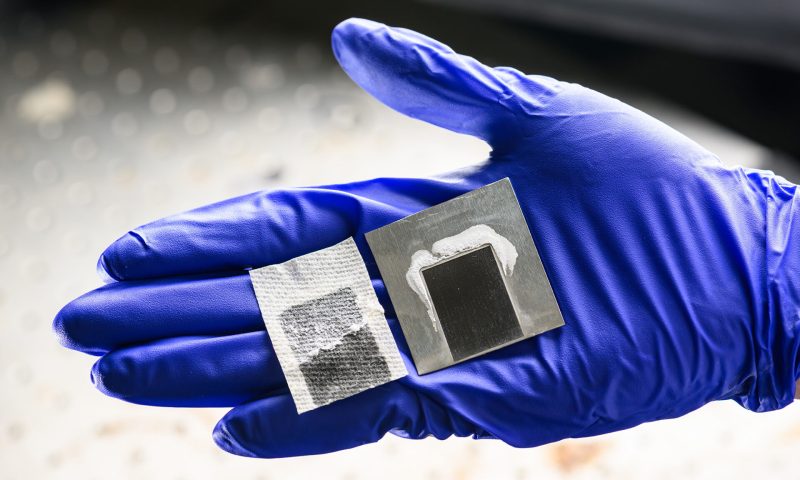
Although desalination is very commonly used these days to convert seawater into fresh water, one of the major disadvantages of current approaches is that commercial desalination plants produce a lot of brine, which has to be dumped somewhere ideally without causing major environmental issues. A new solar-thermal method as demonstrated by [Luheng Tang] et al. was published in Light: Science and Applications, with accompanying PR article.
This method is claimed to require no pre-treatment or leave brine, using special panels that wick water across their surface and then use solar radiation to distill this water. This differs from previous similar methods through a special surface treatment that prevents build-up of salts which would require cleaning or replacement.

The salts and other contaminants that would normally end up in the brine slough off these cells and can then be further processed to recover everything from plain table salt to lithium as well as gold, uranium and other substances of interest that are prevalent in seawater.
So far these self-cleaning cells have been tested with water from a number of oceans with a claimed 74% solar-to-vapor conversion efficiency and nearly 100% salt extraction. As always the challenge will be in scaling this up to industrial levels, but so far it looks promising.









A very good development, however still requires the handling of salt. At scale, the best way will still likely require some sort of dilution / pumped disposal, and thus we are back to environmental challenges and brine, perhaps minus the important elements previously in solution.
Given the amount of salt in rock form mined ending up with solid salts seems like a winner for everything but the salt miners.
Still seems like there is going to be a massive pile of salt somewhere.
No. It’s only bad if you take the salt completely out of the ocean and then dump it back in. If you only take out the water but just leave the exact same quantity of salt behind then it doesn’t count. Stop being so anti-technology.
It counts if you don’t disperse your salt over bigger area. Concentration of salt or salty return water is the problem, it creates hotspots of highly salty water. But dispersing over wider area means more pipes and pumps, which is more expensive to build and operate.
Bury it in a salt mine, after removing the precious elements.
Mines have a problem with ‘ground water’. Once you turn the pumps off they flood relatively quickly and you’re back to the back to similar, if not the same environmental problems.
@Jonathan Not all mines, almost certainly not salt mines. If there were that much ground water, the salt wouldn’t be there in the first place.
Mix it into plane fuel and it can be spread everywhere in the chemtrails :P
Excellent Idea :)
And as a bonus we get to say “We know” when the conspiracy nuts complain about the chemicals in aircraft vapour trails :)
If you take out water, you are left with more salt per quantity of water making the ocean more salty. Which has real effects. The amount can bet negliable. But only if you distribute the salt and or brine.
You are confusing anti-tech with thinking about the effects of tech and understanding them.
Making the ocean more salty? Maybe hyper-locally, but overall we could remove enough salt from the ocean to fill hundreds of stadiums, and the concentration difference wouldn’t be observable.
… which can be used, as was written.
Sea salt without iodine is f.e. better for fermentation of vegetables.
Salt with iodine is better for humans….
Reminds me of:
https://en.wikipedia.org/wiki/Monte_Kali
Sea salt is commonly sold for cooking use. Isn’t it a valuable product of this process, or is there just too much of it?
Just too much of it.
Salt costs about the same as sand at the source – the main expense is picking it up and transporting it somewhere.
Existing sea salt production is very cheap and can be done anywhere with ocean access and doesn’t need all of the expensive equipment to produce clean water and store it or pump it away somewhere. It’s very hard to be cost competitive.
the salt is free if you sell the water. heck, its even a self improving cycle -> eat more salt = get more thirsty = drink more Water = get more salt
And brine can be useful in sodium ion batteries. Plus this could be a method to extract CO2 from the water during desalination which is much more effective than direct air capture. Kind of a win-win-win-win.
If I understand directly, people pay for brine disposal because they have too much of it. Extracting CO2 from water means you need to capture it, compress it, transport it for long term storage (because, you just can’t store CO2 close to the sea shore), but this device doesn’t do that. So anyway, even if it’s possible, it’s clearly not economical so it’s more of a “ignore ignore win” at best but more likely a “loose, loose win” in the end.
Fresh water literally falls from the sky. Most of which ends up in the oceans. The problem is that water gets saturated with salt close to these plants. Sea life tolerates up to a certain level of salt. Depends on where plants are built, how long it takes the added salt to dissipate. Would build it, if not desperate for fresh water. Probably aren’t concerned about the local ecosystem.
look at where desalination plants are built and tell me how they should sustain with the amount of water that falls from the sky.
Interesting Article. It is good to see smart people engineering furtue products to solve todays problems. With increasing global population and limited fresh drinking water we will need more solutions like this. Self cleaning (de-salting) with a micro-coating on the surface. If the water is evaporated off then it is simply dealing with the salt.
Pollution is a resource out of place. Salt has always been a resource. So is the Ocean polluted with Salt?
Pollution is a substance harmful to the natural environment, making it dirty, unsafe, or unsuitable for use. In the ocean, dissolved salts and minerals are generally, with limited exception, diluted sufficiently to prevent them from being hazardous to the plants and animals that thrive there. The same cannot be said for brine produced by desalinization plants. You cannot make seawater potable without either creating a rise in ambient salinity, producing brine, or creating a mountain of salt which must be dealt with somehow.
There are ~135 grams of dissolved solids in every gallon of sea water of that 110 grams is Sodium Chloride. Globally, over 22,000 desalination plants produce roughly 25 to 35 billion gallons of fresh water every day. That works out to 1.4 billion metric tons of “table salt” per year if this technology merely replaced existing desalinization plant capacity.
The problem is the world only consumes around 250 to 300 million metric tons of sodium chloride each year. The vast majority of which is used for large-scale industrial and commercial purposes
The simple statement that “can then be further processed to recover everything from plain table salt to lithium as well as gold, uranium and other substances of interest that are prevalent in seawater.” seems to attempt to sweep this material under a rug of implied 100% utilization. A possibility the numbers simply cannot support.
Eh. Put it in the desert somewhere.
The idea to cover a desert region in meters of salt got cancelled this year, sorta.
https://en.wikipedia.org/wiki/Qattara_Depression_Project
That’s a fascinating project. No idea if it’s a good idea or not but it’s interesting either way.
+1.
That which is dumped in the desert does not stay in the desert. Powerful trade winds drive a 5,000-mile transatlantic journey, carrying massive clouds of nutrient-rich Saharan dust from Africa directly to South America. Every year, millions of tons of this mineral-rich dust cross the Atlantic Ocean to fertilize the Amazon Rainforest.
Our world is pretty damn close to a closed system. You have to consider the butterfly effect and 1.4 billion metric tons if salt is an issue bigger than mothra.
The water mostly stays water though, so will eventually end up in the ocean again. Seems like the problem is how to cheaply disperse the salt back into the ocean without creating high concentrations. Appropriate ocean currents seem desirable? Desalination plants are already location-constrained though, so I suspect the solid salt is actually more of a problem – you’d want to re-hydrate, then pump it through a subsea dispersal system
We don’t ‘consume’ that salt or 1 drop or H2O. We borrow it, die and it goes back where it came. Most of our planet is covered in salt water … but I agree this wick system is tricky advertising that assumes far fetched outcomes.
So what you’re saying is it doesn’t produce brine, it produces salt. And that’s supposed to be better somehow. I don’t know how to explain it, but the reason the process produces brine is that that’s the way to remove the salt. Apparently this process avoids producing brine by leaving the salt on the solar panel and then waving your hands about what you do with it. It’s not really an improvement.
just wait till someone has a great idea about it. its not like there are already plants planned with this technology. maybe it gets used in urban water treatment instead, it another puzzle piece of technology.
Sodium chloride is the feed stock for producing chlorine based bleach, hydrochloric acid, something that I am not going to say because my comment would be deleted if I did, rocket fuel, and many tertiary chemicals are too numerous to list (and saying most would also get my comment deleted). Do some very basic research and you will work it out.
Ok so this process would produce more sea salt than we currently use, and most of the secondary and tertiary chemicals have high energy production requirements, so having even more salt will not drive down the price or increase global usage.
Yes, I make my sodium hypochlorite from sodium chloride. No it does not require much energy. >240wh per gallon – like 9 cents – and 25 cents of rock salt. Clearly, the salt’s the most expensive ingredient – next to packaging if you buy it in the store. So I have to call bullshit on that.
Are you advocating altering Earth’s billion year old chemical balance of sodium chloride through human manipulation ? Hey, what could possibly go wrong?
For home production the salt is the expensive component, if sourced from a store. But globally if you were attempting to process 1.4 billion metric tons the salt, the salt is effectively free when compared to the energy required.
Home production, or even lab scale production, is different to industrial scale.
No desalination system is taking more salts out than it puts back in that same environment. You have a problem w/ that, drink salt water. Concentration removed = salt put back. No, this won’t bring peace of cure cancer, but it might save human life. Wells in groundwater that produce saline are already salty. If you remove x H2O, yes the salt left behind will return to salty water if it rains. Hint: the object was to extract water. If you want to save the salt in your basement, feel free, but you too are altering a many million year old environment, not the reverse.
If the problem is to get rid of the salt, then one way is simply to let the brine concentrate up to near saturation, about 25%, then cool it to near 0 C. Its density (about 1.2 times fresh water) would let make it flow like a river underwater. So let it. Just pick a site where it will flow to a very deep trench or subduction zone. It will stay put.
Cooling to 0 C is very energy intensive.
The Claude “Bud” Lewis Carlsbad Desalination Plant in California produces 50 million gallons of drinking water PER DAY.
Thats close to 15 Million pounds of salt every day, which would work out to 5 million gallons of 25% brine you would be chilling.
San Diego’s ocean water averages 60°F to 70°F (15.5°C to 21°C) year-round. Assuming your desalinization process did not heat the sea water up at all, you would need To chill 4.8 million gallons of 25% saltwater brine from 18.25C to 0 C you will need a total cooling energy of approximately 376MWh. In sunny San Diego that would require between 75 and 110 acres of solar panels, producing enough electricity that could otherwise power around 12000 homes, wasted on chilling brine before dumping it.
A large chiller has a COP of about 7, you’d pre-cool some amount by evaporative chillers, and the actual target is more like 4-5C for maximum density. So energy consumption to cool that to will be more in the ballpark of 50 MWh/d, about 5% of the total plant electricity consumption, and about two percent of the plant’s operating cost.