
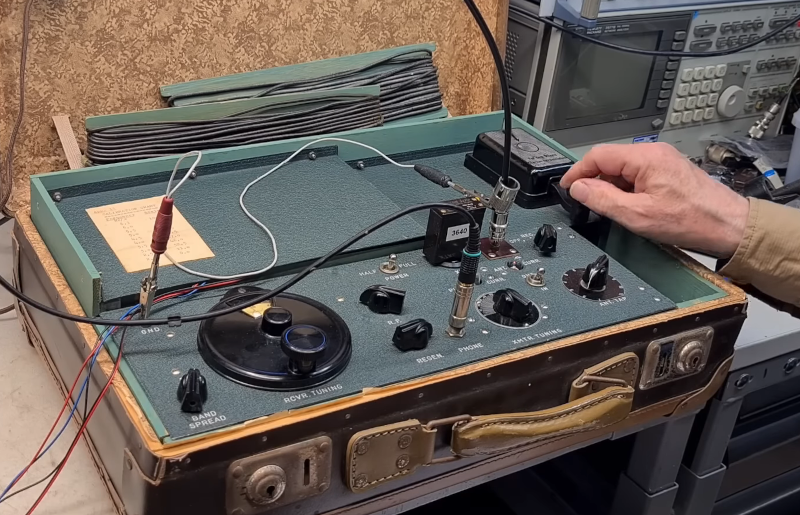
What counts as portable is somewhat a matter of opinion, especially over the years. [Helge Fykse] has a portable spy radio of Swedish origin. For its time, it was considered very portable, crammed into a good-sized suitcase.
You can see the large crystal that sets the transmit frequency and a key to send Morse code. The receiver has a VFO, so it was more agile. Based on the regenerative knob, it appears the receiver was of the regenerative type. The suitcase had its own battery, and with tubes, it could probably put out some kind of signal if connected to anything metal, like bedsprings, a clothesline, or anything. There was a lightbulb to let you see when you were transmitting maximum power.
Speaking of tubes, there were five inside, two for the transmitter and three for the receiver. The radio had storage for spare tubes, and the agent could maintain the radio in the field.
You not only get a peek inside the suitcase, but a look at the schematic. The radio is a model of simplicity, but we are certain it did its job.
We love looking at exotic spy gear, especially radios.












I know it’s been shut inside a suitcase for 80-odd years, but that looks suspiciously clean and shiny to me. And it just worked? No problem with capacitors that old?
It does look very clean. I presume he cleaned it before filming the youtube video.
I know nothing about WWII radios, but assuming it is authentic then perhaps it was unused surplus kept in a nice cold bunker somewhere. And maybe it used ceramic capacitors?
Great video. Some question/comments:
1. Was it made in UK? All labels are in English.
2. The operator must have felt very exposed even when receiving, particularly in CW mode (oscillating). A regen receiver in a wooden case puts out a signal, despite isolation of RF stage.
3. It should have been noted that the schematic has been recreated using modern standards, e.g., nF, and pF rather than µµF.
pF has always been used in Europe.
This appears to be variant of the Paraset?
Interesting.
This appears to be variant of the Paraset?
Interesting.
The later models designed in conjunction with Guildenstern were much better.