
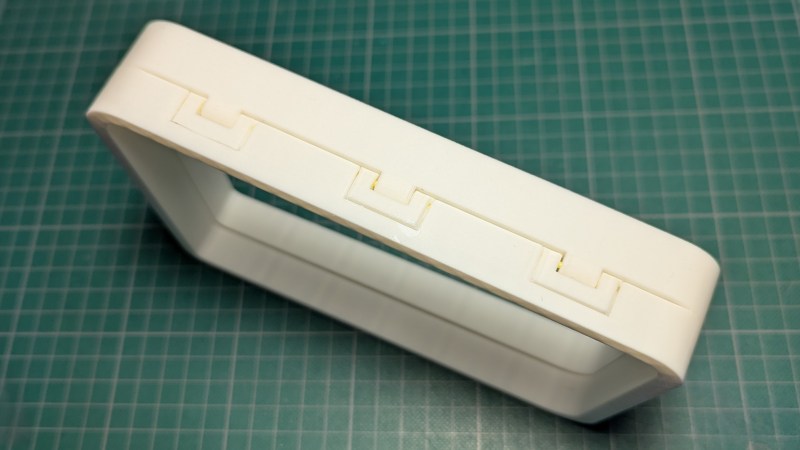
Need a hinge in your 3D printed design and would prefer not to re-invent the wheel? You may find [Alex Krush]’s glue-in filament hinge useful.
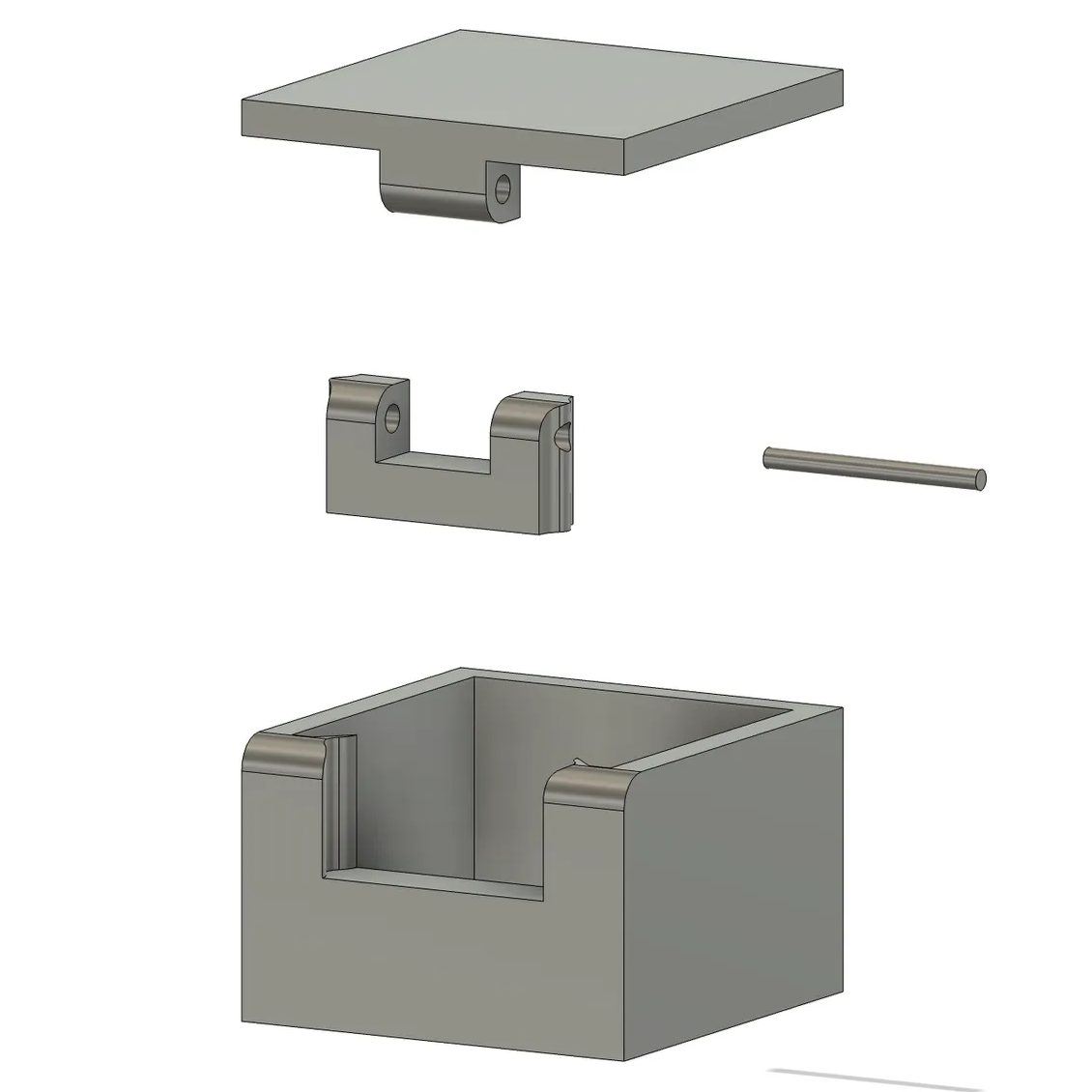
This design prints half the hinge as a separate piece — the u-shaped one in the picture to the side — that must be glued into the target object after printing. It’s a bit of extra work, but doing it this way has a couple advantages.
One is that printing some of the hinge elements separately means one no longer needs to choose between a print orientation that best suits the object, and a print orientation that works best for the hinge. Also, the length of 1.75 mm filament used as a hinge pin is held captive after assembly so there’s no need to glue the hinge pin itself.
[Alex] helpfully provides the parts in STEP format, which makes CAD tweaks and adjustments easy. While incorporating the design should be doable even if one is just using .stl or .3mf files because boolean subtraction and merging is all that’s needed, having the model in STEP format is so much better.
Should you need some pointers on incorporating either into FreeCAD, we have you covered.












If you have to glue it, what’s the point for the middle piece? Just prepare a hole on one side of the “bottom” piece and a grove on the other side. Fit the pin into the top piece (like this contraption) and slide it in the hole & grove. Glue the pin into the grove (and the hole if you need to, usually not required). If the pin is made of thermoplastic you can even use a soldering iron to melt it with the bottom piece to avoid glue (which is much easier if you’re using PE based plastic like PETG that doesn’t like cyanoacrylate much).
“…a couple advantages. One is that printing some of the hinge elements separately means one no longer needs to choose between a print orientation that best suits the object, and a print orientation that works best for the hinge.”
I’m not sure what advantage number 2 of the couple is but there you go, right from the article.
I’m also not sure what orientation is bad for that design though. I guess printing it curved surface down wouldn’t be great. I still think it might work so long as the printer is tuned decently.
I still think that if I needed to print the hinge as a separate object I would consider just using a factory-made hinge as a vitamin. But… if we never try printing things that we think make more sense as vitamins we will miss out on discovering things that print better than we expect so.. hack on.
Oh, advantage #2 was not needing to glue the pin. It was right there!
“groove”
make one big hole from left to right through the object. result: ni strange extra lines for your hinge. but you end up with two holes, almost invisible if you use the same filament for the hinges as the body.
or you could just make plugs for the ends
The biggest problem with using filament as your hinge pin, is that filament gets brittle over time and breaks. ABS, PETG, and PLA all suffer from this. And if you glue in the hinge section then you won’t be able to easily repair it. I like most of this idea, just change the hinge pin to something more robust than a scrap of filament.
ugh. i used PLA for a decade and every single thing got unbearably brittle regardless of how i used it. so when my printer broke (it was made out of PLA), i switched to PETG with my new printer. your report here is the first i’ve seen that PETG also gets brittle and now i wonder if i’ll come to have the same opinion of it, after a while.
As for the brittle pin, just cut the head of of a small nail and use that. Problem solved.
I’ve been using the shaft of a pop (blind) rivet. They are cheap, and come in a good variety of sizes.
I’ve used the rivet bit you usually chuck out, but prefer toothpicks or bamboo skewers as they’re easier to cut to size.
This project solves problems i haven’t found to be problems, and introduces a problem i haven’t been able to solve.
I have not had trouble printing axle holes in any orientation. There is some deformation but it hasn’t ever caused me trouble. If i don’t mind a loose fit, i over-size the hole so the deformation isn’t a problem. If i do want a tight fit, i spec the hole at the right size and then i drill it out with my drill press to cope with the deformation. I drizzle filament to cap the hole and trap the pin.
But i have never had luck gluing big pieces of PLA or PETG together. I’ve had a bunch of partial successes, but fundamentally i haven’t found a way to get faces to stick together with anything resembling the regular inter-layer adhesion.
And just an aside, i’m always astonished the ways people over-use filament for tasks that it’s not good at…filament is not a great material for a hinge pin. I personally use steel wire (fence wire) but there’s a zillion options for pin material that are better than filament.
PVC glue works best for sticking pla parts together in my experience. But it can be messy.
Lots of people suggest superglue, but in my experience that is super brittle.
This. I also use pvc glue or more accurately pvc dip coating. If you check the ingredients it is pvc dissolved in benzene and makes two pieces of petg essentially one piece; the interface will be stronger than the inter layer adhesion.
Hmm, that solves a problem for me, however not using glue. Given a shallow box (like the printed one), inserting a screw from the bottom to lock the hinge against the case would conceal the screw itself, while making the hinge replaceable. Could be useful for e.g. a lightweight hinged display (using a metal pin instead)…
A couple of spring loaded pins into blind holes maybe?
Some of y’all are miserable lol this is way better than print in place