
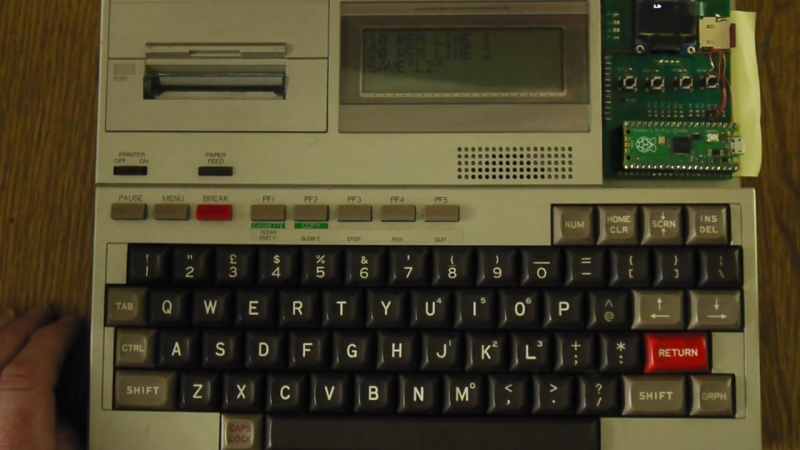
The Epson HX-20 is sometimes referred to as an early laptop computer. It’s a little odd in its form factor, and in its storage, relying on a microcassette drive to store data. It can be problematic to keep these tapes and drives going after so many decades, so [Andrew Menadue] has been tinkering with a more modern solution.
The replacement drive uses a Raspberry Pi Pico to emulate the original tape drive. The Pico uses a microSD card to store data instead of the magnetic media of old. The device has a small screen for showing status information and four buttons for navigation, allowing the faux drive to be controlled as to what “tape” it’s pretending to be. It’s also possible to use the device to emulate ROM cartridges that could be used with the HX-20 in place of its original tape deck storage solution.
We’ve seen some other old hardware get similar drive upgrades before, too. No surprise, because mechanical drives and media simply don’t last forever. Sometimes you need to build a replacement that’s viable today. Video after the break.












Iirc I wrote a modem interface for that sometime in the 80s, wish I could remember more!
if there are any of those that are non-functional they would make a great shell for a cyberdeck. i have a TRS-80 Model 100 that would make for a great cyberdeck too, but it still works. The only reason I have it is that I mentioned in passing that when I was a kid I really wanted one, and she surprised me with it on my birthday. This was back in like 2005 and she got it for next to nothing.
I cared this around with me in the 80s as a kid in grade school. It couldn’t do much but I programmed it in basic for fun.
I had one, made me depressed about how limited it was. Then sold it.
This handheld could have been a portable terminal or a CP/M machine, I think.
There was CP/68 from 1979, I think.
It seems the problem is the screen. It’s just not big enough or with enough characters for much use beyond a status display. I couldn’t imagine trying to do word processing or terminal emulation on it.
It seems like an otherwise solid system that was let down by a poor display.
The company I worked for at the time used the HX20 as an HMI for our palletizers (or any other machine we made actually). It talked via serial to the microprocessor (a TI9995 programmed in pascal) governing the machine and you could use the tape to save/restore the configuration and the integrated printer to print it (or to print production data).
So it was used in a serious application, after all?
Not bad for such an oversized pocket calculator! 😲
When I had mine, I thought it was about good enough to play “Hunt the Wumpus”.
I dunno; used my Model 100 for years. As recently as maybe 5-10 years ago I saw some were still used for data collection; they ran a long time on double-AAs and were pretty darn versatile.
Isn’t this the one that also used bubble memory cartridges?
The grid used bubble memory (not removable), the old pc-5000 had 128k bubble carts.
@Hackaday staff : please add a hx20 tag like all the other articles related to the Epson HX-20 on your website