
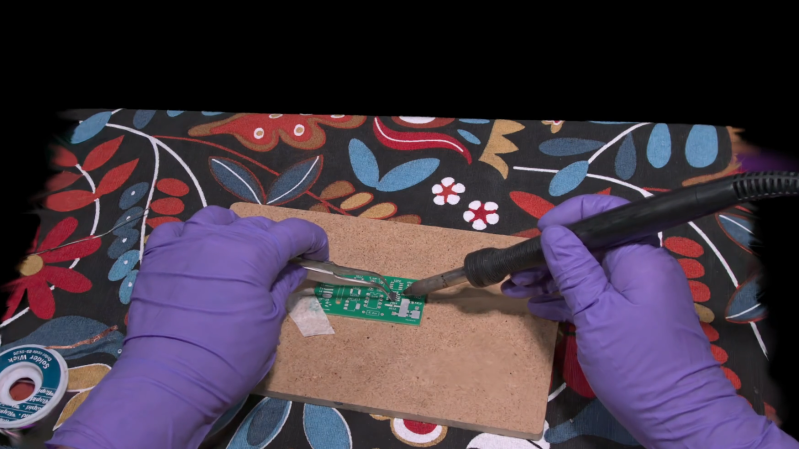
A manual skill like soldering is so much easier to learn and grasp when one can watch it in action, and there’s a brand new way to do that using virtual reality (VR). It isn’t just a series of 3D videos shot at someone’s workbench, either.
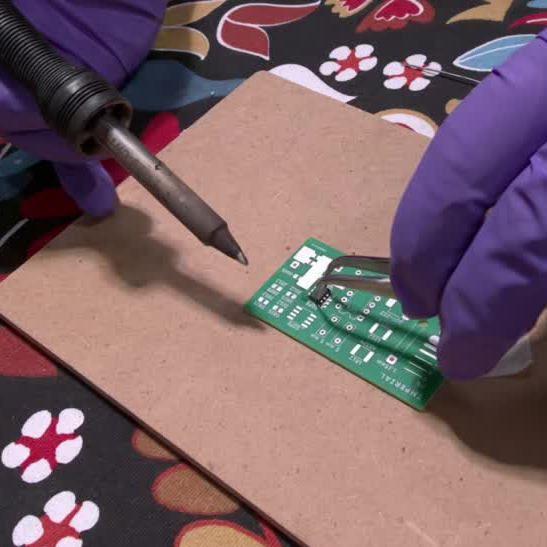
PCB Hand-Soldering Basics is a series of thirteen videos that demonstrate soldering using Gaussian splats, a method of displaying 3D content that allows the viewer to freely look at things from any angle. Gaussian splats aren’t new, but what makes this different is the sheer level of detail and the fact that it’s focused on handheld tool use rather than displaying a famous location, landmark, or something similarly “big”.
Throughout the videos fine detail on the iron, parts, and the PCB itself remain visible from any angle and even from close up. Here’s a short video captured from within a VR headset that is probably the next best thing to seeing it yourself.
An educational production, it was was made in cooperation with the Department of Electrical and Electronic Engineering at Imperial College London. A few more details are in a LinkedIn post by [Tanmay Lad], who was part of the team involved in the production. The goal is to offer a unique, front-row seat to hand soldering with the ability to zoom in or look at it in 3D from any angle.
Not familiar with Gaussian splats? We’ve previously covered a great overview. They look great and are computationally cheap to render, and being able to get up close and see such detail is not really something one expects.












A little related, I wondered if it was possible to take two microscope cameras and stream them to Meta Quest headset to get a 3D Microscope. One can find dual cameras for stereoscopic purposes, just add a big lens or hook that up to a cheap stereo microscope and voila… ?
Great minds think alike. AR headset meets sensor fusion. Throw in some local AI and any repair session can be informative.
Even more tangentially related, is there a good Steam VR or Meta Quest app where you can just arbitrarily feed a wifi camera on the network into one or both eyes in a VR headset? I get latency and resolution would probably be butt, however there’s all sorts of fun experiments that could be done
I’ve done something similar in the past. It works, but make sure you can get the lenses close enough. If the focus distance is e.g. 20 cm, the distance between lens centers should be at most 4 cm.
Otherwise the parallax effect will be too strong and dizzying, as human brain is adapted to particular distance between eyes vs. object distance.
It seems that the grace . ia link from the article isn’t working.
Also for an accessibility standpoint (zomming, pausing, fullscreen) please refrain from sharing YT video as shorts replace the link with the URL for normal videos e.g. post http://www.youtube.com/watch?v=VIDEO_ID instead of http://www.youtube.com/shorts/VIDEO_ID. You could even create a regex to do that for you in your posting workflow. Thanks.
I’ve had a uBlock filter for ‘youtube.com/shorts’ for so long I’d almost forgotten that garbage still exists.
If it’s a rewrite filter do not hesitate to share it, if not a block filter is still a good thing I reckon!
Google “redirect shorts” plus your browser of choice and you’ll find an extension.
lil tampermonkey script:
// ==UserScript==
// @name YouTube Shorts to Watch in New Tab
// @namespace https://www.youtube.com/
// @version 1.0
// @description Redirect YouTube Shorts to normal watch URLs in new tabs
// @match https://www.youtube.com/shorts/*
// @match https://youtube.com/shorts/*
// @match https://m.youtube.com/shorts/*
// @run-at document-start
// ==/UserScript==
(function () {
if (![‘www.youtube.com’, ‘youtube.com’, ‘m.youtube.com’].includes(location.hostname)) {
return;
}
const match = location.pathname.match(/^\/shorts\/([^/?#]+)/);if (match) {
location.replace(
`https://www.youtube.com/watch?v=${match[1]}`
);
}
})();
There’s an extension that automatically detects shorts and replaces the word in the url with “watch” which turns it into a normal scrubbable video.
There are a lot of Youtube channels these days that make videos that contain good information but it is also stretched out over 15-20 minutes of bla bla bla and sponsors. These channels often publish shorts a little later that contain only the good information and none of the fluff. Those are some of the few channels where the shorts are better than the long form videos.
Talking of which, after hearing for so long about tik-tok and its wonderful algorithm and its addictiveness I decided to have a look-see recently. And lo-an-behold it was so much worse than youtube shorts, in youtube shorts (although it’s not for me) you occasionally see something that you think is cute or clever or slightly interesting or skillfully done, but it seems tik-tok must have pegged me completely wrong or something, because there was not a single thing that I appreciated in any way.
So if you hate YT-shorts give tik-tok a go and then YT-shorts seem so much better afterwards :)
Good point! We don’t normally feature shorts at all, but if we ever make an exception (like in this case) handling them like that is a great suggestion. Thanks!
A trick that’s handy for getting regular video features.
Yawn … There’s an app (required) for that.
And not even for Linux.
As a Certified Soldering Snob, I’d caution against putting too much time into watching how-tos from anyone using an iron like that.
T245/T210/T115! And if you need to do stuff like soldering an inch-thick solid copper busbar to another inch-thick solid copper busbar there is a bigger one but I can’t remember right now! They are essentially MAGIC after years of using conventional heater-way-up-in-the-handle irons.
I get you point and your generally right but i dont think thats the iron you think it is….
Thats either a $1000 metcal or at least a $600 thermalteonics station… either way theyre good stations.
Something like that is in, “I’m serious” or making money territory.
So the more expensive and less-good style is preferred (or mandatory) because of tribalism or something? Sure, that makes perfect sense. (in retrospect maybe I am not the snob after all)
If you need to spend over a certain number of dollars to be accepted in whatever peer group, you can certainly spend lots and lots of money on genuine JBC. At least those will work as well as the cheaper T245 stations.
Heater-in-handle was, well, fine I guess, when there were no alternatives but today it is just dumb, no matter how much it costs or how refined they tried to make it.
That is an absurd tip to use for SMT, but that handle is almost certainly a metcal, and I don’t think you understand how a metcal works.
They work on the curie point, they put the heating energy out as a 13.56MHz wave, and depending on the tip and magnetic alloy inside of it, the curie point is different.
One of the downsides of the system is that you need different tips for different temps, you can’t just turn a dial or press a button.
In the rework room of every big-budget ($100bn+) silicon valley company I’ve lead projects at, there are metcals and jbcs. A metcal MX-5210 and a JBC NASE-1C are absolute staples in every lab I’ve worked in over the last ~decade. These are both >$1k stations and the tips cost as much as a cheap soldering iron. The JBC uses resistive heating but the heater is in the tip. A skilled technician can do some pretty wild work with those.
I think the video operator chose a metcal with a thick tip, because it looks like most cheap irons, and would help show an aspiring hobbyist that you shouldn’t be afraid of SMT and can do it with a chunky iron.
Hopefully this helps increase your soldering snobbery hah.
Huh, all the Metcal handles I’ve seen look somewhat different, and they don’t have the holes in the handle around the bit.
But I only know them from videos though.
Nothing beats a Metcal or a JBC and anyone who thinks different has never used one. They may look like an old clunky iron but they outperform anything else on the market.
But some guy is right – this was chosen precisely because it contradicts the instinctual urge of a soldering beginner to go for the finest tip possible when doing SMT work, which are almost invariably the wrong choice.
T470.
JBC cartridges are amazing, but Hakko T12 cartridges are also pretty solid and have the heater in the tip as well. Portable irons like the Pinecil also use the T12 pinout albeit with a shorter tip.
Certified by Costco? This is PS-HC3 handpiece for Metcal PS-900.
A carefully constructed video is very difficult to beat; VR or stereoscopic technology is unlikely to give more or better information.
One such series of videos (by Pace Technologies) can be found at
https://www.youtube.com/playlist?list=PLF06SHGgSg4HVdhxST6QM9PKjsSq0xw5-
Yes, they are old – but that’s a benefit! They were made when videos were difficult to make and view – so they were carefully planned, executed and edited.
They illustrate why 99.99% of yoootooob vids are a waste of time :)
Now all we need is some turret terminals and leaded solder.
Why? Is that something that’s hard to get? I find that silver alloys work better, but I’ve never had problems getting leaded solder (by the ton, if I wish). And if it’s not solder that’s needed, pure lead or arbitrary lead alloys are available and economical, even if you need shipping.
But, it’s equally easy to get something more appropriate for the actual needs of a project, and that often involves minimizing tin content.
And when building one-off control boxes or testing units, turret terminals are still as useful as they were back in the mid-20th century. Niche, but when it matches the needs, use it.