
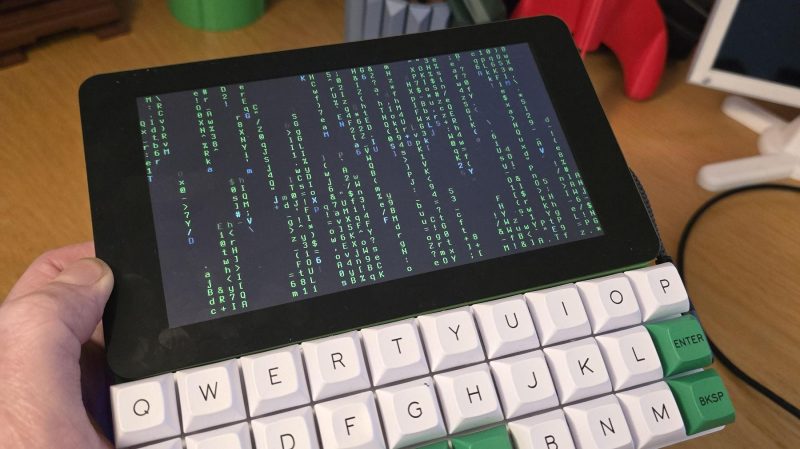
The cool thing about cyberdecks is that you get to design them to suit your personal tastes. [NickZero] wanted an ultra-minimal build, and set about putting together just that.
The build is based around a Raspberry Pi Zero 2W, which has a lighter power draw than the full-fat models at the trade-off of some processing power. Since it’s a W model, it has the benefit of wireless connectivity baked in from the factory. The Pi is paired with a Gherkin 30% layout keyboard kit, which neatly matches the 7″ Waveshare touch display in width. Power is courtesy of a juicy 4000 mAh lithium-ion cell, which is taken care of by an Adafruit Powerboost 1000 charger module. Everything is then laced up together inside a nifty 3D printed case.
It’s a simple cyberdeck, and one that’s probably quite satisfying to use when you get used to the fact that there are no number or modifier keys on the ultra-cut-down keyboard. It’s also a great example of how a bunch of off-the-shelf gear can nonetheless be assembled into quite a cohesive whole. In much the opposite way, we’ve seen some maximalist cyberdeck builds lately, too.












“Cyberdeck” might simply be an aesthetic? What would one actually look like in the event of preparing for society dissolving? This is not a technical challenge, but rather one of actuality!
I’ve only read Neuromancer and not the other two entries in the Sprawl Trilogy, but the book that introduced cyberdecks to the world didn’t portray a society that seemed to be on the brink of dissolving. More like one that had its problems but appeared functional enough in its own way, viewed from the perspective of its seedy underworld. Case’s cyberdeck was not some jury rigged bit of scavenged gear – it was a top of the line Japanese built machine.
Like the linked one: modular and industrial screw plugs.
That one was damned amazing. It made me want to get back into working a machine shop again. Or at the very least find a career that would let me justify building and using a piece of hardware like that.
Cyberdeck kinda applies to anything that would fit right into cyberpunk fiction.
My “cyberdeck” is a backpack mounted N100 miniPC, running OBS to apply contrast enhancement and LUTs to an IR and FLIR camera, which then output to 3 monitors with hotkeys to switch blending modes:
A circular 480×480 OLED mounted to the back of the cameras, a ruggedised 1080p IPS display with a heavy duty cable tether, and an OLED 1080p 7″ display mounted in a monoscopic fatshark HMD frame. It’s for airsoft haha!
Next to add are some 24GHz presence sensing radar modules and possibly a mini projector to highlight warm bodies IRL.
Cyberdeck is defined in the literature.
Gibson novels.
Shadowrun.
Cyberpunk RPG.
Others.
They all use the term mostly consistently.
A cyberdeck is a portable, general purpose computer, that is made of multiple discreet parts that each do a different but required task, that is assembled at the place of use, somewhere not explicitly intended for it[1], and disassembled after use.
The use is a important as their form when defining a cyberdeck.
It is the same situation as the difference between an android tablet and an android smart Tv with a touch interface.
They are both rectangles running android.
Both can run apps. Both can stream TV shows.
But one is mounted on a stand/wall, and the other is used in the hand wherever required.
A laptop is not a cyberdeck. It is self contained.
A Slabtop (laptop with no screen), used with a VR HMD or AR glasses, in a coffee shop is a cyberdeck.
A phone is not a cyberdeck.
A phone + portable monitor + keyboard, used to take notes in class is a cyberdeck.
A game console is not a cyberdeck. Not a general purpose computer.
A SBC + projector + FM audio transmitter, used to make a guerilla drive-in theater in a warehouse parking lot is a cyberdeck.
A LAN party computer is not a cyberdeck. It is set up in a place specifically intended for it.
Now…
About the one highlighted in the article.
I really like this form factor.
We need a name for it.
I want to be able to talk about it without having to say “like a blackberry, but with a full 40% keyboard and a 7″ screen” or ” a keyboard stuck to a tablet. But it doesn’t fold in the middle.
Slablet?
Tab-board?
Tabberry?
Slabberry?
QWERTab?
Typeslate?
Slateberry?
Skateboard?
There has to be SOME clever name that explains what it is for the speaker…
[1] yes there are examples of permanently installed, non-portable cyberdecks from the original Gibson/Shadowrun/Cyberpunk literature. However, those exist to highlight how the term itself has been corrupted in-universe just like the corporations have corrupted everything else that could benefit them, from social contracts to governments. By acknowledging that the word is being used wrong in-universe, the author makes commentary while reinforcing the intended definition of the word.
I didn’t get the impression Case’s deck was modular. It doesn’t seem to need external peripherals except the neural interface (and it might work without that if it has a screen). We see Case connecting external data storage devices to it, but that was to transfer stolen or illegal data offline.
The neural interface is the input and output, the same way a keyboard or VR/AR goggles would be.
The same goes for Shadowrun’s cyberdecks. They require a datajack to use, which is a separate component. But users can also opt for normal “terminals” if not cybered up. Or even use old VR HMDs and gloves in some conditions.
And we watch Johnny Neumonic assemble a deck from components in his movie.
i appreciate the cover photo answering the question ‘what’s this good for?’ so directly. it’s good for running a screensaver.
i feel like the where have hero nerds gone? article puts this in a bit of perspective. one of the things i love about the film Hackers is how they were all so excited about hardware because When I Was Your Age, even getting your hands on a laptop at all was a bit of a struggle…and of course you would customize it because an affordable laptop can’t do anything…i would bend over backwards to interface with whatever happened to land in my lap because i couldn’t possibly afford what i actually wanted. now, temu sells superlative cyberdecks for $150 and every peripheral speaks USB and costs less than lunch
Very nice build. But not a cyberdeck.
A cyberdeck is a portable, general purpose computer, that is made of multiple discreet parts that each do a different but required task, that is assembled at the place of use, somewhere not explicitly intended for it[1], and disassembled after use.
The use is a important as their form when defining a cyberdeck.
It is the same situation as the difference between an android tablet and an android smart Tv with a touch interface.
They are both rectangles running android.
Both can run apps. Both can stream TV shows.
But one is mounted on a stand/wall, and the other is used in the hand wherever required.
A laptop is not a cyberdeck. It is self contained.
A Slabtop (laptop with no screen), used with a VR HMD or AR glasses, in a coffee shop is a cyberdeck.
A phone is not a cyberdeck.
A phone + portable monitor + keyboard, used to take notes in class is a cyberdeck.
A game console is not a cyberdeck. Not a general purpose computer.
A SBC + projector + FM audio transmitter, used to make a guerilla drive-in theater in a warehouse parking lot is a cyberdeck.
A LAN party computer is not a cyberdeck. It is set up in a place specifically intended for it.
Now…
About the one highlighted in the article.
I really like this form factor.
We need a name for it.
I want to be able to talk about it without having to say “like a blackberry, but with a full 40% keyboard and a 7″ screen” or ” a keyboard stuck to a tablet. But it doesn’t fold in the middle.
Slablet?
Tab-board?
Tabberry?
Slabberry?
QWERTab?
Typeslate?
Slateberry?
Skateboard?
There has to be SOME clever name that explains what it is for the speaker…
[1] yes there are examples of permanently installed, non-portable cyberdecks from the original Gibson/Shadowrun/Cyberpunk literature. However, those exist to highlight how the term itself has been corrupted in-universe just like the corporations have corrupted everything else that could benefit them, from social contracts to governments. By acknowledging that the word is being used wrong in-universe, the author makes commentary while reinforcing the intended definition of the word.
How did this get posted twice?
First post errored.
I edited it and pasted it as a reply to another since it answered their question.
Then this one is suddenly here because… No error now?
Oh, please. “not a cyberdeck” is about as pointless as “not as hack”. A cyberdeck is whatever you hack together to meet your needs for portable computing.
The gatekeeping IS excessive. What if it “identifes” as a cyberdeck?
Linux builds have a host name. If I name mine “Cyberlon” is that good enough?
Heck, by the “assemble from parts” argument, the simple act of attaching a keyboard would turn ANY tablet into a cyberdeck. A custom screen / battery / Pi CPU / keyboard passes this standard easily.
Gatekeeping is only a negative when used to exclude others. I’m not excluding any people. I love this thing and went out of my way to compliment it and try to make a way to talk about it. Plenty of things need gatekeeping to stay functional, and language is one such thing. Language NEEDS to change, but it cannot be ALLOWED to change too quickly or it looses it’s ability and purpose to communicate ideas efficiently and specifically.
Yes. A keyboard attached to a tablet IS A CYBERDECK while it is assembled. That is the whole point. I literally gave examples which you clearly didn’t read.
What is the difference between a 24″ Android tablet and a 24″ Android TV with a touch interface?
They are clearly different. We have different names for them that convey ideas about them.
Mount one on a stand or wall and which one is it?
How things are used is just as important as their physical shapes and parts for some definitions.
Words have one purpose. To convey ideas as easily and specifically as possible.
Using them wrong defeats the purpose.
I ENJOY this build.
I want it to have a name too so I can talk about it.
But that name can’t be cyberdeck, because that already has a meaning and this doesn’t fit.
You also can’t call it a laptop, because that conveys a different idea even if you could put it in your lap and use it.
That word already means something specific.
I love the look of this, but I’ve used computers like this where the screen is flat with the keyboard and it’s always hard to use. If you use it flat, then the screen is very hard to read. You want to angle up the screen so you can see it more easily, so you have a kickstand for it, but then the keyboard is hard to use angled up so sharply.
There isn’t a great solution except to have a hinge for the screen. But the screen is always heavier so it wants to flop backwards. So you have to weight the keyboard and now the whole thing is heavier and it’s less portable. The only solution is to make a super light screen and put the battery in the keyboard. And now you just have a laptop. It’s a hard form to get away from.
This looks really cool! This guys videos are really good, I wish I had the skills to do it!