
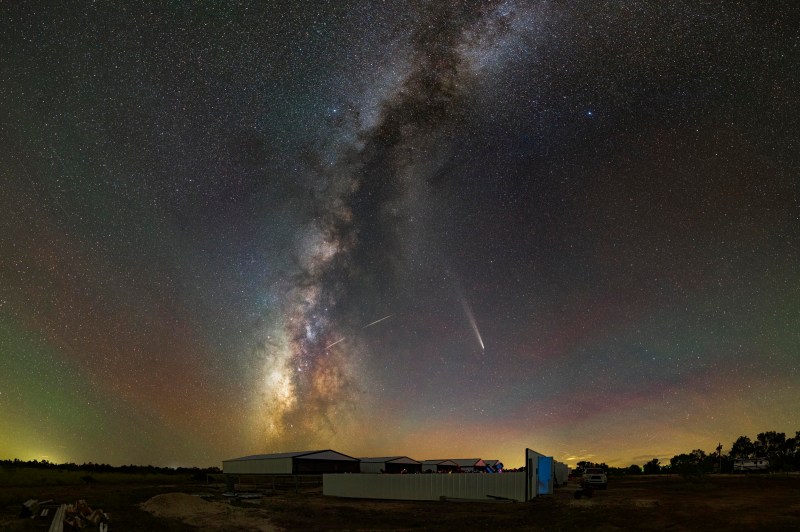
McCulloch County, Texas, is smack dab in the middle of a very large state. We wouldn’t exactly call it the middle of nowhere, but given there’s so little light pollution it scores a 1 on the Bortle Scale, it’s not exactly the Big Apple, either. [Bray Falls] lives there, and has a job description we have become immediately jealous of: [Bray] is a telescope rancher.
Like the song goes, the stars really are big and bright at night deep in the heart of Texas. Not only is his ranch free of the light pollution that plagues more urban locations, central Texas is pretty dry, with only a few days of rain in any given month. That’s not great for agriculture, but it’s great for astronomy since it means the skies are most often cloud-free. Combine that with access to high-speed internet, and you have the makings of a telescope ranch.
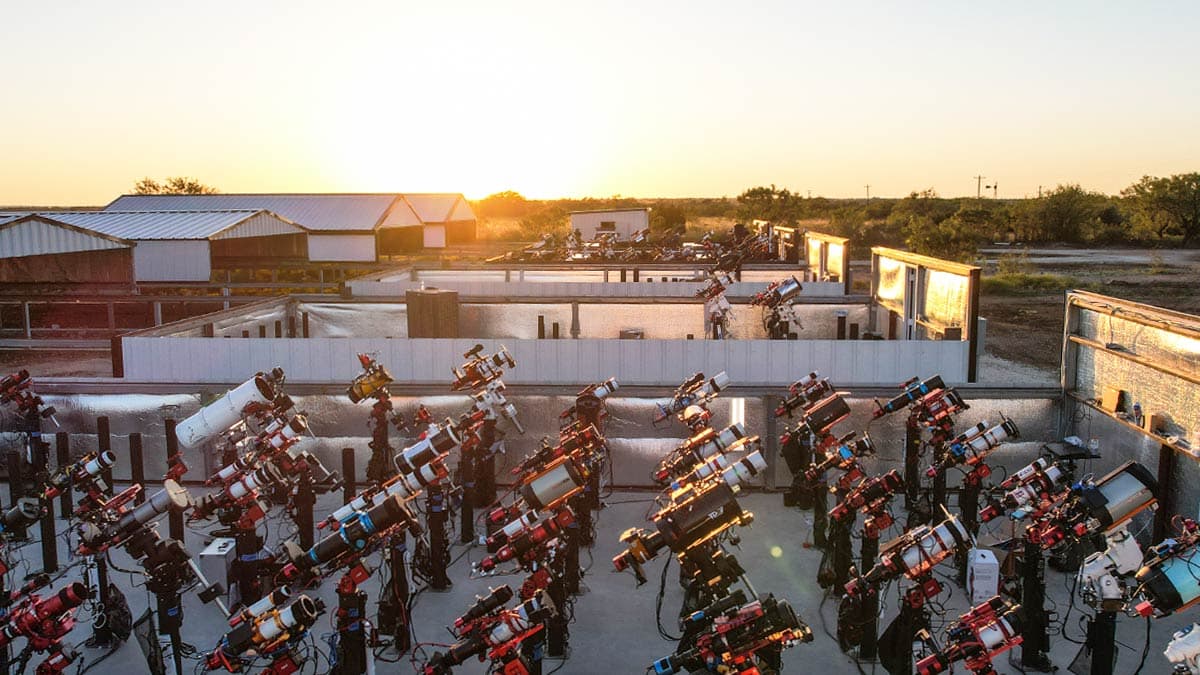
Image: Starfront Observatory
It’s brilliant in its simplicity: along with his own ‘scopes, [Bray]’s Starscope Observatory hosts hundreds of other people’s CCD equipped goto telescopes, all set up to be remote controlled over the information superhighway. On clear nights– which again, is most of them–the roofs roll off the telescope barns and observations can begin. Pad rental comes with tech support, too, so you don’t have to fly out to heart of darkest Texas if your mount gets jammed or you lose signal for any reason. That said, you should be sure to read the fine print before signing up, because said tech support probably doesn’t apply if you 3D printed your own ‘scope, or built your own mount.
That said, having gone to the effort of doing all that, would you really send your baby away to a farm upstate? Best reserve that for the old Celestron collecting dust in the corner. If you think we should be leaving these observations to the pros, be aware [Bray] has apparently discovered a very oddly-placed supernova remnant, 40 degrees off the galactic plane in Virgo. So this isn’t just a rewarding hobby; it’s still science, too.












Everyone wants that “perfect photo”.
Git along, little Dobsonian
Nice.
hmm, we always laugh at the thought texas is a big state, if you put it in Aus it would be one of our smaller ones.. And having lived in it for a while I also laughed at their idea of ‘middle of nowhere’ – we probably have bits of land the size of texas with only a handful of people in them…
Can confirm. Wife and I took the train from Pert tho Adelaide. Miles and miles of nothing but nothing. Beautiful coutry, though. You should start a telescope ranch in Cook, SA
Australia’s biggest ranch is around 7 times larger than the biggest in Texas.
Herding giant spiders for the Asian market I assume.
To give an accurate comparison…..
Alaska is almost 17.5% of the US by area. Texas is only ~7% and California is only 4.3%. Only 6 of our 50 states hold more than 3% of our overall area.
So Texas is pretty big by US standards. Driving east to west across Texas is around 80 miles more than driving California top to bottom. Either of which seems like a HUGE distance compared to the east coast where you can pass through Maryland Delaware New Jersey New York Connecticut Rhode Island Massachusetts New Hampshire and Maine over the same distance.
Texas is 695,662 sq km with a population of approximately 31.7 million roughly 42.9 people per square kilometer with a GDP of $2.9 trillion US
So its smaller than every Australian state but Victoria and Tasmania.
Australia is about 7.69 million sq km with a population of approximately 28.5 million roughly 3.7 people per square kilometer with a GDP of approximately $2.12 trillion USD.
So Australia is over 11 times the size with only 90% of the population with a GDP ~73% of Texas. So you win, Australia definitely wastes more space than Texas.
The Texas fact that I like to scare people with is that if you were to drive from Jacksonville, Florida along Interstate 10 – which crosses the entire continental US – to Santa Monica, California where the freeway ends, the entire middle third of the drive is in Texas. Orange, Texas on her eastern border, is closer to the Atlantic Ocean than El Paso, on the western edge of the state. El Paso, in turn, is closer to the Pacific Ocean than it is to Orange.
Texas is offensively wide.
Ontario says “hold my beer.” The Trans-Canada highway traversing Ontario alone is twice that distance.
Alberta from the US border crossing to the its northern border is also longer. Southern Alberta is closer to California than it is to its northern border. (Though, politically it’s closer to Texas.)
There’s a reason Canada has the highest per capita transportation fuel consumption.
Texas isn’t even in the top ten of 1st-tier subdivisions in North America. Six Canadian provinces, three territories, and Alaska are all bigger. Heck, even little Newfoundland&Labrador, comprising mostly an island, is the same size.
For the Aussies: the drive from the ferry terminal (Port aux Basques) to the capital city (St. John’s) in Newfoundland is about the same Melbourne to Adelaide via the Ocean Road. Equally scenic, but in very different ways. Just replace ‘roos with moose.
The difference is the Canadanastan provinces extend to region where nobod wants to live, then where the government will pay you to live, then to where nobody lives at all and animals are seasonal and fly in from the south in the summer.
The difference is in Texas everything with two legs will shoot you if you look at it the wrong way, while in Australia everything with more then two legs will kill you no questions asked. ;-)
I think in Texas the snake thing is similar except the rattlesnakes will warn you first – sometimes. And the plants don’t want to be touched. And all the lakes are artificial. And the whole state slopes from north to the gulf sea shore in the south at 3 feet per mile. It is so flat that if you have a second floor window you can see your dog running away for 3 days. (There must be variations on the same joke in Oz.)
In Canada we tell that joke about Saskatchewan.
Which wouldn’t be a bad place for a remote observatory, come to think of it. Not nearly as dry as Texas, though.
Didn’t Australia also have Road Trains? US has all sorts of trucker shows, where is the Australian outback show?
(very off topic)
https://en.wikipedia.org/wiki/Ute_muster
Had to look it up to make sure it is real and not something Gary Brannan made up.
Looks like an Ute has a flatbed.
https://en.wikipedia.org/wiki/Ute_(vehicle)
So, they’re doing El Camino?
https://www.youtube.com/watch?v=qwOmRWpKp1g
Oregon allows 3 semi trailers on I5. Or did?
Every once in a while I become aware of a situation in which Australia has a bitter rivalry with America over some issue or another, but nobody in America has never heard of it at all
I’ve always consider it quite insane that a handful of Australians can claim an entire continent.
But they are not the only ones that claim excessive territory though.
Most often its accepted because it’s a lot of desert, but desert has resources and can be converted and it’s still weird in my eyes.
Well it wasnt really a handful of Australians who claimed the continent. It was Great Britain while Europe was in their claim the world era.
You can always spot a programmer, using goto instead of go-to or go to, yeah, the latter both feel somehow wrong to me too.
It’s actually quite sad to see a Bortle Scale map of the UK, nowhere seems to score a 1. I thought the contrast from town to countryside was good. It must be incredible to visit an area that’s class 1. It’s surprising how far out to see you’d need to go to fully appreciate a class 1 rated sky. No doubt something akin to getting glasses for the first time.
Being a programmer has nothing to do with it. “Goto” is the marketing term for that kind of scope mount.
Even more confusing was the vintage Japanese telescope maker Goto.
They did not make GOTO telescopes. :)
I wonder what map you’re using that gives McCulloch county a 1 on the Bortle scale. This map puts most of the county at a 3. Try Catron County NM. Not only is most of it at Bortle 1, the average elevation is 7300′, and it’s bone dry.
Looking at that site I guess you can forget about it in Italy and the Netherlands, but Donetsk gives a better look at the sky (but unfortunately the brutal sky looks back).
I’m a bit surprised how much light pollution northern Africa has, I was expecting a few hot spots in a few cities. Same for Arabia, you would think the light pollution would be more concentrated.
It’s Starfront not Starscope. It does have a beautiful starry sky when clear. But this year has been quite cloudy and humid. Some of that can be attributed to the current El Nino, perhaps.
Starfront has had a fascinating and very rapidly growing success. There have been several similar projects in New Mexico and the EU but IIRC they have stayed fairly small. And now they are hosting so many very good scopes that high-end complete systems are routinely for sale in place and operating due to the owner’s change of plans or upgrading, etc. They have an active Discord channel.
Well, in the picture it seems one camera is most important: a surveillance camera.
OK Tyler we need a small correction: “…the stars really are big and bright at night deep in the heart of Texas.” Should be ” ..the stars at night are big and bright < insert 4 claps here > deep in the heart of Texas” Sorry had to poke you for that one. I need to make a trip out there to see it as I’m about 3 hours away.
Well, at least I know someone caught the reference!
How can you tell if you are in Texas? https://www.youtube.com/watch?v=So23SFwBVvI
I have to admit, MALT – Massive Array of Little Telescopes – was not on my bingo card.
It’s not about the size… it’s how you use it! :)
Are they doing any Virtual Aperture stuff?