
Typically, when you’re sitting on a plane on the tarmac, you switch your phone to flight mode while you’re sitting through yet another “quirky” (boring) safety video. You’ll watch some inflight entertainment, read the airline magazine if you get really desperate, and wonder if anyone ever buys those random watches for sale in the “duty free” section. Then, finally, upon landing, you’ll be connected back to the Internet and you’ll finally feel like you can breathe again.
Only, this time, you forgot to set your phone to flight mode. You’re sitting at 30,000 feet, and… your phone has signal? You’re online, and you’re getting notifications and emails just like you’re on the ground. You’ve accidentally discovered that your flight has an on-board cell tower.
Connection
When you’re cruising on a passenger airliner, you would typically expect to see little to no cellular signal by sheer virtue of altitude and speed. For one thing, you’re blasting past at immense speed and not staying in any one coverage zone for very long at all. Meanwhile, while you’re probably within 10 kilometers or so, vertically speaking, cell towers generally have their antennas aimed at the ground, not the sky. There simply isn’t much signal available, and you’re zooming around a bit too fast to hang on to any cell tower before it’s disappeared out of range.
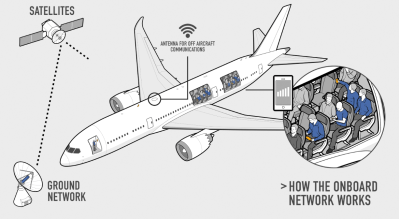
Some airlines have gotten around this problem by providing on-board Internet connectivity over WiFi. The aircraft features an uplink to one of various satellite networks that provide Internet access, and that is provisioned to customers in the cabin over a WiFi router with a captive portal. Typically, for some painful charge in double digit US dollars, you can purchase a few hours of access to your emails and the Web, often with quite shaky connectivity.
However, there is sometimes a way to dodge the painful fees for onboard WiFI, while still getting online. A handful of airlines have equipped some of their fleets with cellular connectivity via a system called AeroMobile. They still rely on a satellite uplink for Internet access, and these planes generally still have onboard WiFi as well. However, if you happen to switch your phone out of flight mode, you might notice it connecting to a cell tower onboard—the AeroMobile picocell, in fact. Your phone connects to this tiny cell tower over cellular data links—originally 3G, later 4G or 5G depending on the hardware onboard—instead of WiFi. You escape the airline’s captive portal and data charges, instead paying your home carrier for data and whatever fee you normally get billed for international roaming. The ability to do this depends on your home mobile carrier, too, and whether they have an agreement with AeroMobile.
AeroMobile’s service depends on customers actually switching out of “Flight Mode” in order to allow the phone to use its cellular radios to connect to the picocell onboard the aircraft. Credit: AeroMobile
AeroMobile has been around for a long time now, first demonstrating its hardware with GSM and GPRS data links on aircraft as far back as 2005. The company’s voice and data offerings have stepped up over the years as mobile technology has moved on, albeit often some years behind the state-of-the-art in the cellular world. The first planes with 3G didn’t fly until 2015, well over a decade after the technology was becoming established on the ground. As a subsidiary of Panasonic Avionics, AeroMobile-equipped aircraft communicate with a range of satellites that Panasonic has access to over Ku-band and L-band links. In recent years, the company has been developing the capacity for its aircraft to seamlessly switch between links to geostationary and low-earth orbit satellites, with the former offering the best coverage, and the latter Eutelsat OneWeb satellites offering much reduced latency and higher link speeds. Ultimately, user experience depends on flight route, local conditions, and other factors; speeds and reliability can vary from good to spotty on any given day. There’s also the fact that, on any given flight, tens or hundreds of other users may be trying to get online over the same link, which can quickly dry up what little bandwidth may be available in some black spots on the world map with poor satellite coverage.
If you’re flying soon, it’s still unwise to rely on in-flight internet connectivity. Whether you’re hooking up over WiFi or cellular, there are still often issues with coverage, or with systems being inoperative on certain flights and at lower altitudes, even on airlines with the best-equipped fleets. You’re also unlikely to regularly get high enough speeds for comfortable streaming, so you’re better off downloading The Thick Of It prior to take-off rather than trying to watch it live off a server while you’re scooting over downtown Astana. However, now and then, when you’re lonely and high above this marbled sphere, you might be just able to hang out on Discord and flirt with a few friends back home thanks to Panasonic and a steady link to the satellites above. Have fun up there.











Reminds me of a system that would supposedly put cell towers that aimed towards the ground on airplanes to provide coverage in weird areas, at least for a few minutes here and there. Unfortunately, one of the companies that was planning on doing this was plagued with various allegations of fraud and corruption. So we’ll see what happens in that industry, but it’s an interesting idea to have the ability to grab a text or a 2-minute call from an airliner that’s zooming over you while you’re in the desert or something.
AST SpaceMobile aims to do this with satellites, compatible with 5G.
It’s going to make E911 more interesting, regardless if it uses AST or Starlink/T-Mobile’s version.
military uses them in c130 style pane to hack everyone and everything as they fly over when one dose fly over dont sit near your pager
There are drones that can do that, like Primoco UAV drones, also with T-Mobile technology https://www.telekom.com/en/media/media-information/archive/deutsche-telekom-uses-drone-as-flying-base-station-for-temporary-coverage-1088440
An informative article, I’ll warn everyone I know to watch out for picocells on planes that carry international roaming charges. From a cost perspective this system is a landmine laying in wait for anyone who hasn’t prepared their phone for travel before boarding the plane.
It’s the same on cruise ships and ferries, if you forget to turn off cellular data there will be hefty roaming charges.
So no longer needed to use Flight mode I guess :D Hypocrites..
Flight mode is less to fight interference between the phone and the avionics, and more to fight the interference between the phone and the brains of the passengers.
If there’s an emergency, passengers have to be paying attention to the flight attendants, not their social network feeds.
“f there’s an emergency, passengers have to be paying attention to the flight attendants, not their social network feeds.”
You do realize that “cell phones must be turned off at this time” predates cell phone accessible social media.
The mandatory rule to turn off cell phones began in the early 1990s as a precautionary measure to prevent portable devices from interfering with aircraft navigation and communication systems. The FCC officially enacted a rule mandating that all cell phones be turned off once an aircraft leaves the ground.
This strict “power down” requirement lasted until October 2013, when the FAA officially updated its guidelines. They determined that personal electronic devices could remain powered on throughout the flight as long as cellular connectivity was disabled.
Today, while the total power-off mandate has been lifted, federal law and airline policies still require that all cellular transmitters be disabled by enabling “Airplane Mode”.
Total power-off is still mandatory in some cases such as when landing in very poor visibility and a fully automatic landing was required.. I have experienced it a couple of times myself, where the captain ask everyone to shut down their devices, and the cabin crew walks down the cabin asking everyone if they have fully powered off their devices.
The last couple of times I took a transoceanic flight (a year ago, and the year before that), the “free” wifi tier allowed you to keep using whatsapp (text only), both with Level (Iberia low cost airline) and United, though in both cases coverage was hit and miss.
Just yesterday I read a press release of the first Iberia flight (from Madrid to São Paulo) using starlink and it said it is completely free for everybody (economy, economy premium and business), with full internet access up to 500Mbps (or so they say). In the next two year the service will be available in all its planes.
Lufhansa and SAS are also converting their planes to Starlink, with one motivation is fuel efficiency as the Starlink antenna is much lighter and sits almost flush with the fuselage.
Musk went on a rant against Ryanair when they refused to use Starlink.
The rule was made back when analogue phones were the norm.
All communication is analog, only the data transferred is digital but the endgame is that if it’s transmitting, it’s interference may cause issues with chips. For example you wouldn’t want ECU in a transatlantic flight to suddenly enter “check engine” mode because some Facebook app triggered a bit flip? Without enough power the plane will crash.
Using an airplane in car mode makes for a long and tedious journey.
the picture suggested a cell tower attached to a plane, to serve the area it flies over. I was envisioning a drone that takes up a stationary position to hoist some antennas up, that might be useful for emergency situations. if you give it a tether that supplies power it can stay up for a lot longer.
Like…a balloon?
“Only, this time, you forgot to set your plane on flight mode. ”
Oh dear. Can the plane take off when it is not in flight mode?
Planes become extinct like dodos.
All plane’s, helicopters , passenger liners ground antennas could be equipped with technology that could be transmitting signals in every direction forming a infinite ever changing world covering single that could potentially make it possible for anyone anywhere in the world to be able to use phones, computers and any other device without signal failures or slow internet speeds,
Basically an ever changing connectivity signal . Let’s call it the world-Air-cellular-Network-Grid.
Like the networks share towers on the ground this could happen anywhere Planes, helicopters. Cruise ships. Container ships , trains, buses skyscrapers. Land towers. The amount of land sea and air signal coverage at any given time would be eminence… wouldn’t it?