
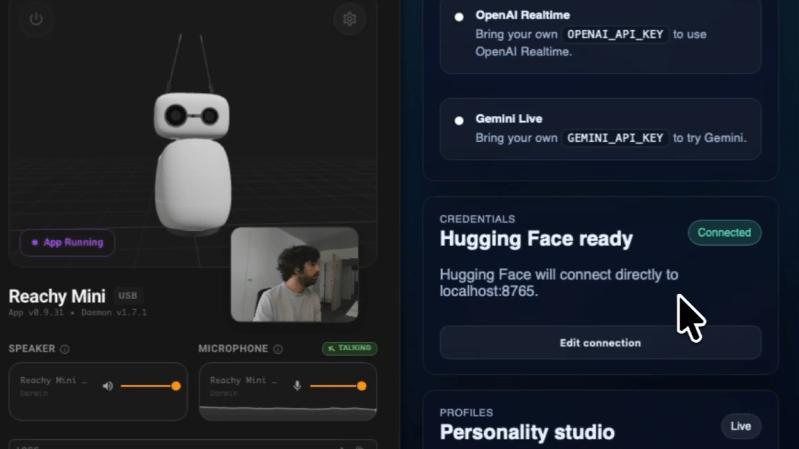
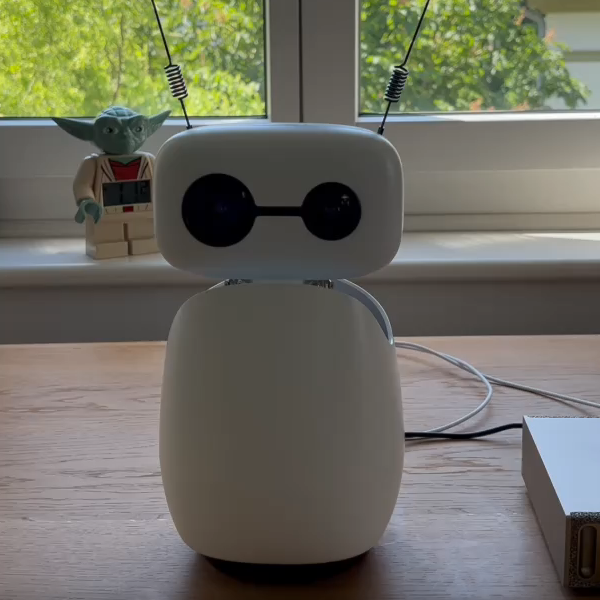
Reachy Mini is a limbless desktop robot from Hugging Face made for human interaction experiments, and to give you an idea of what it’s like is a guide on how to implement expressive, local conversational AI complete with head movements and antenna wiggles. It’s conversational in the sense that it aims to feel natural, with low-latency responses and the ability to interrupt, with everything running on local hardware if one so wishes.
The software stack is essentially VAD (voice activity detection) → STT (speech-to-text) → LLM (large language model) → TTS (text-to-speech) which allows users to tweak things to their liking, or independently swap or modify pieces as things evolve.
This also allows users to tailor the services to match whatever their hardware is capable of. For example, one could easily use a frontier AI model via remote API for the LLM while keeping everything else local.
The local models in the example configuration are effective and relatively modest (Qwen3-4B-Instruct for the LLM, and even smaller models for the rest) but it’s nice to have the option to offload parts to remote providers if necessary.
Reachy Mini looked very interesting when it was launched as a kit last year, and since then Hugging Face has built up an impressive software suite and infrastructure through which users can easily share their applications. If you’re curious, there’s a simulator for Reachy Mini which should give you an idea of what it can do.









Solid software work. But on the ‘open-source’ framing: the full CAD and PCB still aren’t published — HF’s own FAQ says the STEP files aren’t out yet, only some STLs. The team keeps prioritizing first deliveries while the robot sells globally. And when I asked, a Pollen member said the hardware would be CC BY-SA-NC (non-commercial), which isn’t open-source hardware by the OSHWA definition. SDK and skins are shared, but the electronics aren’t reproducible yet. Hoping the files drop, just worth noting…
–
It is so reminiscent of the Nabaztag.
A rainy day project for my rabbits! Update them with something capable of running this inside and waggling their ears….
Oppo f19s