
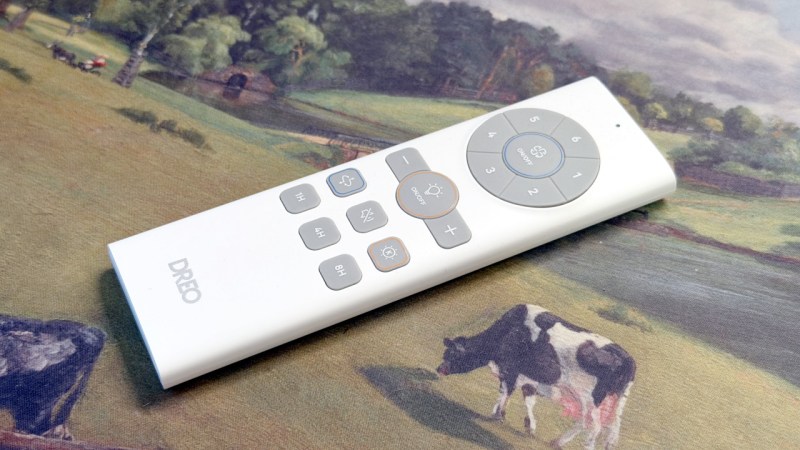
[Sam Wilkinson] recently installed a Dreo CLF513S ceiling fan in his place — it’s cheap, well-sized, and blows air around as you’d expect it to. The only problem is that it only works with an ugly cloud-only smart home setup out of the box. Never mind, though, because [Sam] figured out how to hack up a custom solution.
Hacking efforts began with the included remote control. [Sam] identified that the remote had to be RF, since it didn’t need line of sight to work properly. The FCC ID on the back of the device further indicated this was the case. Armed with that knowledge, it was simply a case of figuring out the commands sent by the remote, building something to replay them, and then hooking that into [Sam]’s existing Home Assistant setup.
The remote ran on 433.92 MHz, a not-uncommon bit of spectrum for these sort of appliances. An RTL-SDR was thusly enlisted to capture the output, with a spectrogram indicating the remote used simple on-off keying to send commands. Once commands were captured, [Sam] grabbed an ESP32-C6 microcontroller, hooked it up to a RFM69HCW radio transceiver, and programmed it to replay the fan on/off command. From there, a little dabbling with MQTT got the ESP32 controlling the fan as desired from within the Home Assistant ecosystem.
Sometimes, it’s hard to find smart home gear that actually suits your tastes and budgets. Often, a bit of tinkering can shape existing appliances to bend to your will instead. If you’re tweaking your own gear to better fit your smart home, don’t hesitate to notify the tipsline.












One buy more the sellers note as “people want this crap”.
Smart Fan controllers seem particularly hard to find. Especially outside of the US
#define smart
A fan with temp sensor with clock and timer. Maybe add a motion sensor.
A seriously “Smart Fan” is a ceiling fan that disables itself whenever a trampoline is put directly underneath it.
Lutron Caseta has a good fan controller switch that ties into any smarthome setup. The only problem is that people got tired of wiring separate circuits for fans and their included lights, so finding a fan with a light that isn’t on some kind of remote or whatever is tricky unless you’re shopping 90s vintage.
I used to have a ceiling fan that ultimately wriggled back and forth enough to cause metal fatigue to its bolts, sending it crashing to the floor one day while I was in Costa Rica (the house sitter told me!). That one was simple and controlled by an ordinary electric switch. The replacement I bought (and you can never know in detail what their quirks are until you buy them) had an electronic RF controller that — infuriatingly in this environment — forgot its state after a power outage. So I could no longer use the system I’d been using with the old fan, which was a mercury tilt switch that caused it to turn on when the temperature rose above about 90 degrees. This was perfect in the winter time for sending the hot air from the woodstove down out of the cathedral ceiling.
A trick to balancing ceiling fans is putting a binder clip on the blade edge.
You move it further or closer to the fan center hub to adjust the amount of “counter weight”.
Many ceiling fan controllers croak due to bad caps or mains transients. I have fixed a few Hamptons.
The remote is the smart controller, it has the temp sensor and timer etc.
What is it with people buying garbage labelled “Smart”? Is it like the craze of buying things starting with the letter “i” or putting “Z” or “X” in the name?
I bought a cheap fan with built in LED and ran it for a few weeks. I then bought 3 more as they work perfectly fine with the supplied remotes: no cloud, not smart. They’re about $10, easy to disassemble and it wouldn’t bother me to bin one when it eventually can’t be repaired.
Capturing simple on/off commands is built in functionality in Domoticz. Simply click on “learn switch”, use your remote and Bob’s your uncle.
(Provided you have the proper hardware of course)
Thank You! 👆.. I’m controlling every ceiling fan in my house from a c3 on the top floor from HA and or my diy voice puck on an s3.. my fans are all obscure cheap and well.. they ‘were’ dumb.. but yeah, one learn command pulled the light dimming, fan speeds, direction control.. everything.. no cloud needed!
Be a real hacker. Make a Fan-b-Gone device.
They typically use Princeton protocol, which while static can have a variety of baudrates and have a 24bit serial in the packet (don’t want you accidentally triggering the neighbors device), as well as the button and preamble. Buttons are not standardized.
Its not really feasible
Weird. Is this different than using a rf/ir/wifi/Bluetooth smart transmitter? I bought a couple for my home about 4 years ago. I have it set to turn my fan/lights off when it’s time to go to work and it turns my remote controlled window shades into a smart device. Also turned my audio receiver into a smart device where I could remotely control it along with my 4k player which was hidden in a closet. And it controls the living room ceiling fan with the rf transmitter.
Yes, it IS an RF transmitter. What’s “weird” about it?
FIA actually opens a case, —it’ll be for crimes against engineering! 🤫🚔