
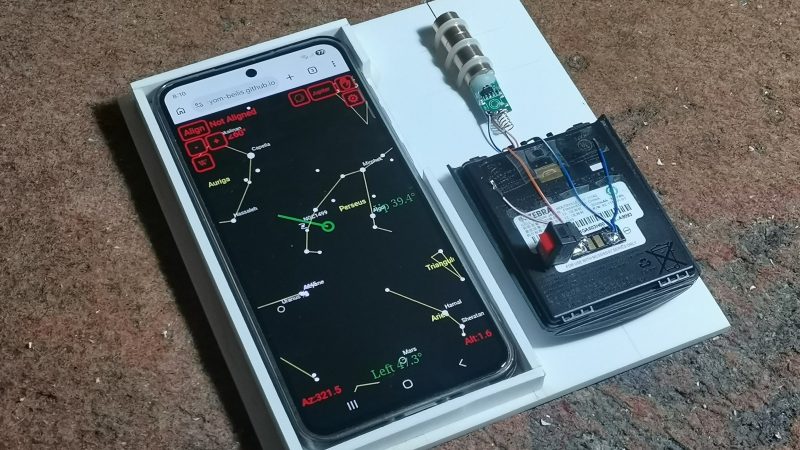
Perhaps the hardest thing for amateur astronomers just starting out is finding the things you want to look at. Prolific maker [mircemk] has submitted a quick-and-easy star-hopper device that will help guide your binoculars with laser-like precision using things you likely already have on hand: a smartphone, a mounting plate, and a green laser pointer.
The smartphone is running AstroHopper, an astronomy app that uses GPS and inertial navigation to know exactly where your phone is pointing, and offer an image of the sky on the screen. There are many others of this ilk, and there’s no reason [mircemk]’s trick won’t work with your favorite. The trick is decidedly simple: the smartphone is mounted to a flat plate, in line with a green laser pointer. Careful placement aligns the axis of the phone and the laser, and the mounting plate is set up to fit a tripod.
Using it is simple: with a labelled view of the sky displayed on the screen, one lines up the phone/laser combo with the desired object, and activates the laser pointer. [micremk] has wired in an on-off switch for this purpose and a large external battery, rather than relying on the stock pushbutton. Since the axis of the laser pointer and the phone are aligned, a green line launches out into the heavens for you to follow with your binoculars. Once you locate that green dot, you can turn off the laser. Yes, the computer has helped you find the object, but your muscles are doing the slewing and that will make it much more likely you start to learn the sky yourself rather than relying on electronic magic.
This is probably the simplest hack we’ve yet seen in the Frikkin’ Lasers Challenge, and yet also one of the most practical. If you enjoy playing with radiation that’s spontaneously emitted, there’s still time to get your entry together — the contest runs until July 23, 2026.













Really cool project; just make sure you don’t accidentally shine the laser at an aircraft!
This is pretty neat. And i really enjoyed seeing the light module taken out of a laser pen sort of device and mounted to a better battery solution — i’ve got the same at home! but :)
There’s a narrow segment of people who invest the effort to pick up a pair of binoculars but not the effort to learn how to use a star chart. And nother narrow segment of people who are willing to align a laser with their phone. And they’re strictly disjoint :)
I think for all of the actual audience, the regular phone inertial starchart is probably gonna meet the need.
I built something like this a few years back. It seemed like a cool idea but I quickly realized that pointing lasers up into the night sky is a recipe for getting visits from three letter agencies.
Nonsense, at least in the US.
Don’t point it at an airplane and you’re fine. And even then, if you were to accidentally briefly hit an airplane cruising at altitude, you’re still fine. The only thing that would get you in trouble would be specifically illuminating an airplane, especially the cockpit, as it’s approaching or departing an airport.
TLDR, if you’re not intentionally causing mischief you’re fine. Again, in the US. My understanding is Australia is much more anal about these things, for example.
Australian here, its about the same. Deliberately target an aircraft with a laser and you’re going to be in severely deep excrement. Incidental temporary illumination during stargazing – the civil aviation authority might react, but very likely nothing will come of it since tou cannot be expected to see distant aircraft at night.
Only if you point it at a plane or helicopter. By the time your beam reaches the star you’re pointing at, it’s likely that you’ll have had more than enough time to blend back in to the rest of life on earth. (If you haven’t died of old age )
But do avoid local aircraft! https://www.youtube.com/watch?v=Z6b51XsHWT8
“If you enjoy playing with radiation that’s spontaneously emitted”
Ehhmmmm… Doesn’t the S in LASER stand for stimulated radiation?
Learning /consulting a star map doesn’t hurt
I made a similar device with my 3D printer about 12 years ago and posted it on Thingiverse (https://www.thingiverse.com/thing:454265). It was a pistol grip handle that held a phone and a green laser pointer. You run google sky map on the phone to search for an object and the laser points at it in the sky.
The phrase “locate the green dot” made me happy!
Use a star chart and learn to star hop