2026 Frikkin Lasers Challenge: Laser Bandsaw

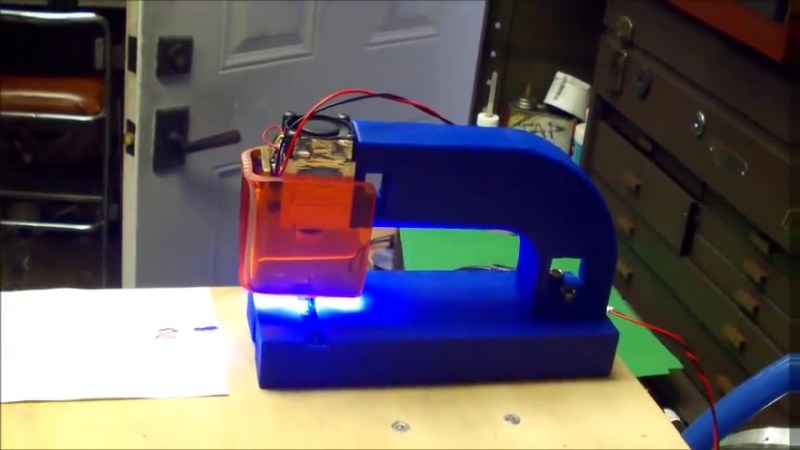
Can you call it a bandsaw if it has neither band nor saw? [WeldingRod1] does, with his entry in the laser contest — a manually-controlled laser cutter that he’s dubbed a Laser Bandsaw. Some might quibble that it’s not actually sawing with the beam, and others will inevitably find the safety implications rather frightening. We think it’s a fun project and that [WeldingRod1] can call it what he wants, as long as he follows his own advice and keeps his laser goggles firmly on his precious vision orbs.

He has actually put some thought into what started as the physical manifestation of a joke in a podcast. The blue diode laser — a NUBM44 diode rated at 7 W — got a custom-made copper heatsink. It’s also got a hefty beam dump in the form of a stack of box knife blades. That’s very necessary to keep the beam from reflecting where it shouldn’t, especially when you consider this operates like a regular band saw: you turn it on, and it’s ready to cut. With only 7 W of laser power it can’t cut that much, mind you, but apparently it’s great on balsa wood and blasts black paint off like nobody’s business.

Now if this was our shop we’d probably want to put the laser diode onto some kind of CNC platform, be it Cartesian or SCARA. But we’ve seen that done many, many times and if you’ve got the motor skills this might be just the tool for you. There’s a pinout and STLs for the 3D printed frame on the project page if you’re interested. If not, why are you still here? The article is finished. Go make something lase and send it in. The deadline for the 2026 Frikkin Laser Contest is fast approaching!

2026 Frikkin Lasers Challenge: Super-Simple Laser Precision For Your Stargazing

Perhaps the hardest thing for amateur astronomers just starting out is finding the things you want to look at. Prolific maker [mircemk] has submitted a quick-and-easy star-hopper device that will help guide your binoculars with laser-like precision using things you likely already have on hand: a smartphone, a mounting plate, and a green laser pointer.

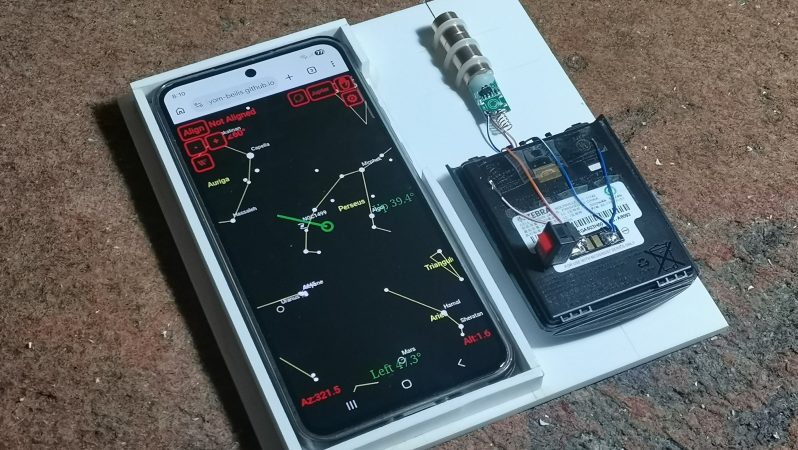
The smartphone is running AstroHopper, an astronomy app that uses GPS and inertial navigation to know exactly where your phone is pointing, and offer an image of the sky on the screen. There are many others of this ilk, and there’s no reason [mircemk]’s trick won’t work with your favorite. The trick is decidedly simple: the smartphone is mounted to a flat plate, in line with a green laser pointer. Careful placement aligns the axis of the phone and the laser, and the mounting plate is set up to fit a tripod.

Using it is simple: with a labelled view of the sky displayed on the screen, one lines up the phone/laser combo with the desired object, and activates the laser pointer. [micremk] has wired in an on-off switch for this purpose and a large external battery, rather than relying on the stock pushbutton. Since the axis of the laser pointer and the phone are aligned, a green line launches out into the heavens for you to follow with your binoculars. Once you locate that green dot, you can turn off the laser. Yes, the computer has helped you find the object, but your muscles are doing the slewing and that will make it much more likely you start to learn the sky yourself rather than relying on electronic magic.

This is probably the simplest hack we’ve yet seen in the Frikkin’ Lasers Challenge, and yet also one of the most practical. If you enjoy playing with radiation that’s spontaneously emitted, there’s still time to get your entry together — the contest runs until July 23, 2026.

Continue reading “2026 Frikkin Lasers Challenge: Super-Simple Laser Precision For Your Stargazing”

2026 Frikkin Lasers Contest: Steampunk, 360 O-Scope Does It With Tubes

Audiophiles all know everything sounds better fed through vacuum tubes, but did you know visualizers look better with them, too? That’s what we’re forced to conclude looking at the Tachyscope Laser, a 360-degree oscilloscope display that is [Daniel Ross]’s entry into the ongoing Frikkin Lasers contest.

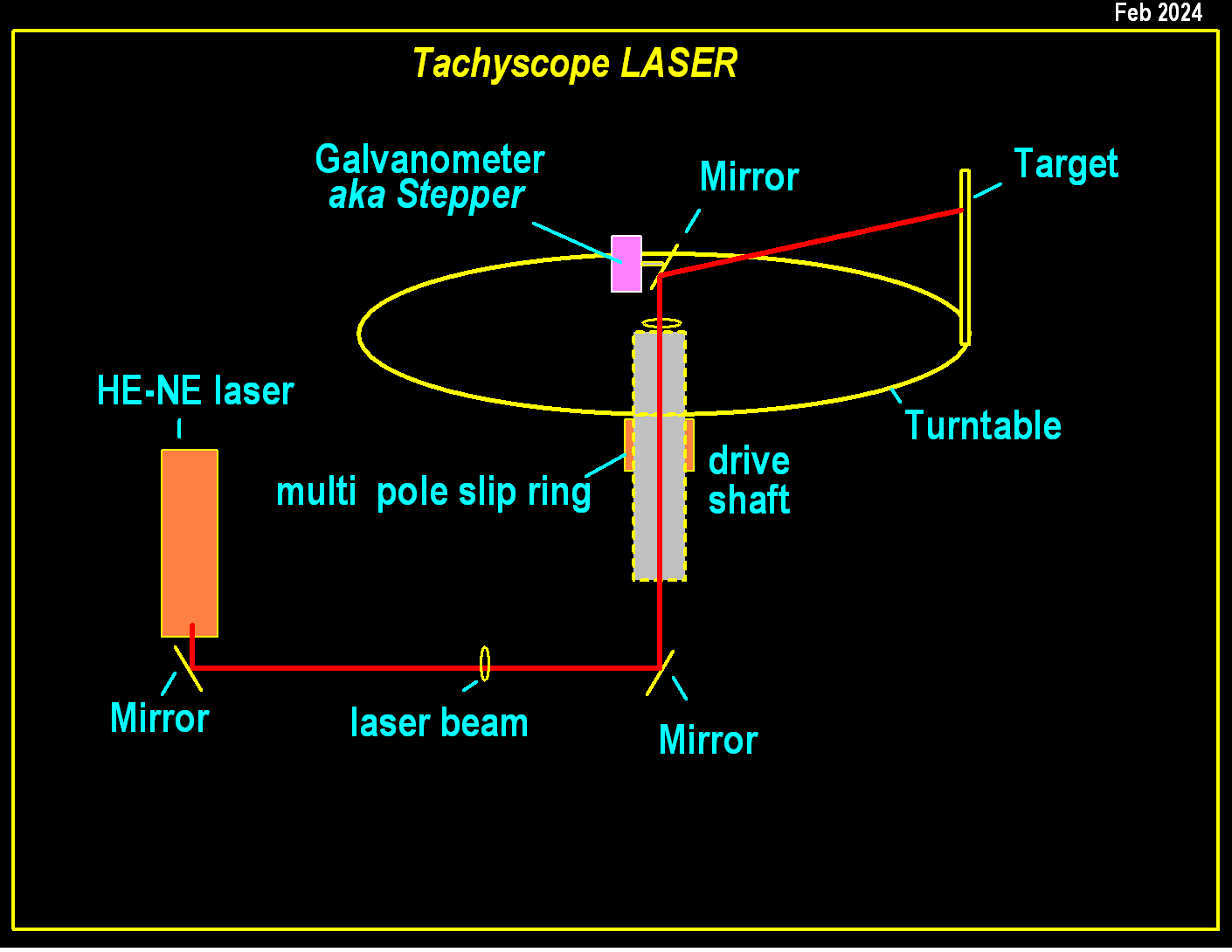
The diagram makes it look easier than building it probably was.

The laser is a good old-fashioned helium–neon tube — something we see less and less of in this era of solid state lasers — and the wavelength gives the waveform display a retro charm. The actual display is unique in our experience, with the beam shining up through a hollow shaft to bounce off a galvanometer mirror on a spinning platform. Galvo sweeps the laser across a translucent target, which creates the waveform by persistence of vision as it spins at 100 RPM or so.

Does the fact that the audio signal feeds through a tube amp to drive the single galvanometer actually improve the visuals? Only in the sense that those tubes make the steampunk-style enclosure look really, really cool, as does the exposed laser tube. That all of the steampunk elements obviously have a point to them rather than just being a another “glue some gears on it” project is icing on the laser-flavored cake.

The contest runs until July 23rd, so there’s lots of time to get laserin’ — and remember that there are categories for DIY lasers and anything that isn’t a display, just in case you think this project puts the bar too high for a light show. We’ve actually featured one of [Daniel]’s tachyscope waveform visualizers before, but that one, madly enough, spun an actual CRT.

Continue reading “2026 Frikkin Lasers Contest: Steampunk, 360 O-Scope Does It With Tubes”

The Frikkin Lasers Contest Starts Now

We don’t need to tell you: lasers are awesome. Those tiny red beams aren’t just for frustrating cats, but can do real work, be a source of infinite beauty, or constitute a science project in its own right — and you can win a $150 DigiKey gift certificate simply by writing your project up on Hackaday.io. The contest runs until July 23rd.

Of course, red lasers are only the beginning. If you have enough energy to move electrons into higher orbitals, you can make nearly anything lase. RGB setups can be breathtaking. Powerful IR and UV lasers are real tools. And the DIY side of lasering combines physics and electronics, with a spicy side of danger that needs to be contained.

We love laser builds of all sorts, and we’d like to see yours! Create a new Hackaday.io project that features what you’re working on, and we’ll pick our three favorites for a $150 gift certificate courtesy of this contest’s sponsor, DigiKey.

Continue reading “The Frikkin Lasers Contest Starts Now”