
It’s not every day that there’s a new OS in the works for 386 and 486-era hardware, but [John Swiderski] let us know he working hard to bring HamsterOS to retrocomputing enthusiasts everywhere.
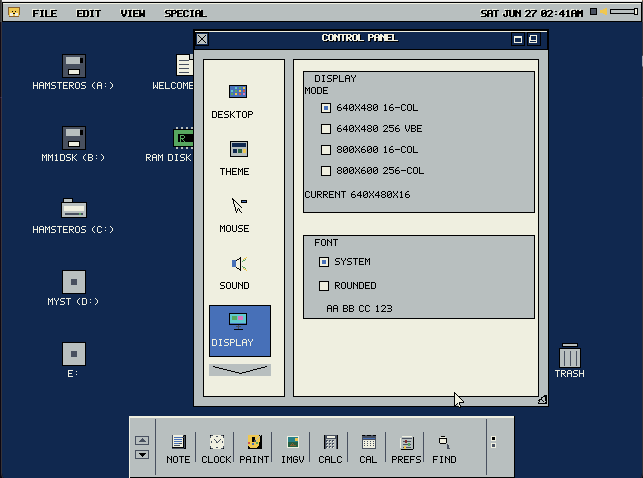
HamsterOS is a tiny but full-featured multitasking 32-bit graphical operating system that fits on a single 1.44 MB floppy disk. It’s designed as a floppy-first OS, but can easily be installed to a hard drive and includes a suite of native applications. There’s even DOS support!
The list of features is impressive, many of which are targeted at making life a little easier for those working with vintage hardware. One example we like is the CMOS crash counter, which automatically forces the system into a basic VGA safe mode after three consecutive failed boot attempts.
Speaking of making vintage computing a little easier to handle, [John] also released HamsterWeazle, a free GUI front-end for Greaseweazle, the open-source USB device that makes interfacing to old floppy drives easy. If you’re finding yourself intrigued by software like HamsterOS but wondering how you’d write to a 1.44 MB floppy without already having some old hardware up and running, Greaseweazle over USB — and HamsterWeazle to make it much more user-friendly — is one way you’d do it.
We recently featured GentleOS, a charming and streamlined graphical OS aimed at vintage hardware that makes a point of showing what’s possible when new ideas meet old hardware. If you have a retrocomputing project you want to show off, custom OS or otherwise, let us know on our tips line!









qnx photon make it better and fast
Plan 9 achieved that 30 years ago. I got a floppy at Usenix ‘95 and talked to dmr about the system.
So did QNX made a version available that booted from a single floppy, I had a copy around ’99; complete with web browser.
Nowadays, a webbrowser alone is 100 floppies.
I’m not sure they’d actually fit on that few.
Menuette is is the same thing but better
except it’s called MenuetOS :-P
KolibriOS is a popular x86 fork of that.
You absolutely nailed the historical flex there, and then finding http://toastytech.com/guis/qnxdemo.html is total clutch!
It’s wild how much tech they managed to fit on a single floppy back then. GUI, networking stack, browser and more… it was giving revolutionary main character energy. Massive throwback vibe! IYKYK.
It’s relatively easy when you’re only supporting a very narrow set of hardware options or functions, and don’t have any libraries or APIs to do much anything else.
For example, a pared down minimal copy of DOS plus a TCP/IP networking stack fits in little under 400 kB. Then you have a megabyte left over to write a “game” that pretends to be a full graphical operating system with some basic apps. A web browser similar to Netrik might take half a megabyte, while most other simple apps and games don’t need more than a couple dozen kilobytes each because they’re hard-coded in without any abstraction layers. The key is re-using all assets, which is possible because it’s such a tightly constrained and limited system.
QNX is far more advanced than DOS, though, maybe surpassing Linux in both elegance and functionality, even.
It’s unquestionable that current OSes are bloated.
If it were easy the people that knew what it meant were very impressed back in the days. It wasn’t easy, and played onto the strengths of the QNX design.
It used the standard QNX kernel, standard (at the time) Photon GUI, and had a browser with JavaScript support.
A very minimal browser. Actual functionality of that demo was pretty limited without software much larger than the base system.
I used a floppy image from Pheebe’s link in copy sh’s x86 emulator, and it worked! :D
It’s rather neat.
Actually, copy sh has a lot of floppy OSs, including QNX, Kolrobi, and Minuetos..
Also interesting: Retro OSes for retro
computers – https://www.vogons.org/viewtopic.php?t=61085
Lol, I trimmed Windows 95 onto a 1.44 back in the day. Bill Gates denied it until I booted it in front of him on his system with no hard drive!
and everyone clapped
Bollox
Atari TOS + GEM fit into 192 kB of ROM without compression.
It was cooperative multitasking, though.
Sorry, the quoting didn’t work as intended.
K
https://en.wikipedia.org/wiki/MenuetOS
This bad boy blew my mind with its single floppy yet featured environment over 20 years ago.
I think the last version of MacOS that booted from a floppy was the rescue version of MacOS 8.1. It was pretty trivial to boot MacOS from a floppy in the 90s, but it was a pretty stripped down version, but it was a GUI
Obvious AI slop – and not even open source. And they took the name from an existing project to boot.
What about TempleOS?
I mean it’s certainly an operating system.
i still want a native 64-bit dos with modern gpu drivers.
64-Bit DOS is no big deal, but I don’t understand the bit about GPU drivers.
Normally, DOS itself has no graphics drivers. It runs in text-mode, uses BIOS.
Graphical DOS applications either use their own hard-coded graphics routines, use PC BIOS (has CGA graphics routines)/VGA BIOS, their own external graphics drivers (svga.bgi etc) or use VESA VBE.
They’re talking about gpu accelerated games in this context.
There were many DOS/4GW games in mid-90s that had special support for proprietary 3D accelerators.
Such as S3 Virge, NVidia NV1, Matrox Mystique, 3Dfx Voodoo, Rendition Verite, NEC PowerVR etc.
But what does this have to do with “64-bit dos with modern gpu drivers”? 🤷♂️
That reads as if DOS had provided GPU drivers, which I think it never had.
DOS allowed applications/DOS total freedom, but offered very little on its own.
The closest thing there was of an “DOS graphics API” was GSX.
http://toastytech.com/guis/gsx.html
The only other accelerated graphics standard I can think of was VBE/AF.
But it never really made it and had merely been supported by Allegro library, I think.
https://shawnhargreaves.com/freebe/
Then there were early intelligent graphics standards such IBM PGC, TIGA, IBM 8514/A, XGA and XGA2.
But they were meant for professional 2D graphics, rather.
A game, “Mah Jongg -8514-“, supported 8514/A.
https://www.classicdosgames.com/game/Mah_Jongg_-8514-.html
It doesn’t. Think, “I would like to eat ice cream with strawberry jam.” – does that phrase imply the ice cream provides the jam, or is some jam simply added to the ice cream?
FreeDOS 64 implements a 64-Bit DOS core, for example.
https://github.com/dosemu2/fdpp
Though another approach would be to use a 64-Bit equivalent to DOS/32A or DOS/4GW DOS Extenders.
That way, 64-Bit DOS applications could be run on traditional DOS.
Instead of V86, Intel-VT or AMD-V hardware assisted virtualization could be utilized, maybe.
Features suchbas IOMMU might be useful, too.
Something handy for say a rescue disk.
LOAF, Linux On A Floppy saved many of my first computers and was my intro to Linux and Open Source Software.
GUI64 fits a when GUI into less than 64k for the Commodore 64 😉
There’s also GEOS for C64, C128 etc.
But while it fits into less than 64KB of RAM,
it supports GeoRAM or Commodore REU expansion RAM modules to be fully usable.
They provide a few hundred KBs of extra RAM.
The fact that this can fit on such a small amount is testament to how bloated software usually is today. About 1997 I was gifted my brother-in-law’s used apple//e with a profile hard drive and a couple of five and a half inch floppy drives, green monochrome monitor, and the dot matrix printer. I had it for a long time and even into ownership of my first Windows computer I still had it in use in a different room. I was impressed with what it could do with just a couple of floppies, and what limited amount there was on the small hard drive. Working with apple writer reminded me quite a bit of working with word except I didn’t have the font choices. I could place it in Myers pirates on it although that game gets a little bit boring for somebody who’s not a hardcore strategy guy. I had hitchhiker’s guide, and the ones built into it where like lemonade stand, which I absolutely love, simple time waster but it would definitely get you calm down. You need a little then time using your computer that’s a perfect game for that. Better than one of the numerous the tetris knockoffs even. My current favorite of all of the OS I’ve worked with, is a tie betweens the first released version of Mac system 7 and Windows 98. I had win98 at home and Mac7 at school. I could customize my 98 like crazy and I did.. I stayed on 98 until about 2010. There was no real reason to change. At that same time I had a laptop that ran win 7, but I liked 98 better. When I finally switched it over to XP it ran slow as all get out. He was right around that time I kept asking myself, why can’t they get this stuff so it fits on a single floppy or no more than a couple of floppies? They did it on my Apple? So I like seeing articles like this where somebody is taking a decent GUI and shark it down really small. Unfortunately my computer that had a built-in floppy has died. If I wanted to run that nowadays I have to get an external. I would also probably have to get rid of whatever modern OS is on it and started from scratch with an older OS, we’re at the very least Linux. So please keep publishing these articles because I find them fascinating because it’s kind of the direction I could find my computer needs going.
DOS softwares used to be limited to the size of a 360 kb floppy or two.
When 1.44 floppy disk come out, I’m having a blast of needed just a floppy to to insert and immediately given a choice of running WordStar, Lotus 123 or dBase III+. Else ignore them for Norton Commander 2.
Just a floppy for a full office productivity!
I still prefers 5.25 floppy though, because when they inevitably failed, you can still reuse them.
Just open the jacket, take out the diskette and flip upside down. Format them and it’s almost brand new. Failed again and it’s still reusable again.
You can’t do that to a 1.44 floppy. When it’s failed it’s just sayonara.
Oberon OS, written Nicklaus Wirth, for easily on a 1.44mb floppy. It was an entire graphical system, including a suite of applications. There’s a programming language, also by Wirth, by the same name. I used to have a copy many years ago.
Sorry about the spelling errors. Curse you, autoincorrect!
The thing is obviously vibe-coded. The guy who made it also runs an AI-based scam site titled “pawprints3d.” I am astonished at how none of the Hackaday or Tom’s Hardware editors have caught onto the ploy before giving the guy free publicity.
Is this the old HamsterOS project from neworder.box.sk, that was developed back in early 2000’s? The feature set makes sense, but the lack of available code and comments (the original Hamster was a teaching aid) says no.
I have a grad degree and a software engineering career because, in part, of the old Hamster that taught me how OS worked at low levels.
Doesn’t it look like DSL os?