
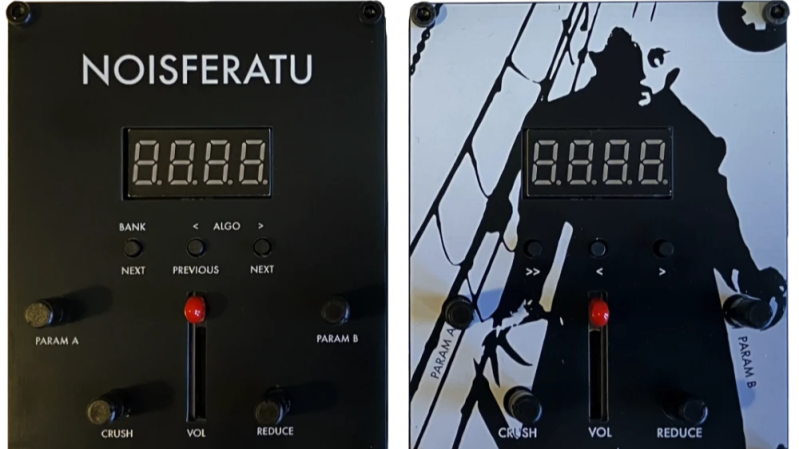
The NOISFERATU is an open source generative textural sound synthesizer, or as creator [Robert Heel] puts it, “a sound designer’s dream and audiophile’s worst nightmare”.
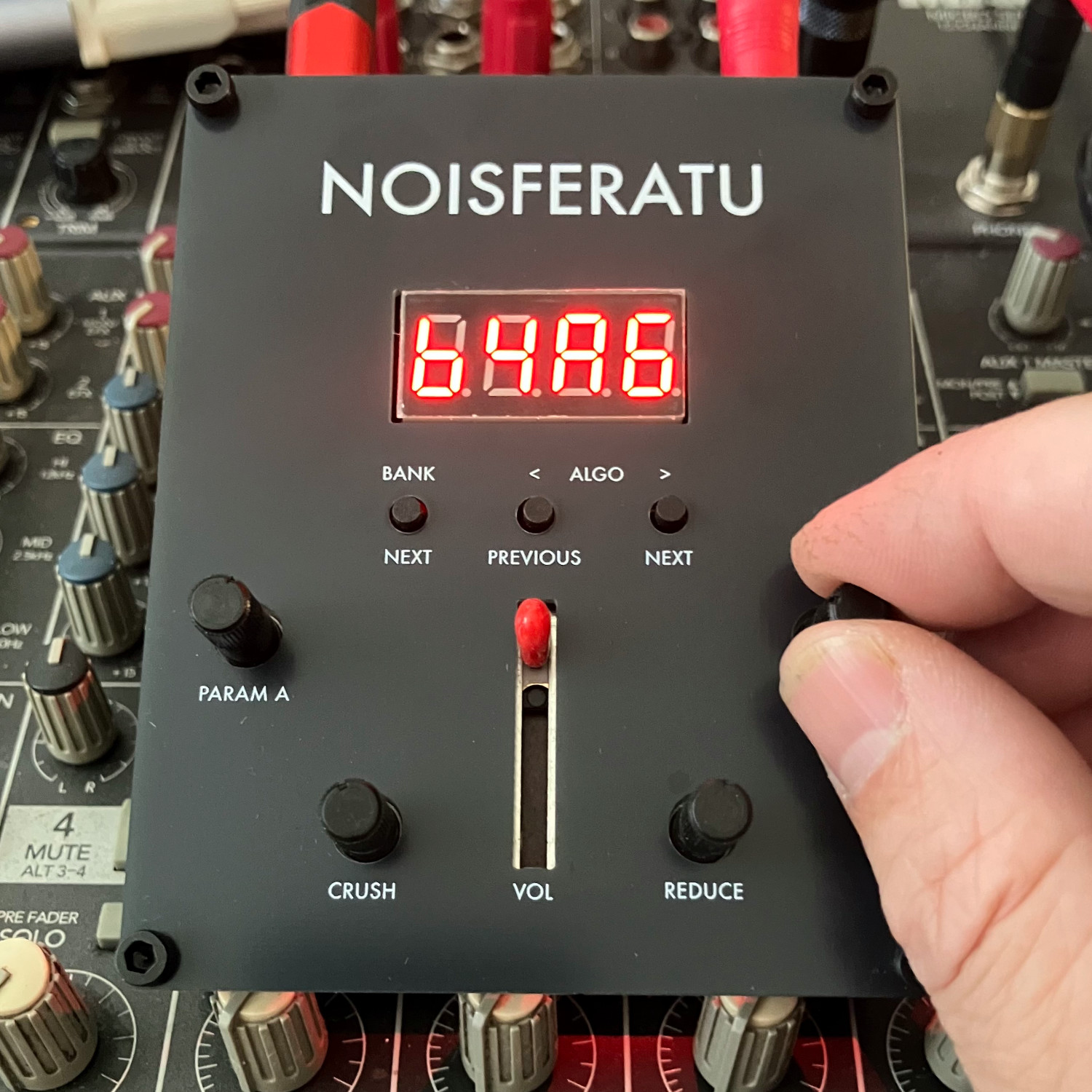 NOISFERATU offers 45 different sound algorithms grouped into five banks to produce a dazzling range of evolving soundscapes and patterns that resist repetition or settling, each influenced and shaped — the word controlled does not quite apply — by a volume slider and a few hardware knobs.
So what does it actually sound like? Check out the video embedded below to give it a listen, it’s pretty trippy.
Hardware-wise NOISFERATU is centered around the Seeed Studio XIAO SAMD21 microcontroller board, takes power over USB-C, and has a headphone jack for sound output. We love the artwork on the dual-sided front panel, too.
DIY synthesizers based on logic chips have a long and proud history, and seeing the different directions people can go by incorporating microcontrollers is always a delight.
If NOISFERATU’s experimental sound and noise sounds up your alley, the design files and code on GitHub have everything one should need to build one. Kits are for sale direct from the designer, as well.












This reminds me of an event way back when. The local FM radio station (KUNM) was broadcasting this weird noise. Made from a wire strung up in the local mall and connected to some electronics.
A few years back I found a CD of it: Music on a Long Thin Wire.
This is why I love HaD comment section, I love Alvin Lucier’s work and wasn’t somehow aware of this! You made my day (year) fellow netizen of the Internet
Does anyone have access to the original audio from KUNM? It seems to have been recorded (at least one hour of the 5 days and nights it was broadcasted) but isn’t available from Europe
https://americanarchive.org/catalog/cpb-aacip-207-15bcc3sf
Of course, this also could be done on the cheap/fast with bunch of 555s.
I literally knew a dude in B’More (Baltimore) who did that – 555-induced auditory hallucinations. He was out of work living in a low-income place that was not tremendously well maintained overall (I’d say a LOT of parts of B’More have been gradually sliding towards the same fate), so he ripped a chunk of wood board from the basement, hammered copper-plate nails he found laying around in random fashion and connected control wires. Then he went outside, dug some soil worms and let them slighter between the nails. I forgot what he called the concoction, but the resulting audio was about the same in scope. Oh, when worms would dry a bit and stop conducting, he’d spit on the board. obviously, the control voltages were benign and no animal cruelty was involved, as he later put worms back where he found them.
I suppose that next you’ll say he put sensors in his commode to generate audio based on the, um, deposits.
I lost track of his endeavors, eventually he’d graduated and moved out of B’More. If I remember right, he was something like quantum physics major, so between semesters, occasional part-time job here and there, and whatnots, he scraped together things for fun.
He wasn’t the only one in the vicinity, at some point there was lively indie performance venue (we are talking early 2000 – could be “Def, Dumb and Bass” – no longer archived anywhere I looked : – ]) with all kinds of creative artists – that’s where I run into him and bunch of other folks with quite a roster of inventions on a shoelace-thin budget. Some things I run into were worthy a patent.
I think you misspelled the title?
He probably also does not know about Murnoise.
Fixed! (It was an embarrassingly easy typo to make)
Cool. The permalink is still misspelled but maybe too late to change that?
Just delete it from the URL in your browser. Problem solved.
it = the extra “e”
Boards files for ease of production would be amazing in the repo
Dream of it. It´s “opensource” PDF that yo have to feed an LLM with to get a Kicad BOM and netlist and create the schematics from that. Which i do routinely and it works.
Curious. Which LLM do you use? Could you elaborate on the prompt?
Claude. Feed him the PDF(s) , put strict and precise guidelines and a checklist.
like
”
examine this PDF, it´s a schematic and extract this information:
– all components represented on the PDF, independently of their rotation
– all nets between components
output files:
– kicad 8.0 BOM
– Kicad 8.0 netlist
-check that no component is missing in the BOM, if one is not obvious, show me and ask me
-check that all wires on the PDF are listed in the netlist
”
The Kicad files are relatively trivial for Claude to produce, but it won´t create a good schematic without effort, that is not a problem if it can output a netlist (wire the schematic by hand)
A netlist or a BOM is really no fuss easy to produce (and to check)
And Claude´s PDF features extraction is well suited for the job.
I have spent most of my long life trying to avoid noises like these in my electronics.
This is what our grand parents died for in the war?
Oh my days, do you simply not like it or is there some critique?
Now to combine this tech with underwater acoustics
https://techxplore.com/news/2026-07-cavity-based-underwater-lens-focuses.html