
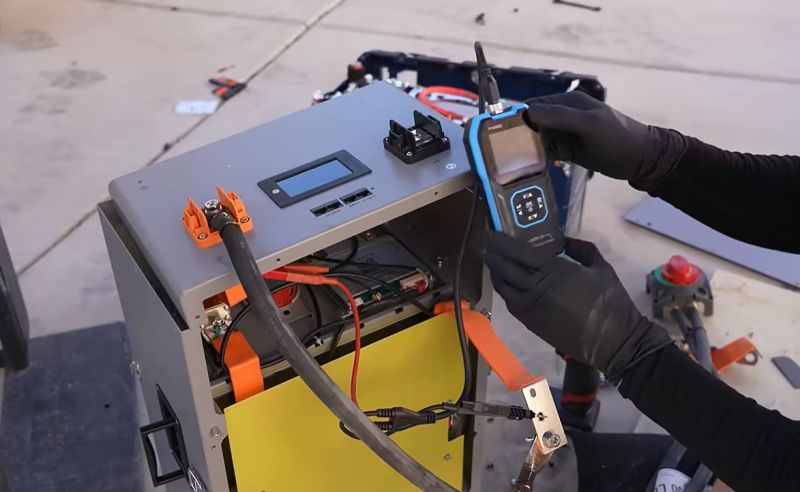
Generally, LiFePO4 (LFP) batteries are quite safe and stable, but it’s still possible for something to go wrong, even something catastrophic, like the battery management system (BMS) developing a direct short. This is one of the tests required to be certified for the UL 2054 standard that targets household and portable battery safety. In a recent series of videos, [Will Prowse] demonstrates how a series of commercial batteries pass these tests, and how some still fail.
This particular short-circuit test is quite demanding, as it requires that this failure condition is immediately detected and some kind of fail-safe mechanism – like a fuse – kicks in. The first two batteries easily pass this test by blowing their fuse, just as you expect. Interestingly, the second unit here isn’t even UL-listed but comes with multiple layers of safety.
The third unit shown is a ‘Li Time’ LFP battery akin to what you’d purchase off a random online retailer’s website. This battery features the typical basic BMS and battery configuration, but is missing a chunky, prominently placed fuse. ‘LiTime’ also claims to be UL 2054 certified. The problem with this claim is that there is no fuse to prevent a thermal runaway event if the BMS were to short.
The final battery tested is made by Battle Born, and it also had issues. [Will’s] testing shows the battery catches fire as its purported thermal safety does extremely little to interrupt the current.
The takeaway from this demonstration is that you should look for safety features such as internal fuses. It’s also worth it to add terminal fuses to batteries to potentially interrupt dangerous currents at those points. Better to replace a blown fuse than to deal with an out-of-control inferno and/or violent hydrogen detonation.












Battleborn still stands by their statement “it’s a designed safety feature” and would rather file lawsuits to cover it up instead of fixing the issue.
Probably they will be sued back as soon as they admit something. So they act as if everything is allright.
There’s something wrong with the system when fixing the problem is worse for a company than pretending it’s not an issue.
There’s speculation that Battleborn is in bad financial shape. If it admits to a problem, the company won’t survive a product recall. By denying the problem, it’s forestalling bankruptcy a little longer. I believe it’s simply a matter of time before the company must face the music and it might be attempting to buy time to find some way out like getting bought.
It’s also a money grab, rather than a “find some way out” strategy. Every day that they continue operating before collapsing is another day of earnings that are largely transferred out to cover costs. That money isn’t recoverable later if they lose a suit. Companies like this generally don’t let revenue linger within the company for long, so if they lose a suit and go bankrupt, only whatever was within their control when the clock got stopped is available for recovery.
It’s the Ford Pinto all over again…
Not really a problem with the system. If a company willfully designs a dangerous and noncompliant product and claims to the contrary for the purpose of economic gain, they are inherently liable for the damages.
So, if they did so egregiously, they can’t afford to back down.
In a sense, it’s vaguely analogous to an armed robbery of a bank. Once you’ve done it, there’s no low-consequence way back out, but that doesn’t mean that there’s something wrong with the system.
I’m wondering if there is some fraud involved in the UL testing and listing which gave those battery designs an approval. I hope Will gets a chance to get all internal email around that approval and find out how they were approved. And it shows that a UL listing means little. We’ve seen unapproved systems with far better designs and safety features.
You pay a lot of money certification, no one likes a lab that gives them a failing result. As a result, the labs compete with each other to bend the rules in every way possible, or just deliver fake results. Less testing is also cheaper when quoting. I’ve seen it many times with international brand Chinese labs (not singling out China but that’s where I was doing the testing). The incentives are all backwards, just like the rating agencies before the financial crisis… and presumably today as well.
External fuse wouldn’t even help matters because remember the original complaint came from the use of plastic washers on the battery terminals and loose connections leaving to internal overheating conditions.
Battleborn probably doesn’t have enough money to issue a recall. I think the next step for them is to declare bankruptcy.
Their stock is down by a factor of 500 in the last four years, to just 0.2% of IPO. They don’t make enough profit to pay the interest on their debt. But, hey, maybe they’ll win enough in the lawsuit against Prowse to keep the investors at bay for a little while.
Incorrect test method if the scoped standard is UL2054. But he has sent a clear message that some of these batteries suck.
Per the U.S. OSHA and (UB) building standards, you are looking at NFPA 70 or 855 is the battery is a structural install. NFPA will require test certificates to test standards such as UL2054, UL1973, UL1642, UL9540, and others. So this simplistic test is the tip of the iceberg. In any case, it takes much more than just proper fusing to build a safe battery or ESS.
This guy might be needing to talk to a lawyer. Conformity to a standard is assumed only where there is an NRTL mark with a reference to a test certificate on the device or system. If the company says ‘built to conform to…’ or ‘we tested widget xyz per…’, or some such weasel words, but never claims an NRTL cert, then he could be subject to litigation.
no one is going to sue because you were misled by their misleading advertising.
Yes they will. And they will win.
When a regulation requires a certified device, a device made by someone who says “we looked at the certification process and we think ours will pass” isn’t good enough, and you are liable for it if you choose to buy/install it anyway.
We aren’t talking about counterfeit products here.
We are talking about actual non-certified products, which you will absolutely be liable for.
We figured out the test didn’t reflect UL2054, which the battery is in fact listed to (By Intertek IIRC).
And, UL2054 is appropriate for small gadget batteries not house/RV/boat batteries.
The way he tested approximates UL1973. That standard is appropriate, the battery is not listed to it, and apparently it would not be able to be because it caught fire.
He’s already subject to litigation form Battleborn for pointing out that a plastic washer is not a safety disconnect.
Shutdown separator:
https://www.batteryuniversity.com/article/bu-306-what-is-the-function-of-the-separator/
https://volta.foundation/lithium-ion-battery-separators-and-their-role-in-safety/
CID:
https://www.mdpi.com/2076-3417/14/18/8238
Redox shuttle additives (chemical overcharge clamp):
https://www.osti.gov/biblio/1579
Coupled shutdown chemistry:
https://image-ppubs.uspto.gov/dirsearch-public/print/downloadPdf/8758945
Redox shuttle additives (chemical overcharge clamp):
https://www.osti.gov/biblio/1579
Coupled shutdown chemistry:
https://image-ppubs.uspto.gov/dirsearch-public/print/downloadPdf/8758945
The only thing about the test (second video) is that he did not close the battery. Would enough heat have reached the positive side of the battery, with the cover in place, and started a fire there as well, perhaps tripping the thermal fuse?
It’s not good testing, when such questions can be asked.
Define thermal fuse.
A thermal fuse isn’t a thermal fuse just because the battery maker declares it to be one. It’s a thermal fuse because it passed certification to a relevant standard, within defined hysteresis and thermal thresholds. And, in this case, a thermal fuse’s entire design purpose is to prevent ignition in the first place.
Certified batteries are routinely used in environments where even a momentary flame is sufficient to create a catastrophic safety-of-life hazard. Doesn’t really matter if the fire goes out after a few seconds later.
And batteries aimed for emergency/survival usage (as BattleBorn used to heavily advertise) have higher requirements, not lower.
What if I like ‘out-of-control inferno and/or violent hydrogen detonation’?
I hope all you other readers gained enough experience to make up for any missing body parts in the recent/ongoing holiday.
Sounds like promising youtube content. Let me know when it’s posted :)
Sadly, high-energy experiments are kind of out of my budget range this year, so I must settle for piggybacking on the expensive good lessons paid for by others…
yeah, the devil is in the details. Just because a battery has passed the tests its also the process of manufacturing and to make sure nothing deviates from the tested object. Of course engineers make mistakes that show up later, but a good manufacturer makes a recall and take responsibility for the mistake. When you open up things and it is not just batteries, you see the engineering skills in the design and attention for details, as i started, the devil is in the details and if you are not careful and take your time you will end up with issues.