
Unlike almost every other kind of microscope, atomic-force microscopes (AFMs) don’t use any kind of optical beam to image their subjects. Instead, they physically detect the subject’s surface with a tiny probe, repeating this thousands of times to build up a height map of the subject, sometimes with a resolution below a single nanometer. [Ben Krasnow] got to use an AFM in an investigation of one of his projects, and shared some unusual uses of it in his latest video.
For his first demonstration, [Ben] took a video of the probe head in action. Since the probe oscillates at nine kilohertz, this was less straightforward than it sounds, but a stroboscopic welding camera filming near that frequency could visualize its motion. The next project was to image some biological samples, particularly bacteria. First, [Ben] let the bacteria from nattō (fermented soybeans) multiply in a sterile growth medium, then centrifuged and washed them.
He spin-coated a thin layer of gelatine onto part of a silicon wafer, which provided a very flat substrate. The gelatine is electrostatically attracted to the bacteria, adhering them to the slide and letting [Ben] wash away other contaminants. This let the AFM image the bacteria clearly, even revealing how a spin-coating step had oriented them all in the same direction.
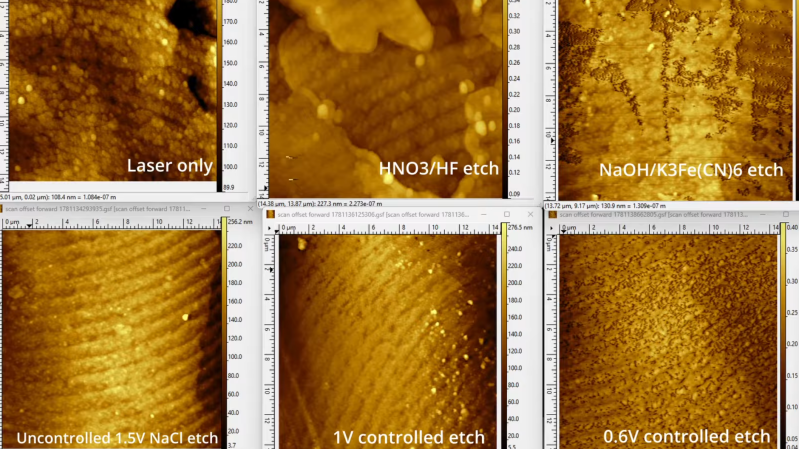
[Ben] also imaged a few other samples, including silver nanoprisms and track-etched membranes. Track-etched membranes use high-energy radiation and an etchant to cut very consistent, fine holes into a plastic filtration membrane. Finally, [Ben] used it to image his laser-etched diffraction gratings; to find out how the laser had created these diffraction patterns, he tried to selectively etch away the laser-exposed metal, using the AFM to verify that this metal had been stripped away. Neither an acidic nor a basic etch worked, but electrochemical etching seemed promising.
If after seeing this you want your own atomic force microscope, we’ve seen a few DIY AFMs, including one which can resolve individual atoms.
Thanks to [H Hack] for the tip!












Does it offer high enough resolution to detect the tiny Peter of Pete the pick-up driver who does his daily commute in a raised F-250 while blasting KoRn music for everyone around to enjoy?
A web search says atomic force microscopy can resolve around 0.1 nanometers vertically. I don’t think femtometer-scale measurements are possible yet.
As someone who has manufactured diffraction gratings, I would have never even bothered without an afm. Afms are great and ben is a treasure
To be dead honest, even an AFM ultimately measures the deflection of a light beam from the probe, and infers movement from that.