
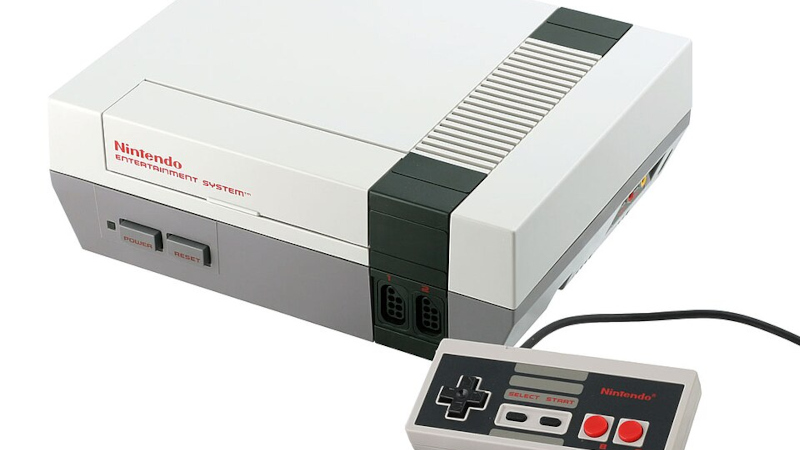
The NTSC television standard is a masterpiece of mid-century engineering, to pack a color image into the transmission bandwidth of a monochrome one, and to do so while maintaining backward compatibility with earlier monochrome TV sets. In terms of its timings and choice of sync and carrier frequencies it’s elegantly thought out for maximum quality on a 1950s round-CRT color TV set.
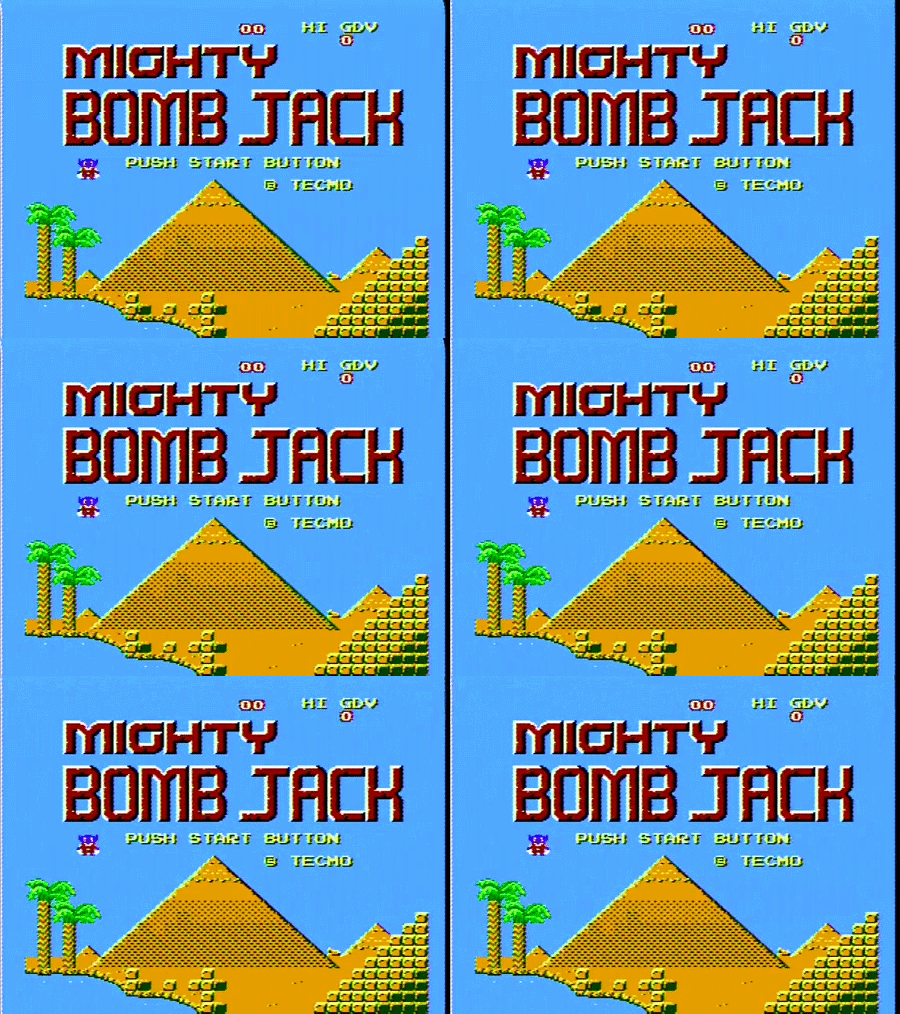 The trouble is, that while the standards are exacting, the receivers are quite forgiving, and will display adequately even with substantially off-spec video. [Nicole Express] is here with an in-depth examination of a time when that was pushed just a little bit too far, explaining why the Nintendo Entertainment System (NES) displayed wobbly color images.
We’re treated to a run-through of the NTSC standard itself, and a look at how some of the other consoles and home computers of that era either had similar problems, or managed to avoid them. The key lies in the exacting timing required to achieve perfect interlacing, and the NES’s use of a single crystal to provide all the clocks. The dot clock on adjacent frames was almost right, but not quite, leading to a side-to-side wobble that while barely perceptible, was exacerbated by some graphics. It’s a fascinating read.
We’ve looked at composite video in detail in the past.
NES image: JCD1981NL, CC BY 3.0.












You could probably argue that this is what gave the consoles a character and what retro-enthusiasts miss in modern LCD as much as the blur.
Yes!
In the UK broadcast biz NTSC was known as Never Twice the Same Colour.
Pay for Added Luxury
System Essentially Contrary to American Method
And Pale and Lurid
old enough to remember this. Let’s not even bother with SECAM
Do PAL NES consoles have the same issue? Similar effects occur on other systems. For example, the early ZX Spectrum hardware revisions had dot-crawl, which meant that you could design dithered graphics characters which gave animated effects (e.g. a cyan-blue dithered graphic which looked like shimmering water).
https://youtu.be/5Dk136-Q7cM
Yes. Just like the NTSC NES and SNES emit 227 + 1/3 chroma periods per scanline, the PAL NES and SNES emit 284 + 1/6 chroma periods per scanline. (“should be” 283 + 3/4).
Stills of vertical lines drawn by PAL NESes show this 6-line pattern.
Unlike the NTSC (S)NES, the PAL (S)NES always emits the same number of chroma periods per field ((284 + 1/6) × 312 = an integer) so stills don’t have any visible dot crawl. Moving details (e.g. a scrolling background) do.
Hi, there! I probably shouldn’t comment on every HaD article but I’d like to share my experience here.
I had a “German” NES in early 90s hooked on a Commodore video monitor via A/V*.
From what I remember, the picture wasn’t like the NTSC counterpart but it wasn’t perfectly stable, either.
You noticed a certain, um, “unrest” if watched closely.
But that’s just my experience, according to my memories.
The Commodore monitor was fully analog and had a comb filter, probably,
which I think wasn’t to be taken for granted on domestic 1970s-to-1990 or 1995 TVs (pre video DSP models).
It also had knobs to adjust image size and position, so I have seen no PAL borders back then.
(*Yeah, Composite Video wasn’t unheard of overhere, -thanks to home computers and VCRs- even though the SCART/RGB hype perhaps makes it seem as if we were spoiled RGB brats all the time. 😆
In reality, I think we were still accustomed to vintage TVs with RF antenna jack from the C64 days.
Grandma’s old TV or a b/w TV from the attic, basically. We were kids, after all. We got passed on the old stuff, often.
By late 80s or so, the upgrade path to this was a) a small video monitor with A/V input or b) a big a** SCART TV (in the living room, kids had smaller ones if they had).
The Commodore monitors also had an RGB option sometimes,
but often just had Composite Video and Chroma/Luma, which basically was S-Video with different voltages.
Friends of mine had the Super NES hooked up to SCART TVs via the passive A/V adapter that was in the original box.
Which provided just ordinary Composite Video aka CVBS.
S-Video was not common on EURO SCART sockets because there was no provision for supporting both S-Video and RGB.
The French who designed it in the 70s or so didn’t consider it, I think. After all, they wanted to overcome SECAM limitations and go straight RGB.
So as a workaround, some SCART TV models had two separate SCART sockets or an extra Hosiden socket for S-Video,
often next to the red/white/yellow RCA or phono or “Cinch” sockets.
Anyway, RGB cables for video game consoles were sold as accesories, however, that’s right.
So it might be true that some kids grew up on pixel-perfect RGB video.)
i definitely simultaneously miss and do-not-miss the many artifacts of crts (NTSC and VGA). but i am going to go off-topic here…
near as i can tell, the majority of 720p TVs in the world have a 1366×768 panel in them. Notably, 720 != 768. And 720×16/9=1280 != 1366. And, worse! HDMI demands pixel width is a multiple of 16, so it’s actually impossible to work around this at the source… you have to chose between 1360 and 1376. Since i still use the interlocking chain texture (a tiled 4×4 image 1110 1101 0111 1011) that was the default xsetroot background when i first installed xfree86 in the late 20th century, it’s a very noticable interference pattern that repeats 6 times across the width of the screen, because i chose 1360 for my livingroom pi.
HDMI(well, DVI) does not appear to require that multiple of 16; if anything that should be your graphics card. Historically there were VGA-inherited limitations for why the width had to be a multiple of 8, but I’ve since used graphics cards that let me specify a literal 1366 wide.
I guess it’s possible that if the HDMI can carry & is carrying some kind of subsampled format (YUV422 for example) then there might be limitations requiring an even width? But even then that’s much finer than 16 or 8.
eh https://en.wikipedia.org/wiki/Extended_Display_Identification_Data#Limitations
it’s possible to parse that as blaming the video cards but in practice it’s just plain an HDMI limitation.