
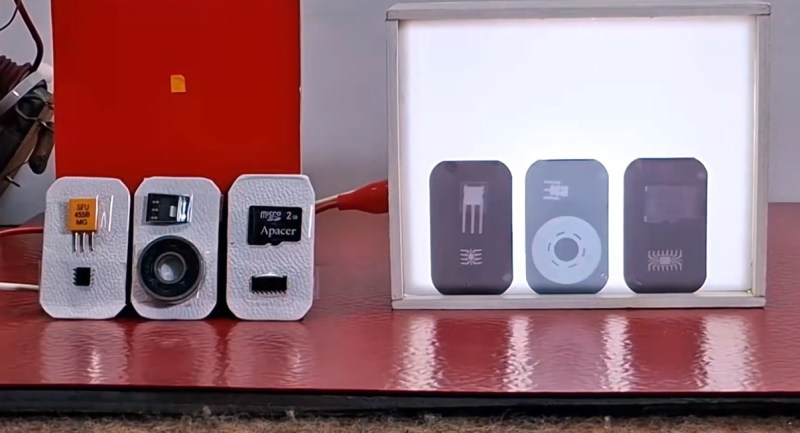
Just because you probably shouldn’t make a DIY X-ray machine, doesn’t mean nobody would. [mircemk] shows off his DIY unit, how it works, how to use it safely and of course, some pretty X-ray photos of household objects.
The machine repurposes a DY86 vacuum tube from old CRT TVs to emit X-ray radiation. To drive the tube without blowing it up, a rather specialized series of power supplies is needed; a low-voltage DC power supply powers a high-voltage AC inverter, which is then sent through first a transformer, and then a Crockfort-Walton voltage multiplier, to reach the incredibly high voltages needed for such a vacuum tube’s radiation emission to reach X-rays. Naturally, this didn’t go to plan first try, leading to the unfortunate demise of three vacuum tubes (as well as another three which had already lost their vacuums).
Now how do you capture an image with X-rays for a light source? With dental X-ray photo films of course! The dental film is placed behind the object to be scanned, the transmitted X-rays making up the resulting image. After going through the standard process of developing for about 30s, washing, fixing for about half an hour, and washing again, the photos become clearly visible. The best results were obtained at a distance of 10-15 cm an an exposure time varying from 15 minutes to an hour depending on material hardness.












That’s “Cockcroft-Walton voltage multiplier”:
https://en.wikipedia.org/wiki/Cockcroft%E2%80%93Walton_generator
Even the video got it right.
“Crockfort” sounds like a variety of cheese…
It depends on material density and the type of material, not hardness.
X-ray diffraction can be used to determine the hardness of hardened steel, but that’s not what this project does:
https://dl.astm.org/jte/article-abstract/12/1/13/17580/An-Estimation-of-Hardness-of-Hardened-Steels-by-X?redirectedFrom=fulltext
X-ray film is available in larger sheets, if desired. A considerable number of people with large format cameras have been experimenting with using it, since it is in some ways closer to the films that would have been used in those cameras when they were first sold and it is relatively easily purchased and cut to size.
“…incredibly high voltages…” is nonsense. The voltages are completely credible, i.e. believable
Perhaps you meant “very high”, but in this case “extra high” would be more appropriate.
Anyone touching it would think it’s incredible.
No :) Credible means capable of being believed. Incredible means not believable.
I taught my daughter to be careful of electricity by getting her to touch an electric fence. After that, she believed in and “understood” high voltages. They had become credible, not just an abstract concept.
I know someone who got a 20kV jolt from a TV EHT; he believed thereafter.
You’re incredible
When I was a teenager I wanted to know how pepper spray smells and can it be used as a spice for foods. I thought it would work like any other deodorant in a can – when pressed a gentle stream would come out. Nothing scary, eh?
I decided to spray some on the back of my hand, which I held pretty close to my face. Why? Because I was worried the smell of peppers would dissipate quickly.
I pressed the button and a very powerful stream bounced off my hand, straight into my eyes. Oh the amount of shouting and swearing that happened on that day 🤣
That day I learned how cans of pepper spray are pressurized much higher (and probably with nitrogen instead of propane) compared to something innocent like a deodorant or hair spray.
Still, a fun memory.
It means that, AND has a second correct definition that just means “extremely.”
The usage here is incredibly correct.
A secondary definition of “incredibly” is “extremely.” per both Miriam-Webster and Cambridge. How it’s used here is perfectly correct.
If you’re going to be pedantic at least be right.
Used X-ray tubes start at $150 from what I’m seeing on ebay (and other sources) so no wonder why used TV HV Rectifiers are being used.
in a lot of countries like mine, it is even illegal to buy x-ray tubes
Kinda hilarious that the very tube that was used to produce the HV in a real television is now used to consume HV made by a solid-state rectifier.
At first glance I was hoping this was a way to use the actual CRT display as the x-ray emitter, to use in a inverse-geometry x-ray CT (IGCT) scanner: Use the CRT as a flying-spot x-ray source.
IGCT is very cool because it can eliminate certain classes of cone-beam artifacts in CT reconstruction, plus has the potential of no physical moving parts (so, no motion control hardware, and very fast scans). It also offers a mechanism for reduced dose (or increased image quality for the same total dose), by modulating source intensity as needed depending on its location.
Some of the early implementations of IGCT did actually use a big CRT for the source.
You can cut the wash to 5 minutes with full water replacement. Fill/dump fill, shake a little, dump. Fill, shake a little, dump for 5 minutes. It means the concentration of the fixer in the water is always close to zero. See the diffusion equations.
Did this when I was 12. Not the same way of coarse . But did produce x rays. Managed a very poor image of the bones of my hand, on a large negative.
Surprised I had normal kids.
Normal? Are you sure? /snickers
Soviet TVs were radioactive because they were made using the infamous ГП-5 tube. Watching TV was like having 2-5 X-rays per hour and this is why parents prevented their children from sitting in front of the screen. Only after 1990s when modern TVs (like Trinitron) became available people could safely play Dendy.
Have you got a source for that? I’d love to read about it.
That was the price for owning an early color TV in the USSR. The ГП-5 is a 30kV shunt regulator triode, similar to the western ED500/PD500. You had to carefully shield these things, but they were definitely not radioactive. You might be confusing this tube with the infamous ГП-5 gas mask, which can be radioactive after being used in certain places.
In the 1960s General Electric sold home x-ray machines… they just called them “color TVs”.
The sharpness of his radiographs was surprising, given that they were exposed to the emissions from the tube through a large rectangular open bigger than the tube itself. I’m guessing it was that the objects were so close to the film. Would adding a small aperture have helped?
Something tells me that rather sooner than later a garage made ray gun will be in the news.
The electrolaser is already a thing.
How well could this work for wood?
https://www.therpf.com/forums/threads/red-alert-lost-3-ft-tos-enterprise-found.354596/page-40#post-5735053
I was thinking that having film, then sliding the X-ray with a metal slit could give a true side-view without parallax.
Might this X-ray be combined with a 3D scanner?
Next stop, digital oss x-ray plates lol