
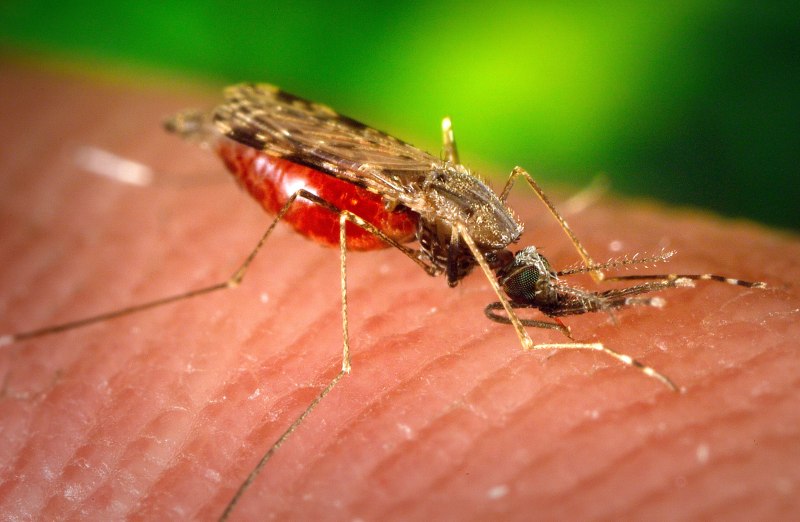
Despite their small size, mosquitoes are one of the deadliest creatures on Earth, and keeping them away from you is one of the best ways to stay safe. DEET has been the mainstay of insect repellents for decades, but what if there was a repellent you could grow yourself?
Researchers at Cardiff University found that the essential oil from catnip plants (Nepeta cataria) could be as effective as DEET at repelling mosquitoes when applied as a 6% lotion. The oil has been shown to be effective against many species of mosquitoes, ticks, and mites in previous research. You can look at the paper for details, but the catnip oil was obtained through steam distillation followed by some processing with hexane. The essential oil was then mixed with “water, glycerin, emulsifying wax, cetyl alcohol, cetyl stearyl alcohol, shea butter, glycerol monostearate, olive oil, coconut oil, sunflower oil, methyl paraben, propyl paraben and silicone oil.” We suspect that list will look familiar to anyone who’s read an ingredient label of most any store bought lotion, unless it was paraben free.
The Guardian’s coverage quotes one of the researchers, [Dr. Simon Scofield]: “We did not conduct any experiments to see if it is attractive to cats, but given that the active ingredient [nepetalactone] has well-known cat-attractive properties, I would expect they would quite like it,” he said. Depending on how your cats react, you may want to consider applying the lotion shortly before departing home.
If you want some more options in your mosquito defense, how about becoming a bug zapper, using drones and sonar, or genetically modifying mosquitoes to curb their numbers.












You can thank GreenPeace for that. If it wasn’t for their yapping about DDT, mosquitoes would probably be a thing of the past by now.
DDT would have been the nuclear option that takes pretty much everything else with it, leaving no pollinating insects around where it has been sprayed.
Not to mention birds of prey, which help keep other vermin under control.
Which includes carrion eaters, like the California condor which very nearly went extinct.
None of us live without the planet. So why are some people still so willfully ignorant? I mean seriously. WTF is wrong with so many people? Make it make sense.
What are you complaining about? Your statement is so vague that I can’t make sense of it.
Not to mention that insults show a lack of desire to hear the other’s perspective. Maybe there are valid reasons for whoever they’re insulting, but Zangar will never know.
Valid reasons for annihilating the biosphere?
It’s a complex topic, but I’d say that mountains of money are being invested into making ignorance look cool and science uncool. We need to fight that tendency, and in that respect your comment is a small contribution (hopefully mine as well, and neither would be possible without Hackaday :)).
Unfortunately, as annoying as they are, they have a purpose in Nature. One of them, they are the major pollinators of the cocoa plants and are a major food source of other, also important creatures. It all comes down to balance. If we didn’t disturb nature so much, we would have far less problems.
I agree mosquitoes are a necessary evil; but they don’t pollinate cocoa plants. That job is done by a look-alike insect called (appropriately), chocolate midges.
Mosquitoes? Far as i know, even the few spiders that eat them prefer other insects, since mosquitoes have low nutritional value. Did i get that wrong.?
DanielF, you are right. The world does not need mosquitoes. https://www.ovid.com/journals/natr/abstract/10.1038/466432a~ecology-a-world-without-mosquitoes?redirectionsource=fulltextview
Interesting idea. If it both attracts cats and keeps the mosquitos away then it serves two purposes.
I made my own mosquito repellant based on waypoint survival’s recipe that he based on the recipe from horace kephart, a legendary man from the beginning of the previous centruy. It contains pine tar, castor oil, pennyroyal oil, camphor, citronella oil, cedarwood oil, lavender oil and eucalyptus oil. You only use a tiny tiny bit and it works amazingly well.
I’m the type of person that when I sit among a group of people, no one is attacked by mosquitos except me. They swarm around me. With this stuff they find a new target. It’s amazing. I might want to add nepeta cataria to the mix. If it works then I’m a happy camper.
To save everyone else time looking for the link: https://www.youtube.com/watch?v=fHUxrG0GJeg
So, if I apply this I’ll not get bitten by mozzies, but will be instantly buried under a mound of ecstatic, blissed-out cats? Sounds like a winner.
Reminds me of the time I had a rodent problem in my parked cars, so I asked a friend to grab some coyote urine from the hunting store next time he was there. What he bought – and I didn’t spot this until I’d sprayed it liberally around the driveway & the cars – was coyote attractant.
I didn’t see any mice after that, but did see a coyote sitting on the hood of the car. Whether that was an improvement, I can’t say.
Absolute upgrade. So cool. (As long as you don’t have any pets or children, I guess.)
“Sounds like a winner”… You’ve clearly never been licked by a cat before.
Don’t get me wrong I love cats, but being licked by a mound of blissed out kitties would not be fun, it’d be death by sandpapering.
I think you’ll be at the centre of a cloud of fighting cats who all want exclusive control of the nip. Still would, just wear thick clothing.
“So did that catnip mosquito repellant keep the mosquitos away in the woods?”
“Yeah, but I was covered in bobcats!”
Not as many cats as you might think. About 50% to 70% of adult cats respond to catnip. You’ll survive being buried by half as many cats as you thought
Unfortunate, but acceptable.
Heck of a hood ornament. Everyone will be asking what brand car you have.
I’m no expert, but my understanding is that undiluted essential oils of pretty much anything — including catnip — are quite toxic to cats. I don’t know whether the recommended recipe dilutes the stuff enough, but I would strongly recommend checking with your vet first.
If you have cats, you should avoid essential oil diffusers and candles for the same reason.
I hope I’m not raining too much on the parade. Mosquitos suck and I’d give a lot to get rid of them — just not little Fluffy. :-)
I see what you did there :)
We had 3 cats with 3 conpletely different reactions to catnip. From totally ignoring it to going full blown mental agressive attack mode. Not sure you would want that last one being triggered by your skin…
Given that most “big cats” react to catnip in the way domestic ones do, the most hilarious outcome of all of this would be someone being cornered by a lion or cougar which then fell over in stoned bliss….
Ah btw, lavender oil keeps wasps away. Diluted and in a spray bottle applied to the windowsill or wherever. Not immediately; they have to first report and cross-check, but a few hours later, no wasps for weeks.
This story is an obvious plant by the global evil cat conspiracy.
In other news:
Attaching a 6 foot length of yarn to your ceiling fan keeps roaches away.
Scattering pieces of tuna sashimi around the house will drive away bears and venomous snakes, no wasabi.
My friend in Uganda and his family and friends have had malaria too often and want to know where they can get and grow catnip and how to make the oil. They have a hard enough time managing contaminated water and lack of food and lack of low-cost medical and simple things like appendix removals. Removing/reducing malaria from mosquitos would be a huge win for their overtasked bodies. On top of everything else, they run a tiny cat sanctuary because one of the son’s can’t stand to see abused neglected cats ( in that country it is still a very common belief that cats are tools of evil spirits and also used by witches). I told him I don’t know what seeds they used or what soil and water needs the Ugandan research catnip involved.
I guess extracting the essential oil from catnip leaves, like used in this research paper, needs a more elaborate process than what can easily be done at home in a developing country. But I’m not sure if you really need to extract the oil in this way to get the effect. Probably some other methods would also work, like taking the catnip leaves and make some sort of tea and apply this to the skin. Or put the leaves in some skin-friendly oil that you have available, quench them, let them soak and then apply the oil to the skin.
Steam distillation should be possible to do well enough with a pretty crude/hacked together setup. Either steaming or boiling the catnip, collecting the steam, and then skimming the oil from the distillate. Catnip is very weedlike and hardy; easy to grow in almost all environments, so as long as they can get seed they should have no problem.