
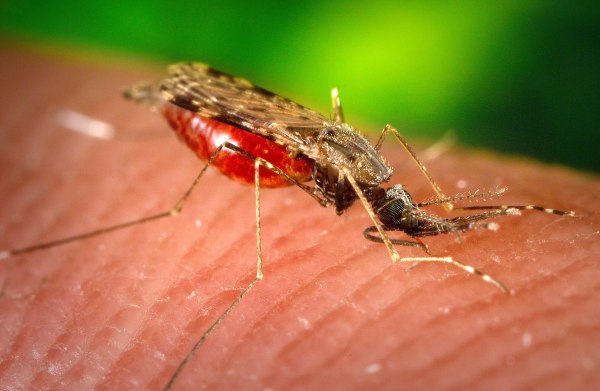
An image of a brown, red, and black mosquito on light human skin

Keeping Mosquitoes Away With Catnip-Based Repellent

Despite their small size, mosquitoes are one of the deadliest creatures on Earth, and keeping them away from you is one of the best ways to stay safe. DEET has been the mainstay of insect repellents for decades, but what if there was a repellent you could grow yourself?

Researchers at Cardiff University found that the essential oil from catnip plants (Nepeta cataria) could be as effective as DEET at repelling mosquitoes when applied as a 6% lotion. The oil has been shown to be effective against many species of mosquitoes, ticks, and mites in previous research. You can look at the paper for details, but the catnip oil was obtained through steam distillation followed by some processing with hexane. The essential oil was then mixed with “water, glycerin, emulsifying wax, cetyl alcohol, cetyl stearyl alcohol, shea butter, glycerol monostearate, olive oil, coconut oil, sunflower oil, methyl paraben, propyl paraben and silicone oil.” We suspect that list will look familiar to anyone who’s read an ingredient label of most any store bought lotion, unless it was paraben free.

The Guardian’s coverage quotes one of the researchers, [Dr. Simon Scofield]: “We did not conduct any experiments to see if it is attractive to cats, but given that the active ingredient [nepetalactone] has well-known cat-attractive properties, I would expect they would quite like it,” he said. Depending on how your cats react, you may want to consider applying the lotion shortly before departing home.

If you want some more options in your mosquito defense, how about becoming a bug zapper, using drones and sonar, or genetically modifying mosquitoes to curb their numbers.


Genetically Modified Mosquitos: Biohacking For Disease Prevention

Many years ago, I took a summer trip to the Maryland shore with some friends. One of my buddies and I got bored with playing football on the beach, so we decided to take a hike on one of the many trails back into the wooded area behind the dunes. At the trailhead we noticed a prominent sign, warning about the presence of “very aggressive mosquitos” and not to enter without first applying ample insect repellent. We scoffed at the warning as only young idiots could and soldiered on, bare-legged and confident that we’d be fine.

About three minutes into our hike, a small group came pelting down the trail in a panic. “It’s true! Turn back!” they shouted as they flew past us. Undeterred, or at least unwilling to appear that way to each other, we pressed on, only to discover a few minutes later that we were making a substantial blood sacrifice to the next generation of mosquitos on Assateague Island. We couldn’t bear more than a few seconds before turning tail and running back to the beach and jumping into the ocean to get rid of the last few dozen bloodsuckers.

I learned a valuable lesson from that experience, as well as developing a deep and abiding hatred of mosquitos. It turns out I’m in good company — pretty much everyone hates mosquitos, which are not just a nuisance but can be downright dangerous to be around. But if tests with genetically engineered mosquitos currently underway in Florida turn out well, we may be able to finally turn the tide against mosquito-borne diseases, simply by killing all the females before they ever reach adulthood.

Continue reading “Genetically Modified Mosquitos: Biohacking For Disease Prevention”








