

The 16K Display That Ate Las Vegas

You may have a 4K television. Perhaps you have even bought an 8K screen, despite the shortage of things worth watching in 8K. A 16K display is, today, a rarity. But even when those eventually become commonplace, yours probably will not cover 14,900 square meters, rise 73 meters into the air, or wrap over your head and behind your peripheral vision.

That is approximately what happens inside Sphere in Las Vegas. The venue’s interior display is quoted as having a resolution of 16K by 16K and an area of 160,000 square feet, or about 3.7 acres. Unlike most enormous movie screens, it is not illuminated by a projector. The entire surface is a direct-view LED display: an immense, curved video wall assembled from tens of thousands of smaller pieces.

After seeing The Wizard of Oz at Sphere, however, the most interesting part was not simply the screen’s size. It was how thoroughly the screen could disguise itself.

Where Did The Theater Go?
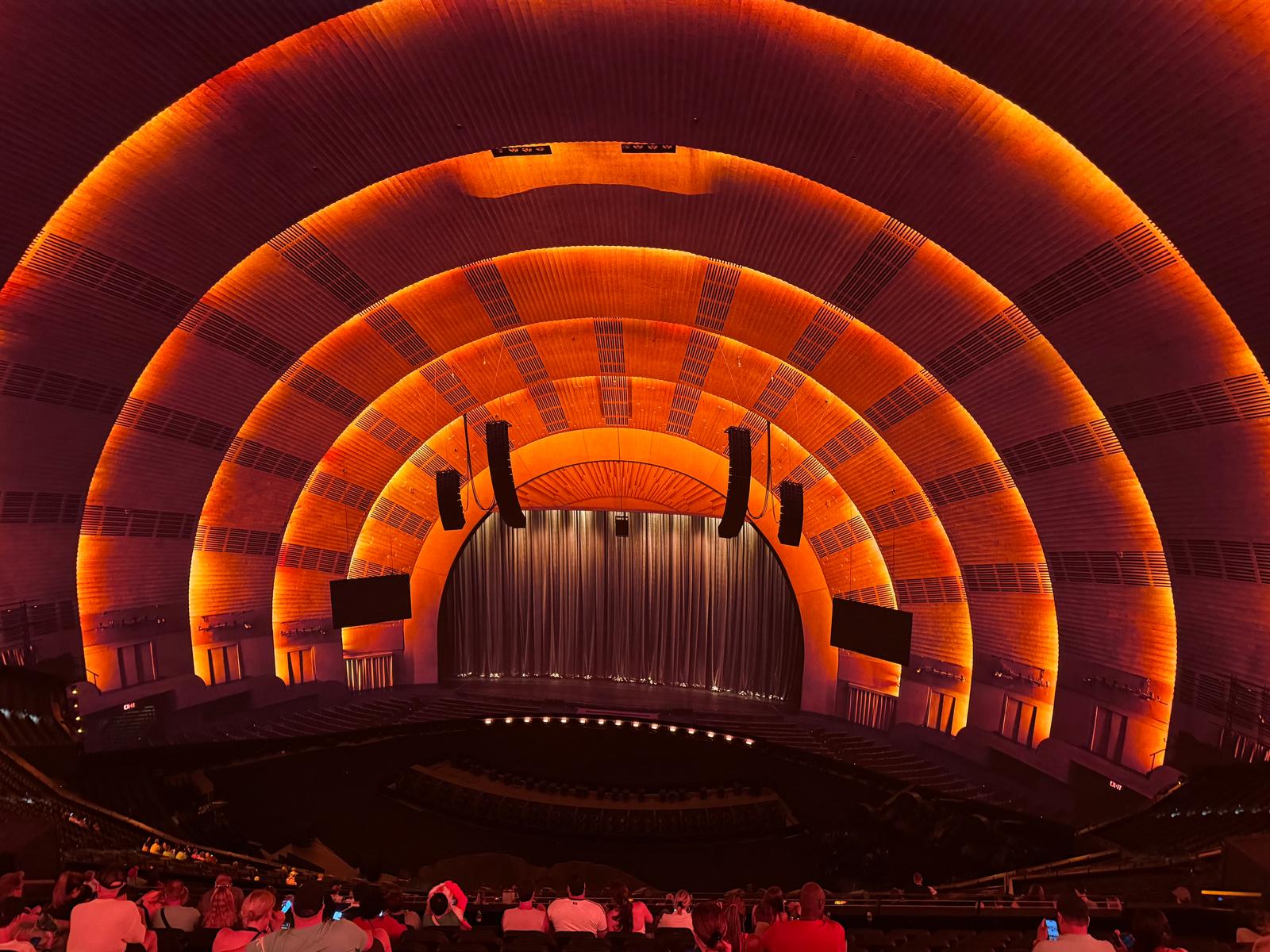
Radio City or the Sphere? (It is the Sphere; photo courtesy [DP])
Before the presentation began, the auditorium appeared to have a conventional architectural ceiling. Great orange ribs curved over the seating, while ventilation grilles, suspended loudspeakers, lighting fixtures, curtains, and video monitors completed the illusion. It looked like the Radio City Music Hall’s proscenium. Then the show started — and the apparent theater completely disappeared. The speakers, the TVs, even the stage.

The obvious first conclusion was that the LED surface must be optically transparent, allowing the audience to see the real roof behind it until the pixels illuminated. That explanation was attractive because Sphere’s audio system really is installed behind the display, and the surface must allow sound through it.

It was also, apparently, wrong. The only explanation that makes sense is that the ceiling, ribs, grilles, speakers, and monitors were already being displayed by the screen. It was like a holodeck impersonating a physical theater interior. When the Oz material began, the system simply replaced one complete visual environment with another.

That’s what happens when a display fills nearly all of your useful visual field. A normal screen announces itself with a bezel, a wall, or at least a clearly visible edge. Sphere’s display extends upward and around the audience, removing many of those references. Give the image credible perspective, texture, shadows, and familiar architectural details, and the brain accepts the pixels as a room.

The same effect makes the Oz landscapes seem less like scenes displayed in front of the audience and more like places into which the auditorium has been inserted. Of course, there are more special effects. For The Wizard of Oz, there is wind and smoke, along with paper leaves, flower petals, and foam-rubber apples that fall from the sky. All of this makes it even more immersive.

Continue reading “The 16K Display That Ate Las Vegas”

Click Your Heels Thrice, Hail A Cab Home

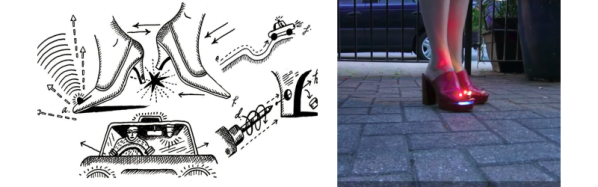
If Dorothy from The Wizard of Oz were to wake up in 2017, with her magic Ruby Slippers on her feet, she’d probably believe she had woken up in a magical world. But modern folks will need a little more magic to impress them. Like Clicking your heels thrice to get home with these Uber ruby slippers. [Hannah Joshua] was tasked by her employer to build a quirky maker project. She got an idea when a friend complained about having trouble hailing a cab at the end of a hard day at work.

[Hannah] started with ruby colored slippers with a platform toe and high heels to allow space to stuff in all the magic dust, err, electronic bits. The initial plan was to use an Arduino with a GSM/GPS shield but that would have needed a separate SIM card and data plan for the shoes. Instead, she opted for the 1Sheeld which connects to a smart phone over Bluetooth. The 1Sheeld gets access to all of the smart phone’s sensors including the GPS as well as the data connection. The Arduino and 1Sheeld are put in a cavity carved out in the toe section. The 9 V battery goes inside another cavity in the heel, where an activation switch is also installed. Three LED’s indicate when the shoe is active, the cab request is accepted, and when the cab is on its way.

The code is basic since this one of her first Arduino projects, but it gets the job done. It sends an http request to Uber’s API to request a cab. The destination is hard-coded, so the slippers only allow you to get from your current location to whatever destination is programmed. The GitHub repository provides code, as well as some additional information on construction. [Hannah] has also added notes explaining some of the design choices and things to take care about if you plan to build one of these magic slippers.

We covered the 1Sheeld when it was introduced several years back, and if you get your hands on one, try building this Hand Waving Door Unlocker.

Continue reading “Click Your Heels Thrice, Hail A Cab Home”








