
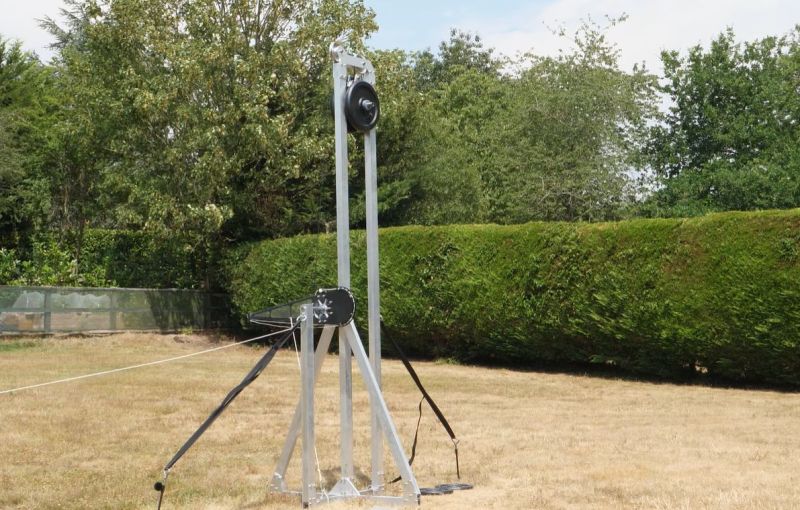
As awesome as trebuchets are, the fact that medieval engineers didn’t create versions capable of launching supersonic projectiles is a bit of a bummer. Fortunately it’s possible to correct this oversight with modern insights and technologies, as [Tom Stanton] demonstrates in a recent video.
While a traditional trebuchet is fairly straightforward, using a heavy weight moving an arm around a pivot that has the projectile attached to the other side, a few tweaks can make it much more lethal. One change is to have the projectile’s rope wound around the arm, forcing an additional pass around the arm to gain velocity. The other is to use a gearing system which uses the dropping weight’s energy more efficiently.
One complication here is that the arm now takes a few rotations to come up to speed, meaning that the release of the payload has to be controlled exactly, with only about an 0.0025 second release window. The solution was both low-tech and effective: since the arm is attached to a drum that the rope is wound onto, the moment enough rope is unwound from the dropping weight, a latch inside the drum is released to launch the projectile.
In a first test with a 10 kg weight, the projectile reached a velocity of around 528 km/h, which definitely was a good start, but also showed just how not aerodynamic the arm was. Some redesigns later of the entire trebuchet, the entire system was tested again with 10 kg and achieved a projectile velocity of 634 km/h. From there it was time to ramp up the weight to the full 40 kg, which theoretically should hit supersonic speeds.
Unfortunately the first attempt hit a mere 1,152 km/h (716 mph), which is just shy of the sound barrier at 1,235 km/h at 39% system efficiency and some components clearly breaking apart. Some more redesigns later and with a lighter projectile at 4 grams, a 40 kg weight achieved an arm speed of 2,342 rpm. The projectile now left the sling with 346.4 m/s, or 1,249 km/h, with an audible snap as the sound barrier got broken.
Even if the era of trebuchets in warfare is well and truly past, they remain fascinating physics demonstrations, with this case in point.












Really enjoyed watching the video for this project! Stanton’s work is impressive and inspiring.
Isn’t the mais issue of not reaching the speed of sound in a traditional trebuchet related with the weight of the projectile (it would require a multi-ton weight)?
Shepherd’s slingshots, which had a smaller projectile (few grams) was able to exceed the sound barrier.
It’s not really the weight but the speed as he explains in the video. A conventional trebuchet, regardless of the weight, can only reach 9.81 meters a second on the weight side, so speeding up a conventional trebuchet means a longer arm and a shorter weight side, which will never reach the speeds required.
A good slings can indeed easily reach the sound barrier. I like to sling and I do have a cracker on the end (similar to a cracker on a whip) and often crack it, which means that it broke the sound barrier.
Why can it only reach 9.81 m/s? I can agree that the acceleration of the weight is limited to 9.81m/2^2, and that achievable only in one point during travel, but counterweight trebuchet work with a leaver giving you ability to multiply that acceleration.
But I grant you that it’s probably not feasible to create long enough leaver to reach supersonic speeds yet it being rigit to transfer the force.
However it would be funny if someone did the math of how long the leaver would need to be and what the counter weight would need to be.
Regardless of what path the falling weight takes, it always ends up with the same kinetic energy at the lowest point of the swing, which results in the maximum speed that we’re interested in – not the acceleration per se.
The mass of the counterweight will depend on the mass of the projectile, but with a 5m arm for the weight, it will ‘fall’ 10m, and reach 14m/s at the bottom, so to reach the speed of sound (343m/s) the arm for the projectile will have to be 122.5m long, but that assumes that the arms weigh nothing. Any weight on the projectile side of the arm will subtract from the weight on the other side.
Slightly counter-intuitively, a shorter weight arm results in a shorter projectile arm (0.5m weight arm ‘only’ requires a 38m projectile arm).
Unless I’ve screwed up my maths somewhere
In a trebuchet, the sling swings independently of the arm, behaving kinematically like a double pendulum (simplified, assuming the weight itself doesn’t pivot). Ideally, for maximum efficiency, the centripetal force of the sling decelerates the main weight-attached arm to a standstill at release, giving all its kinetic energy to the sling+projectile. The trick is getting the timing and inertia ratios just right so that the release happens right at the point when everything else is stopped. This interplay is the main driver of the arm length, not the naive arm speed length ratio like in a simple catapult.
Hell yeah Tom…. You made it
That could be mounted along utility truck guard rails….drones could tow lines too though
Unfortunately Tom Stanton has a history of re-doing existing projects without giving due credit to the originals. This is yet another example where the original is just briefly mentioned and the video is not even linked, even being in the same video platform.
The first supersonic trebuchet from 5 years ago, by David Eade, is actually much better and polished, I highly recommend watching that one (How to Build a Supersonic Trebuchet). It is also more didactic and engineering is explained in great detail.
While Tom’s projects could have merit of his own, not acknowledging other people’s work isn’t fair.
While showing David’s video Tom says that he doesn’t want to use rubber bands to accelerate the arm like David did. And this had a huge impact on the design.
David made an entirely different design. You say his is better and polished, I highly disagree. I wouldn’t even call David’s project a trebuchet as it skips the trebuchet part and replaces it with elastics. David made something that looks more like a different catapult design. As far as I’m concerned, Tom’s trebuchet is the first one to reach the sound barrier. It’s nice that he mentioned the work of David but there was no need for that at all.
It’s the same design: wrap a cord around a drum and pull on it to accelerate the arm around. The only difference is what’s pulling on the cord: rubber band or falling weight.
Both are a variation of the earlier Magnonel or the traction trebuchet, which had people pulling on a rope instead of a falling weight.
https://en.wikipedia.org/wiki/Mangonel
Remember kids, don’t feed the trolls.
A bit much high-tech materials imo, a whip also doesn’t need that. Instead of min-maxing, maybe a wheel instead of an arm would do better? Maybe even with wood and rope?
I guess the advantage of the design as-is is that it has lower moment of inertia so more of the energy goes into the projectile and less into spinning the arm.
Bwahaha, what a hack! No, yes, absolutely nice.
Except missing the thread, carambà.
Awesome.
I thought a pigeon had bought the farm in fairly spectacular fashion about half-way through.
I wonder how long before he’ll be looking for inspiration from spin launch.
love the sound this thing makes.
I watched all the angles of that shot in total awe. Then I skipped back and watched them again! I felt euphoric so I can imagine Tom must have had euphoria for the rest of the day at very least. What an absolute legend!
he’s got a good basis there for a guillotine as well, which could come in handy as the oligarchs continue enshixxifying reality
He also has a 2nd channel: https://www.youtube.com/@TimStation/videos
I can understand why the main arm is carbon fibre (strong, light weight).
BUT – why is the counterweight section of the arm, also carbon fibre?
A heavier material, like steel, would surely be better.