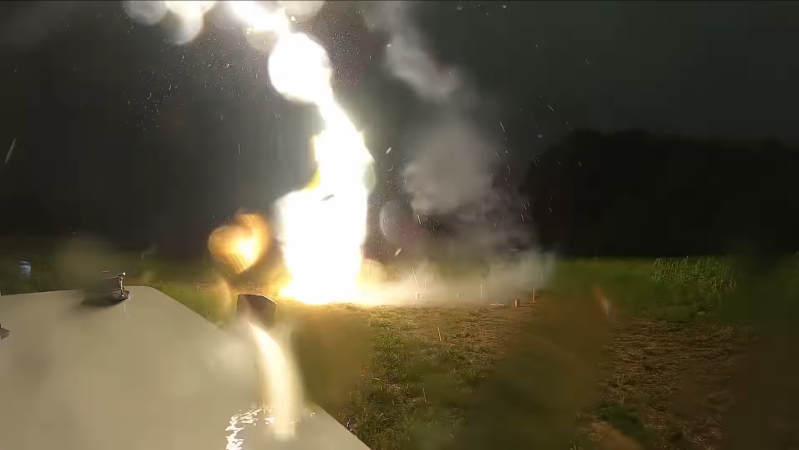
A lightning strike is shown striking the ground at close range (fewer than thirty feet away).

Triggering Lightning With A Rocket

Lightning, despite being a common and readily-detected phenomenon, is nevertheless difficult to study. One reason is the difficulty of predicting when and where lightning will strike; tall structures do attract more lightning strikes, but it’s hard to move them into a storm’s path. Instead, researchers often use small rockets carrying a fine wire to trigger strikes, an approach [Electron Impressions] recently replicated (more details).

The science of this is less than straightforward: even in calm weather, there’s a surprisingly strong atmospheric electric field, about 100 volts per meter off the ground. During a thunderstorm, though, this can build up to kilovolts per meter, and may reverse polarity. When an updraft carries supercooled water, ice crystals, and graupel (ice particles formed by supercooled water freezing on a snowflake) upwards, the heavier graupel falls relative to the other components. As it collides with ice crystals, it builds up a negative charge and the crystals accumulate a positive charge; across a storm, this leads to positive charge building up near the top of clouds and negative charge near the bottom. Lightning equalizes this imbalance. In the relatively few cloud-to-ground strikes, a dielectric breakdown begins from both sides of the stroke, with leaders rising from the ground and descending from the cloud. The wire trailed by a rocket creates an artificial leader, ideally triggering a controlled strike.

To consistently get a strike, the rocket needs to be launched under a strongly-negatively-charged region of the cloud. An electric field mill measures the local field strength; these are usually quite expensive, but [Electron Impressions] managed to build his own. The rocket itself was 3D printed and designed to fly well under stormy conditions. It carried a strand of thin copper wire wound onto a plastic spool meant to minimize friction and prevent broken wires. The rocket’s igniter was waterproofed for storm conditions and remotely triggered using a walkie-talkie for safety.

After many attempts, [Electron Impressions] finally managed to trigger a strike and video the results. The first stroke created a plasma channel, along which several more strokes followed. This indicated that the cloud had probably been negatively charged, which was in agreement with the field mill’s measurements. The wind blew the plasma channel slightly to the side, where it caused a second rocket to explode on the ground. Both ignition systems were destroyed, and the remains of the rocket were never found. Sadly, the strike doesn’t seem to have formed a fulgurite, but it did fracture the ground as water flash-boiled.

For a more reusable solution, some researchers have also experimented with using drones to trigger lightning. There’s good reason for more study; the theory of lightning formation still has some major open questions.

An Attempt At 3D Printing A Hybrid Rocket Engine

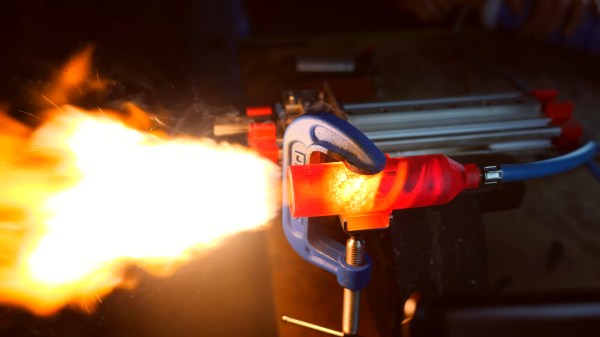
Liquid fuelled engines are throttleable and monstrously powerful, but highly complex. Meanwhile, solid rocket engines are simple and cheap, but once you light them, they’re going full-bore until burnout. Hybrid rocket engines offer perks from both worlds, with simple solid fuel and the ability to throttle down by regulating oxidizer flow. Naturally, [Integza] decided he should try and 3D print one.

The build came about somewhat by accident, as the 3D printed casing of one of [Integza’s] liquid-fuelled rockets continued burning once the fuel was turned off. This prompted the realization that he could 3D print rocket fuel, and simply supply oxygen, creating a hybrid rocket. Thus ensued much experimentation, going so far as to create custom sugar-loaded resin for more power and experimenting with ABS as a potential fuel.

Most of the rockets self-destructed within a few seconds and thrust was minimal, but the basic concept should be a goer. As always, [Integza] is struggling with the thermal limitations of plastics, but we fully expect he’ll one day get to a flight ready engine. His previous experiments show he certainly doesn’t give up. Video after the break.

Continue reading “An Attempt At 3D Printing A Hybrid Rocket Engine”

Experimenting With 3D Printed Rocket Nozzles

Rocketry is an exacting science, involving a wide variety of disciplines, encompassing everything from fluid mechanics to thermodynamics and materials engineering. As complex as it sounds, that doesn’t mean it’s beyond the purview of the average maker. [Sciencish] demonstrates this with a series of experiments on rocket nozzles in the home lab. (Video, embedded below.)

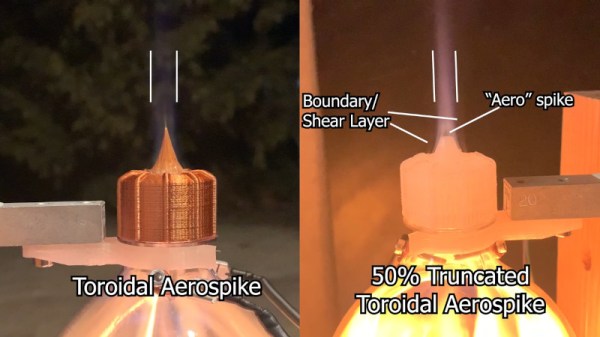
The video starts with an amusing analogy about nozzle design based on people fleeing a bad pizza. From there, [Sciencish] 3D prints a wide variety of nozzle designs for testing. The traditional bell nozzle is there, of course, along with the familiar toroidal and linear aerospikes and an expansion deflection design. Of course, 3D printing makes it easy to try out fun, oddball geometries, so there’s also a cowbell nozzle , along with the fancy looking square and triangular aerospikes too. Testing involves running the nozzles on a test stand instrumented with a load cell. A soda bottle is filled with rubbing alcohol vapour, and the mixture is ignited, with each nozzle graded on its thrust output. The rockets are later flown outside, reaching heights over 40 feet.

[Sciencish] notes that the results are a rough guide only, as the fuel/air mixture was poorly controlled. Despite this, it’s a great look at nozzle design and all the science involved. It also wouldn’t be too hard to introduce a little more rigour and get more accurate data, either. However, if solid fuels are more your jam, consider brewing up some rocket candy instead.

Continue reading “Experimenting With 3D Printed Rocket Nozzles”

3D Printed Rockets Are A Gas

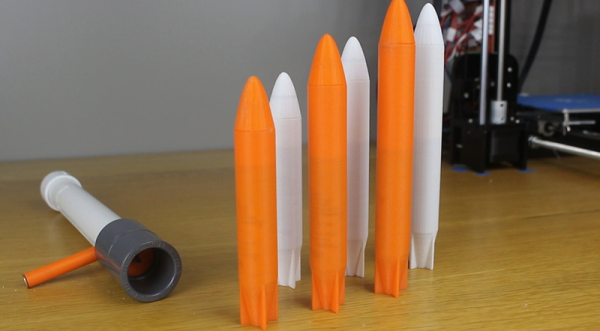
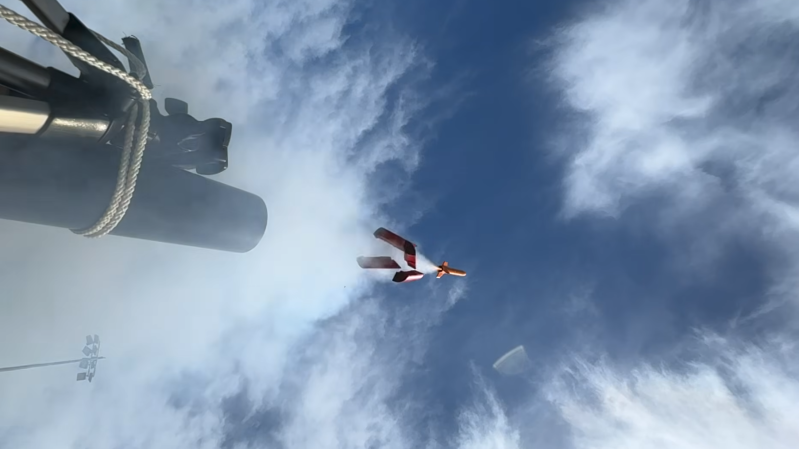
We’ve probably all made matchstick rockets as kids. And around here anything that even vaguely looks like a rocket will get some imaginary flight time. But [austiwawa] is making some really cool 3D printed rockets that use common CO2 cartridges as a propellant. You can see them in action in the video below.

You might think just sticking a CO2 cylinder in a 3D printed jacket isn’t such a big deal, but [austiwawa] really went the extra mile. He read up on how to make the rocket stable (by manipulating the center of gravity versus the center of pressure) and explains what he had to do to get the rockets flying like you’d expect.

In addition, the launch tube is pretty interesting. A 3D printed part holds a sharp point and a spring. You lock the spring and when released it punches a clean hole in the propellant casing. The actual tube is a long piece of PVC pipe. From the video, it looks like these little rockets fly pretty high.

Judging from the video, the rocket body and launcher came from TinkerCAD. The way [austiwawa] put the fins on was both simple and clever.

Of course, you could also use Coke and propane, if you like. We’ve also seen some pretty cool setups with compressed air. Check out the rockets in action after the break,

Continue reading “3D Printed Rockets Are A Gas”