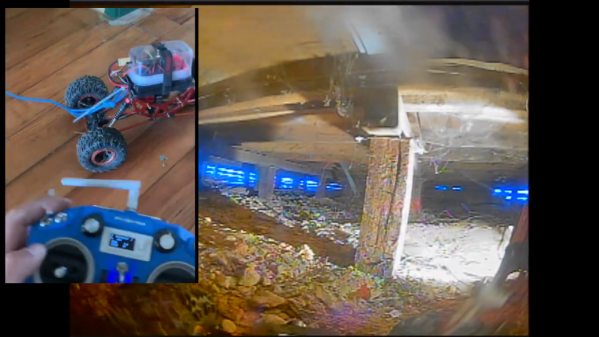
Drone control links are, from a radio signals perspective, nothing short of amazing: using a transmitter capable of transmitting, at most, one watt, a protocol such as ExpressLRS (ELRS) can control a drone over 100 kilometers away. [Stan], who has been building a drone electronics stack from scratch, recently designed four ELRS receivers and went over the principles behind their incredible range.
Up to a certain point, the simplest way to increase a radio’s range is to lower the frequency; lower radio frequencies penetrate better through most materials and don’t attenuate as quickly with distance. However, although ELRS can use 900 MHz bands, [Stan]’s receivers primarily use 2.4 GHz. The major improvement is in modulation: unlike other control protocols, which mostly use frequency modulation, or Wi-Fi, which uses phase and amplitude modulation, ELRS uses Chirp Spread Spectrum modulation. This has a low data rate, but it’s very reliable; every bit is transmitted as a chirp – a linearly rising radio tone – and the data is encoded in the chirp’s starting frequency. To decode this, the receiver multiplies it with an inverse chirp, then takes a fast Fourier transform, revealing the starting frequency. This process has an equivalent gain of 24 dB, which is enough to let it decode signals even below the receiver’s noise floor.
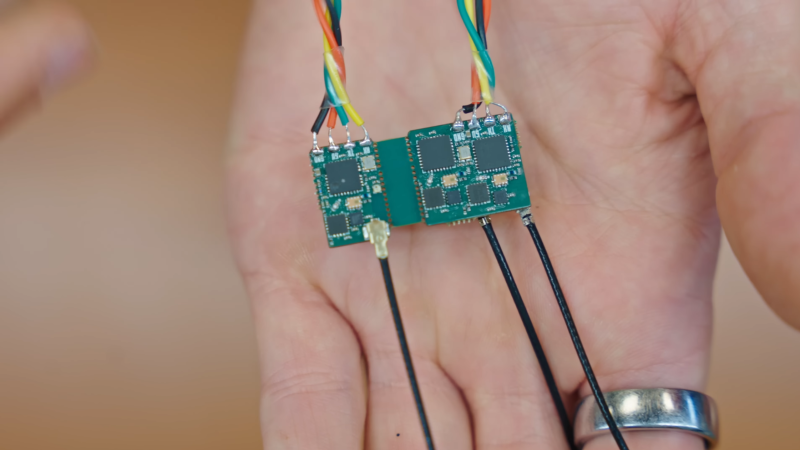
The hardware [Stan] designed to implement this was comparatively simple, just an ESP32 microcontroller, an SX1281 radio chip, and a few peripherals. All four receivers worked in 2.4 GHz, but two had additional 900 MHz antennas. Against RF design convention, one of the receivers used a via to connect the antenna. This would normally cause a significant impedance mismatch, but since there were enough ground-plane vias nearby, the current return path was barely affected; the receiver’s performance hardly changed. In one test, all four receivers maintained a connection at more than five kilometers, despite a forest blocking the signal’s path.
We previously covered ExpressLRS when it was still an emerging technology. To get this kind of range, it builds on LoRa technology, which has reached some impressive distance records.
Thanks to [Keith Olson] for the tip!